Benefits include accessible shade, cooler water, and less fatigue, according to direct testimony from farmworkers
15 December 2025
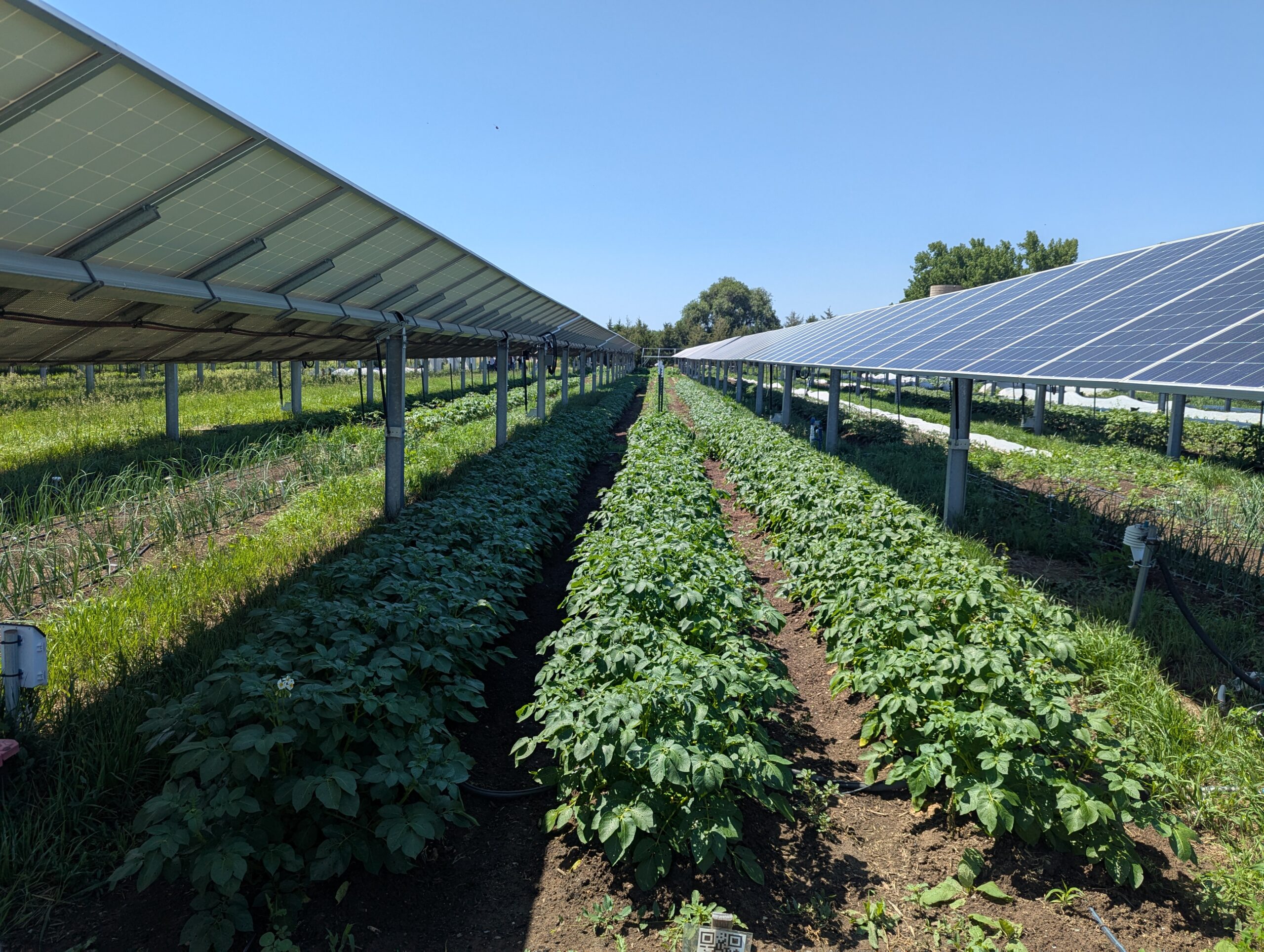
At Jack’s Solar Garden in Longmont, Colorado, rows of solar panels stand over the crops, casting swaths of shade that benefit plants and farmworkers alike. Credit: Talitha Neesham-McTiernan
Researcher contact:
Talitha Neesham-McTiernan, University of Arizona, [email protected] (UTC-7 hours)
AGU press contact:
Sean Cummings, [email protected] (UTC-5 hours)
NEW ORLEANS — Putting solar panels above agricultural crops may do more than produce food and clean energy on the same land: It can also significantly augment quality of life for farmworkers, according to new research to be presented at AGU’s 2025 Annual Meeting in New Orleans. Worker-reported benefits include shelter from the sun, cooler drinking water and reduced fatigue, while physical measurements indicate the panels can help farms avoid conditions conducive to dangerous heat stress.
“In a lot of [food] sustainability conversations, we’re thinking about resource use and not about farmworkers and their bodies,” said Talitha Neesham-McTiernan, a human-environment researcher at the University of Arizona who led the research. She will present her work on 15 December at AGU25, joining more than 20,000 scientists discussing the latest Earth and space science research.
A bundle of overlooked, but crucial, benefits
Hybrid solar-food fields, better known as “agrivoltaics” systems, typically involve solar panels mounted at or above head height, spaced among crops to allow sunlight to pass through the gaps between. In addition to making efficient use of land, these systems can benefit crops by reducing both sun damage and water lost to evaporation — and even by trapping some heat near the ground during colder months, Neesham-McTiernan said.
In her four years of fieldwork on farms like these, often during brutal Arizona summers, Neesham-McTiernan noticed a pattern: Researchers and farmworkers alike would strategically plan to work in the panels’ shade during the hottest hours.
“It just seemed to be something that people in these systems were doing, but nobody in the research area was talking about it,” she said. That struck her as odd, as farmworkers are 35 times more likely to die from heat-related illness than non-agricultural workers. With climate change pushing that figure higher, making any tool to reduce heat stress would be increasingly valuable.
To end that silence, Neesham-McTiernan and her coauthors asked seven full-time farmworkers at Jack’s Solar Garden, a small agrivoltaics farm near Longmont, Colorado, how their experiences differed from those on traditional farms.
The biggest reported perk, by far, was shade. One worker, Neesham-McTiernan said, confessed they found it hard to imagine ever going back to work on traditional full-sun farms — where, they added, their favorite crops had always been tomatoes, because of the shade the tall plants offered.
“By 9 a.m., in the summer, you’re just cooking,” Neesham-McTiernan said. “Being able to take that direct heat load off makes such a difference.”
Shade keeps drinking water cool too, the workers noted — a crucial benefit, given water’s role in mitigating heat stress. “They can pop their bottles under the panels and they stay cool all day,” Neesham-McTiernan said, “rather than it being, as one of the farmworkers described it, like drinking tea.”
Another worker said these benefits helped them feel less exhausted by day’s end, leaving more energy for social life and allowing a faster recovery for the next day’s work. Others said simply knowing shade was nearby reduced their mental stress.
To tell the full story of heat stress, gather stories and numbers alike
The researchers also recorded air temperature, wind speed, humidity and solar radiation to quantify heat stress metrics such as wet bulb globe temperature, which is commonly used to identify dangerous outdoor work conditions. Compared to open-field farms, they found, agrivoltaics reduced wet bulb globe temperature by up to 5.5 degrees Celsius (10 degrees Fahrenheit) — the difference, Neesham-McTiernan estimates, between stop-work conditions and simply requiring a break every hour. “When that builds up over a day, over a season, over a lifetime of harvesting, that’s really significant.”
That’s not to say the measurements always matched farmworkers’ testimonies: for instance, they occasionally disagreed over which parts of the farm were hottest at which times of day. But fully understanding the experience of heat stress, Neesham-McTiernan said, requires both personal and measured evidence.
“Every farmworker said one benefit was being able to lean against the beams that hold up the panels, just to take the weight off a bit,” she noted. “If I just had my sensors in the field, I wouldn’t know that, but it clearly makes such a difference in their day-to-day comfort.”
Neesham-McTiernan said she’s working to expand the research into other regions to see whether the benefits apply in different environments. She also hopes to eventually collect more rigorous physiological and health data to quantify the impacts of agrivoltaics on workers’ bodies.
“[Agrivoltaics] isn’t a one-size-fits-all solution,” she said. “It can’t be used everywhere. But with the threat of heat, we need a catalog of ways we can protect farmworkers. Without them, we can’t feed ourselves. Protecting them and their bodies should be paramount to everyone.”
Abstract information:
Farmworker experiences reveal heat mitigation advantages of agrivoltaics
Monday, 15 December, 10:40 – 10:50 CST
Room 278-279 (Convention Center)
AGU’s Annual Meeting (#AGU25) will bring more than 20,000 Earth and space scientists to the Ernest N. Morial Convention Center in New Orleans, LA from 15-19 December. Members of the press and public information officers can request complimentary press registration for the meeting now through the end of the conference. Learn more about the press AGU25 experience in our online Press Center.
AGU (www.agu.org) is a global community supporting more than half a million professionals and advocates in Earth and space sciences. Through broad and inclusive partnerships, AGU aims to advance discovery and solution science that accelerate knowledge and create solutions that are ethical, unbiased and respectful of communities and their values. Our programs include serving as a scholarly publisher, convening virtual and in-person events and providing career support. We live our values in everything we do, such as our net zero energy renovated building in Washington, D.C. and our Ethics and Equity Center, which fosters a diverse and inclusive geoscience community to ensure responsible conduct.
Subscribe or change your emailing preferences for the AGU Newsroom