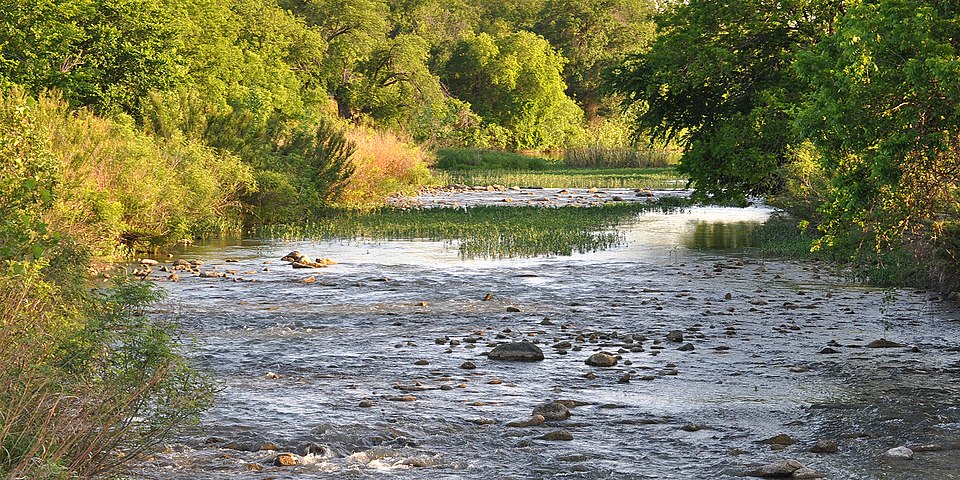
Parts of the San Saba River in Texas, USA, have experienced water temperatures up to 45.2°C (113.3°F). Riverbed microbes exposed to temperatures recorded there grew less active the hotter it got, indicating that climate change may make it tougher for some rivers to break down organic matter, especially where stagnant pools form. Credit: William L. Farr
.jpg)
AGU News
Ocean Science Meeting special hotel rates end next week
Staff, freelance and student journalists, press officers and institutional writers are eligible to apply for complimentary press registration. Book conference hotels at the discounted rate when you register by 14 January. (Press, please register before booking hotels to avoid conflicts with press registration!) [media advisory][OSM26 Press][eligibility guidelines][preview conference hotels]
Featured Research
As rivers heat up, their tiny, invisible recycling teams may slow down
Microbial metabolism doesn’t always crank faster at higher temperatures, a new study finds. Microbes living in streambed sediments break down organic matter and recycle nutrients, helping to maintain healthy water quality and nutrient balance in riversBut climate change could impede that gift by making rivers warmer, especially in the stagnant pools that form when rivers dry up. Researchers tracked riverbed microbes’ activity over 77 days at 20, 30 and 40 degrees Celsius and found that their activity slowed down at higher temperatures — contrary to common assumptions that heat speeds up metabolism. [Geophysical Research Letters study]
When shooting fluids underground, go slow and steady to minimize earthquakes Industrial activities like geothermal energy production and underground carbon storage involve injecting fluids underground, which can trigger earthquakes. To find out how to mitigate this effect, researchers experimented in a lab with a piece of sandstone containing an artificial fault. Injecting water at high pressure caused faster fault slip and more quaking, as did injecting it in repeating cycles. Conversely, injecting water slowly and steadily minimized slipping and quaking. [JGR Solid Earth study]
Stratospheric aerosol injection could prevent some climate “tipping points,” but which will get priority?
Some scientists have proposed scattering sunlight-reflecting particles into the atmosphere as a supplementary way to mitigate climate change, in addition to reducing carbon emissions. A new modelling study finds this strategy could also protect various “tipping elements” — ice sheets, permafrost, rainforests, coral reefs, and other systems at risk of suddenly and irreversibly deteriorating due to climate change. Scattering particles at high latitudes would most effectively protect high-latitude elements (like the Greenland ice sheet) but leave lower-latitude elements less protected, while doing so at low latitudes would achieve the reverse. A particle deployment strategy designed to stabilize the overall global temperature, meanwhile, would offer medium-quality protection for elements at both latitudes. As such, the authors write, using this strategy may require weighing which outcomes to prioritize. [Earth’s Future study]
New Moon crater fractures mapped
When high-speed meteorites strike planetary bodies, the intense energy melts parts of the impact crater, creating “impact melt deposits.” As the molten rock cools, it contracts, causing fractures to split open along its surface. Since mapping these fractures manually can miss smaller melt deposits, researchers tried using a deep learning model to automatically detect fractures in satellite imagery of the Moon. The model discovered new impact melt deposits in Crookes crater. For the first time, it also mapped fractures in the Schomberger A crater, which could contain water ice due to the crater’s dark, near-polar location. [JGR Planets study]
Deaths from flooding down in Asia but rising in Africa
Improvements in infrastructure and emergency response have made floods and storms in Asia less deadly, according to an analysis of 2,000 of the world’s deadliest extreme climate events since 1988. While Asia’s upgrades have saved an estimated 350,000 lives since then, the research found, other regions have been less fortunate. Population growth has made African floods more deadly, and extreme temperatures are killing more Europeans as heatwaves become more common relative to cold snaps. Understanding how mortality from climate hazards changes over time can help us predict and prepare for future hazards, the researchers write. [Geophysical Research Letters study]
Marine heat waves can exacerbate heat and humidity over land
Researchers found the unprecedented 2023 East Asian marine heat wave increased land temperatures and humidity by up to 50%. [Eos research spotlight][AGU Advances study]
How a move to the shallows 300,000 years ago drove a phytoplankton bloom
And what that could mean for today’s ocean. [Eos research spotlight] [AGU Advances study]
What could happen to the ocean’s carbon if AMOC collapses
Mass glacier melting may have led this influential ocean current system to collapse at the end of the last ice age. A pair of modeling studies examines how such a collapse could affect dissolved inorganic carbon and carbon isotopes in Earth’s oceans. [Eos research spotlight] [Global Biogeochemical Cycles study and study]