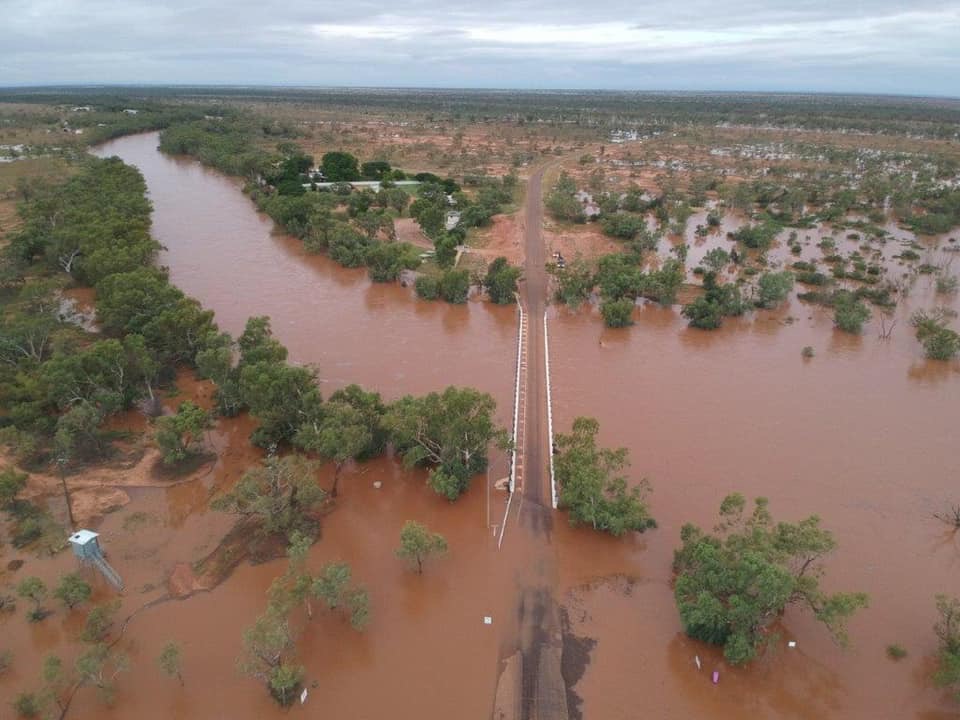
Flooding of the Burke River in Queensland, Australia during Tropical Cyclone Trevor in 2019. New research projects that up to 70% of Earth’s land will face worsened flood risks as human-driven climate change continues. Credit: John Robert McPherson, Wikimedia Commons

AGU News
AGU and global partners announce platform to advance responsible governance of solar geoengineering research
As interest in solar geoengineering research grows, a group of international scientific, policy, and civil society organizations today announced a new platform designed to bring clarity, consistency, and public accountability to how this research is governed. [press release] [Solar Geoengineering Research Governance Platform]
Featured Research
Human actions intensify flood risk around the globe
Under human-induced global warming of 1.5 to three degrees Celsius, 60% to 70% of Earth’s land surface will likely face rising flood risks, especially in tropical regions. The increase comes mostly in the form of larger floods, though floods also become 10% more probable, on global average, under two degrees of warming than under 1.5. Near hydrological basins, researchers said, up to 88% of the increase in risk would not occur without human-driven climate change and past water and land management. By 2065, they project, the influence of human activities on flood risk will become apparent across nearly 40% of global land area. The team came to these results using model simulations of river discharge and climate impacts, aiming to account for human land and water management more than climate models typically do. [JGR Atmospheres study]
Minnesota winters may warm up to 12 degrees Fahrenheit this century
Winters in Minnesota may become up to 12.6 degrees Fahrenheit hotter over the course of this century, with summers warming up to 7.2 degrees. The projections draw from global climate models combined with data on the climate interactions of more than 60 of the U.S. state’s lakes. Researchers also project up to 70 and 55 fewer days per year with lake ice and snow cover, respectively, with winter snow depth thinning by over 12 centimeters and lake ice shrinking by over half on deeper lakes. Precipitation will likely fall less often — especially during mid-to-late summer, Minnesota’s peak growing season — but more intensely when it does occur. As human-driven climate change disproportionately affects high latitudes, detailed projections like these can inform decisions about agriculture, infrastructure, and water resources, the team wrote. [Water Resources Research study]
Hydropower dries up Swedish river habitat, but strategic flow release could help
An analysis of nearly 1,000 Swedish “bypassed reaches” — river segments drained mostly dry by diversions to hydropower plants — documents over 1,250 kilometers of lost habitat where fast-flowing riffles, rapids and waterfalls once supported specialized plants and animals. Regulations guarantee some minimum flow released back into only about a quarter of these dry stretches, and in 88% of those, the amount is too low to support fish that need strong currents. Researchers found the bypassed reaches often occupy key positions in river networks, disrupting broader movements of water, nutrients, and species. Placing minimum water discharges on high-priority reaches in Sweden and beyond, they wrote, could improve ecological health and biodiversity for thousands of kilometers of river while still allowing for hydropower. [Water Resources Research study]
Earth’s energy budget deeper in the red than forecast, even considering warming
Under global warming, more energy enters Earth’s climate system (via the sun’s rays, for instance) than leaves it, fueling a planetary energy imbalance that has climbed rapidly since 2010. Yet as of 2024, this imbalance has swelled even more than most models expect global warming to cause. Researchers realized this after teasing out the portion of the imbalance expected due to global warming from the portion driven by other factors, using satellite measurements and temperature records from Earth’s surface. The discrepancy’s exact cause remains unclear, they wrote, but the results may indicate a growing rift between modeled expectations and real-world measurements of the energy imbalance. [Geophysical Research Letters study]
Holes drilled for carbon storage grow over time, potentially enhancing storage
An emerging strategy for mitigating climate change is to pump water containing carbon dioxide into boreholes in peridotite rocks, prompting a mineral-forming reaction that locks the planet-warming carbon away. Researchers studying two such boreholes in Oman discovered that, even over two years after drilling, four new clusters of fractures formed in the rock after heavy rainfall raised water pressure in the boreholes. The team detected the fractures using hydrophones, finding that they grew slowly downwards for over 200 meters, likely driven by water moving into them as they formed. This process could create new pathways for fluids to reach fresh rock, potentially improving the carbon storage of the system, the researchers wrote. [JGR Solid Earth study]
New method could improve U.S. forecasting of West Nile virus
An innovative model uses regional climate data and records of West Nile virus neuroinvasive disease to outperform existing forecasts, potentially helping communities prepare. [Eos research spotlight][GeoHealth study]
Why more rain doesn’t mean more erosion in mountains
Erosion in mountain-basin systems driven by long-period climate variations is buffered by an erosion saturation effect, which weakens peak erosion and leads to reduced sediment flux. [Eos editors’ highlight][JGR Earth Surface study]