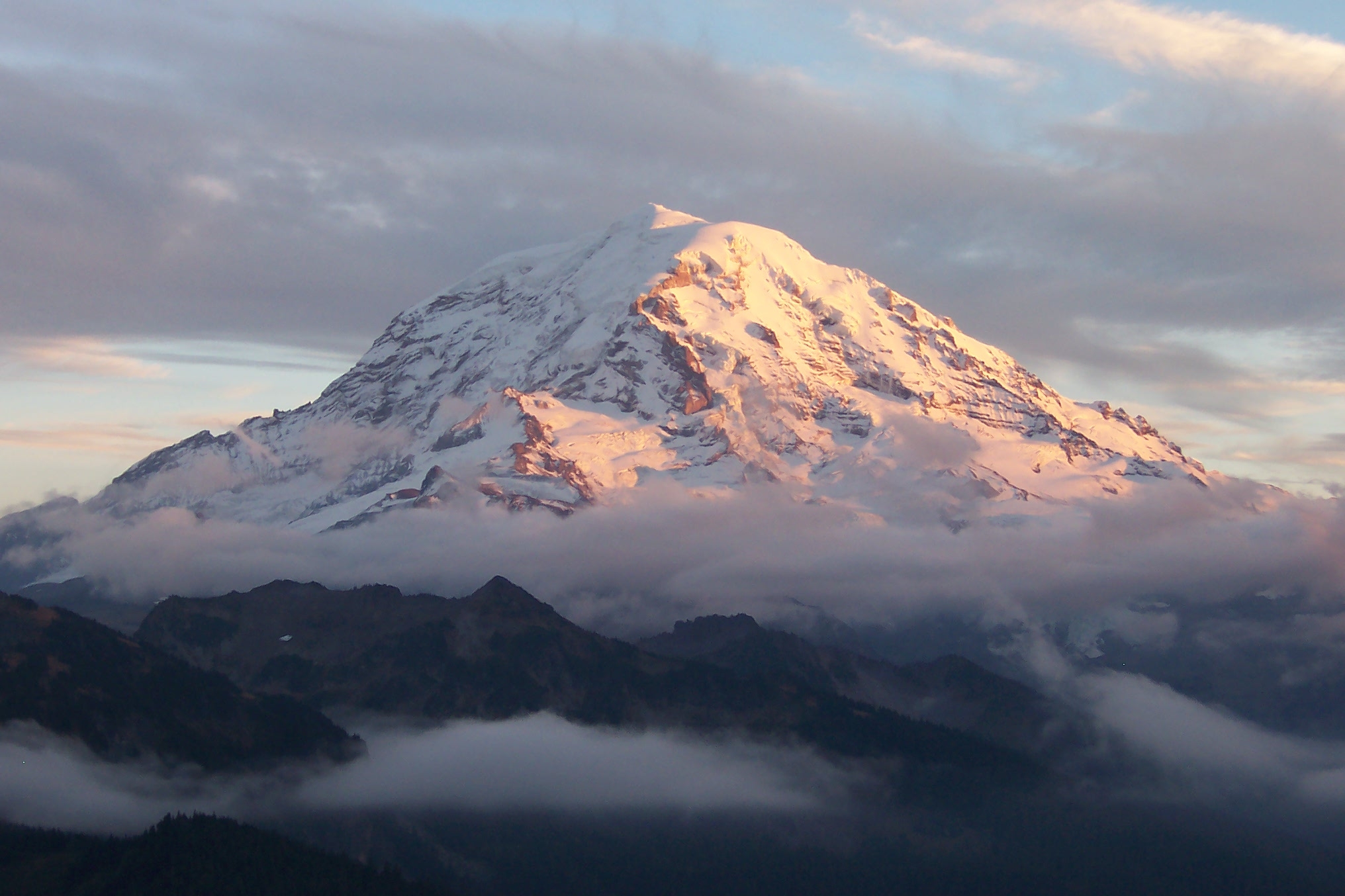
Mount Rainier in Washington state. The Sierra Nevada and Cascade mountain ranges in the western U.S. are losing groundwater, but new research suggests short, extreme bursts of winter precipitation may help them recover groundwater lost during long dry spells. Credit: U.S. National Park Service, Wikimedia Commons

AGU News
Earth’s Future expands scope
AGU’s popular journal for interdisciplinary research on the past, present and future of our planet and its inhabitants is adding three new thematic areas: climate impacts, communities and resilience, and sustainable resource systems. Learn more about the research directions these topics encompass from the new deputy editors. [Eos editors’ vox][Earth’s Future editorial]
Featured Research
Super-wet winters can recharge western U.S. mountains’ groundwater
In the mountains of the western U.S., extremely wet winters can replenish groundwater enough to make up for multiple years of loss. This helps these systems quickly bounce back to above-normal levels after historical lows, according to a new study using satellite measurements of groundwater in the Sierra Nevada and Cascade ranges. The mountains release groundwater at a steady rate, the researchers wrote, meaning they can store the extra water from a super rainy season for at least a year rather than letting it flush through them rapidly. For communities and ecosystems around these mountains, groundwater is critical: as severe multi-year droughts have recurred, sharp groundwater declines have accounted for over 90% of the regions’ total water loss over the past 20 years. Scientists predict extremely wet winters to get more frequent and intense, which may help offset those losses as the regional climate gets drier. [Water Resources Research study]
Human emissions amplified Asia’s extreme 2024 heat-flood combo
In the spring of 2024, northwestern central Asia took a double-whammy of extreme weather: severe flooding from record-breaking rainfall displaced over 100,000 people, while a subsequent heatwave cranked the average 7-day maximum temperature to nearly six degrees Celsius above normal. Although natural forces like La Niña and sea surface temperature patterns played a significant role, researchers reported, warming from greenhouse gases amplified the effect, making the extreme combo eight times more probable. A scenario of moderate continued greenhouse gas emissions could raise the risk of a similar event by more than 22 times by the end of the century, according to observational data and climate model simulations. [JGR Atmospheres study]
Earth’s oldest trees offer a history of cold snaps at sub-seasonal resolution
Using tree ring cores from 83 bristlecone pines (Pinus longaeva), the longest-lived tree species on the planet, in the White Mountains of California, researchers have built a 1,100-year climate record spanning 900 to 2014 C.E. The record is the longest yet created based on “blue rings,” microscopic bands within tree rings where sudden, unseasonable cold prevented cells from fully lignifying, or becoming rigid and woody. These subtle features document abrupt cooling events too brief for traditional tree-ring studies to detect, including cold snaps induced by volcanic eruptions blocking sunlight. The detailed history may help scientists studying short-term cold extremes today, especially as climate change is projected to induce more late-spring frosts in some parts of the world, stressing crops and forests. [Geophysical Research Letters study]
Full force of polar warming may be masked in short term, surging centuries later
The pace of human-driven warming at Earth’s poles may vary in the short term before flaring up centuries down the road, according to climate simulations comparing different rates of CO2 increase leading to the same final atmospheric concentration. The poles are already warming more than the global average, a phenomenon called polar amplification. This effect may dominate the Arctic early on, but if CO2 concentrations consistently climb faster than 0.5% per year, changes in global ocean circulation and heat transport could cause Arctic amplification to fade — only to return after several centuries. Regardless of the rate of CO2 increase, the models showed amplified warming in the Antarctic emerging more gradually, then surging more than 1,000 years after CO2 concentrations stabilize as heat stored deep in the ocean rises to the surface. [Geophysical Research Letters study]
Mining and industry pollute a vital Colombian river with heavy metals
Concentrations of mercury, cadmium, and nickel in the Sinú River often rise significantly above baseline levels scientists frequently use to evaluate trace element pollution in soils. Soil samples collected at various depths during the rainy and dry seasons of 2021 along a stretch of the Sinú — a critical river supplying water for irrigation and everyday use to communities in northern Colombia — revealed concentrations exceeding those baselines by up to five times, although lead, zinc, and chromium levels stayed below the threshold. The pollution likely stems from mining, agricultural and industrial activities in the area that discharge the hazardous metals into the environment, the researchers wrote, highlighting the need for better environmental monitoring and management. [GeoHealth study]
Stealth superstorms reveal lightning on Jupiter: beyond the superbolt
On the gas giant, the strength and frequency of lightning appear to be more diverse than previously thought. [Eos research spotlight][AGU Advances study]
The multi-faceted water footprint of data centers
Data centers powering artificial intelligence consume significant amounts of water, highlighting the need for greater transparency regarding water use in both existing and planned facilities. [Eos editors’ highlight][AGU Advances study]
Trees shed their leaves to adapt to droughts
The browning or loss of tree leaves that can be observed during droughts may be a coping mechanism to deal with dry circumstances by avoiding additional water stress. [Eos editors’ highlight][AGU Advances study]