Using artificial intelligence, climate models, and weather observations, researchers find strong evidence that greenhouse gases emitted since the 2015 Paris Climate Agreement have intensified Europe’s recent heat waves.
22 September 2026

Water misters spray a scorching street in Firenze, Italy, during a recent heatwave. Credit: Richard Vanlerberghe on Unsplash.
Stanford University press contact:
Katie Jewett, Stanford Doerr School of Sustainability: [email protected]
Researcher contacts:
Jared Trok, Stanford University Doerr School of Sustainability: [email protected]
Noah Diffenbaugh, Stanford University Doerr School of Sustainability: [email protected], +1 650-223-9425
AGU press contact:
Sasha Warren: [email protected]
In brief:
- Researchers trained a generative AI model to predict how extreme heat waves in Europe could unfold under different global emissions levels.
- The team found more than 99-in-100 odds that human-caused emissions from the last decade made the deadly 2025 European heat wave more intense.
- The study is an advance in linking subsets of emissions to climate change damages and emphasizes the need to prepare for intensifying extreme weather alongside global emissions reductions.
STANFORD Calif., — Recent heat waves in Europe have been intensified by the greenhouse gases emitted since nations committed to limit global warming under the 2015 Paris Climate Agreement, according to a new study in Geophysical Research Letters, AGU’s journal for journal for high-impact, innovative, and timely articles on major advances spanning across all major geoscience disciplines.
“We found strong evidence that if Europe’s heat wave in the summer of 2025 had occurred without the emissions since 2015, it very likely would have been cooler,” said lead author Jared Trok, a PhD student in Earth system science at the Stanford Doerr School of Sustainability. “That result is not unique to the 2025 heat wave, but also true for Europe’s hottest week in every individual year since at least 2021.”
Scientists have long studied whether the burning of fossil fuels since the Industrial Revolution in the mid-19th century has contributed to changes in global average temperatures and other aspects of Earth’s climate. Over the past two decades, researchers have developed methods to study how historical emissions have affected heat waves, hurricanes, droughts, wildfires, and other extreme weather events.
This new study builds on that research by using generative AI trained on climate models to quantify whether subsets of all human-caused emissions have influenced specific weather events in recent years. The findings highlight the need to prepare for more extreme weather, even if policy goals for reducing greenhouse gas emissions are successful.
Under the 2015 Paris Climate Agreement, nearly 200 countries pledged to limit global warming to well below 2 degrees Celsius above pre-industrial levels, while pursuing efforts to limit warming to 1.5 degrees Celsius, or 2.7 degrees Fahrenheit. Global warming is already approaching the 1.5 degree Celsius threshold, and stabilizing the global temperature will require reducing emissions to “net-zero,” the point at which greenhouse gases released into the atmosphere are balanced by natural mechanisms or advanced technologies.
“Even in the most optimistic timelines for reducing emissions, there will still be more emissions in the future than there have been in the last decade since the Paris Agreement,” said co-author Noah Diffenbaugh, the William Wrigley Professor and Kimmelman Family Senior Fellow in the Stanford Doerr School of Sustainability. “This study highlights that we can expect the kinds of extreme heat waves we’ve been experiencing recently to intensify even more in the coming years.”
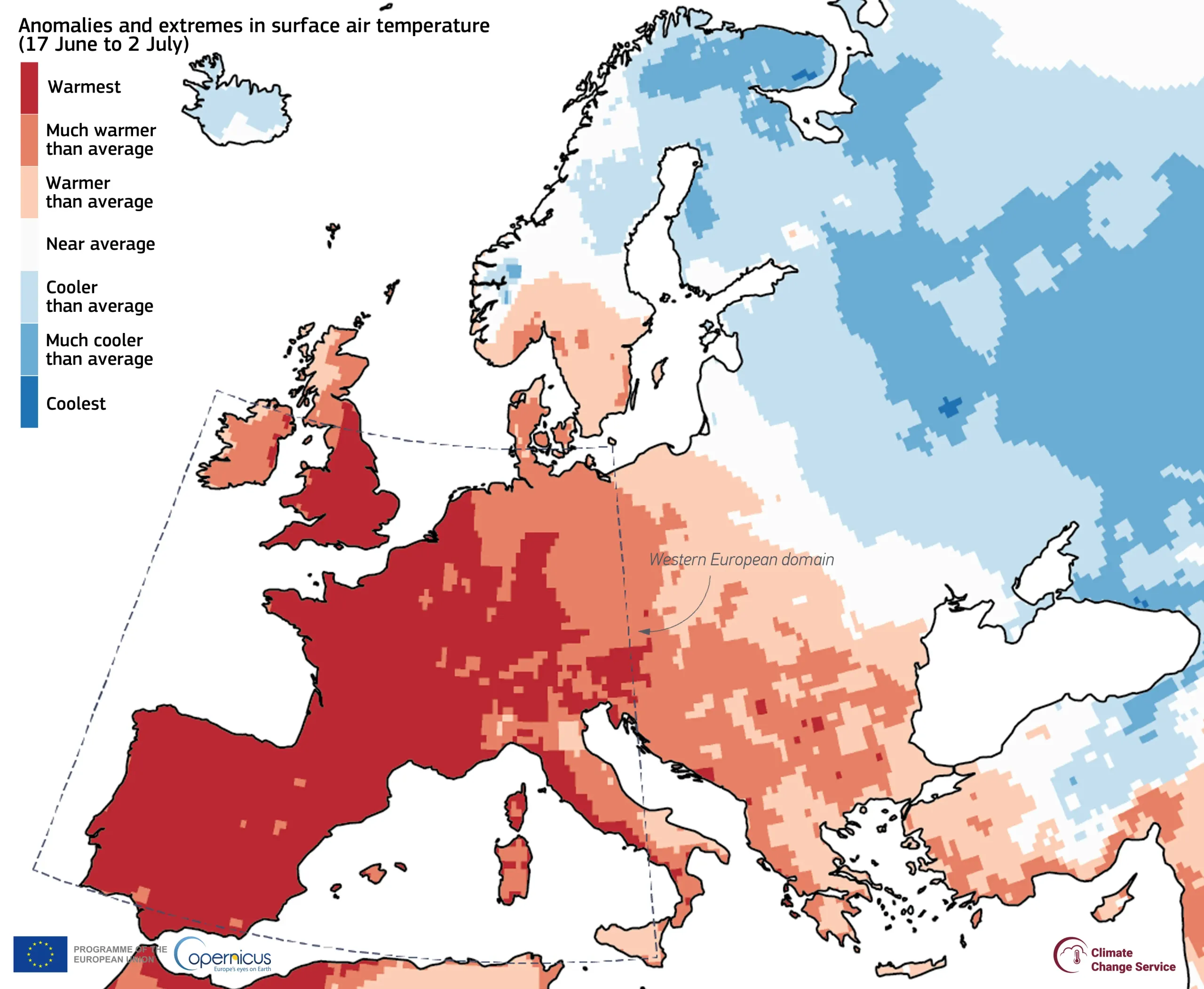
A heat wave swept western and southern Europe from June 17 to July 2, 2025. The event’s average air temperatures are compared here to the same 16-day period from 1979 to 2024. Red indicates that the 2025 heat event had the warmest average temperature of any year since 1979. Credit: European Union, Copernicus Climate Change Service Data
Outsized impacts
As annual global emissions drive up carbon dioxide levels in the atmosphere, heat waves are reaching new extremes. Scorching temperatures killed several thousand people across Europe in 2025, resulting in the hottest June observed in the region until heat waves broke that record in 2026.
Almost one-fifth of all carbon dioxide emissions from burning fossil fuels have been emitted in the decade since the Paris Agreement was adopted. Most of those emissions have come from burning oil, natural gas, and coal.
The new study results indicate the odds are more than 99 in 100 that emissions during this decade intensified Europe’s deadly June 2025 heat wave. The researchers estimated the emissions increased average daily temperatures in some regions by roughly a third of a degree Celsius, or just over half a degree Fahrenheit.
“That third of a degree temperature change may seem small,” said Trok, “but a large body of literature shows that small changes in temperature can have meaningful impacts on the damages caused by those extreme weather events.”
For example, previous research by Trok, Diffenbaugh, and colleagues has found that a small climb in temperature can disproportionately increase the risk of heat-related deaths in Europe. Another study shows that changes in daily temperature have disproportionate impacts on electricity demand, mortality rates, agricultural yields, labor productivity, and other sectors across the United States.
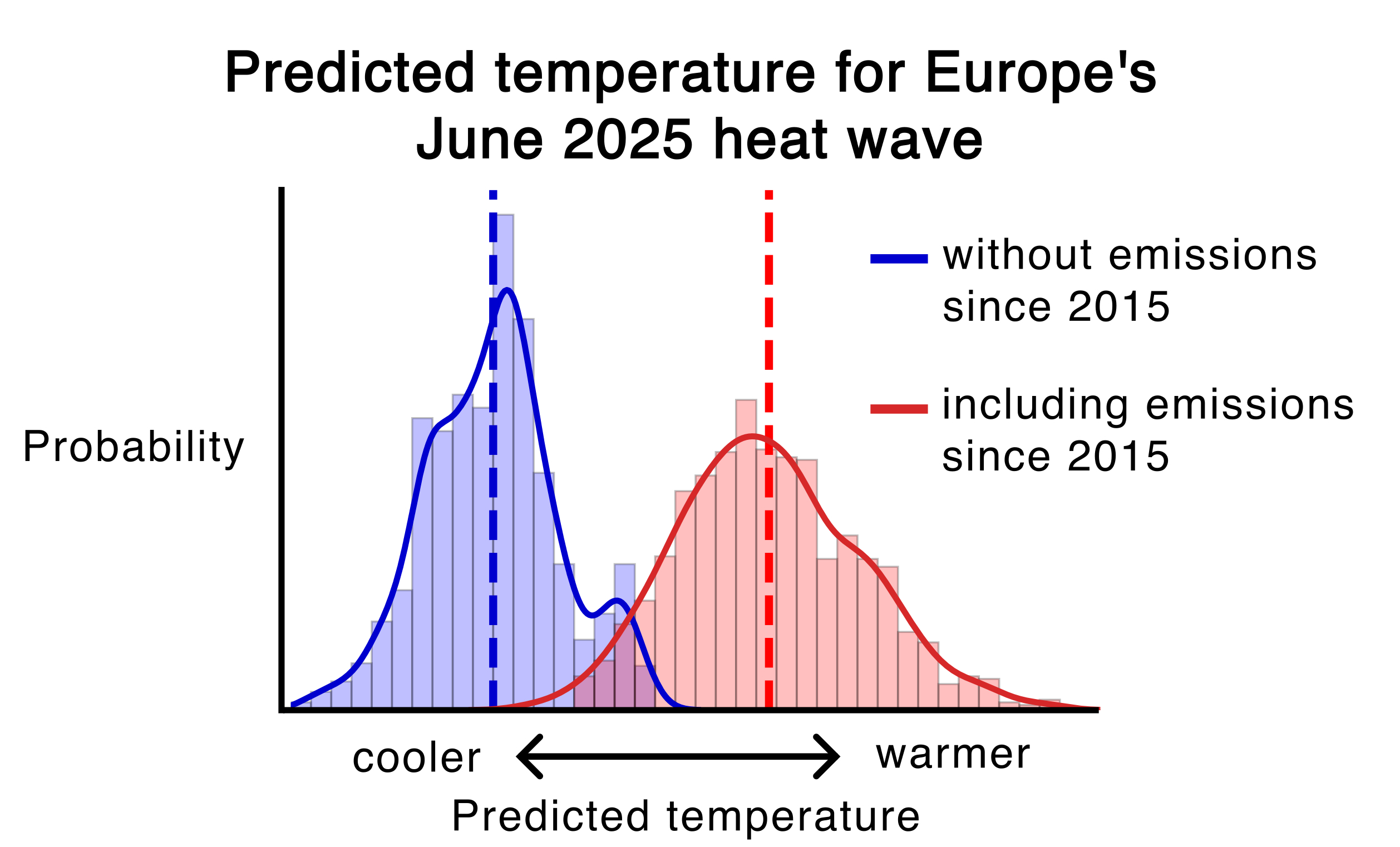
A new AI model predicts that global greenhouse gas emissions since 2015 very likely increased average daily temperatures during Europe’s summer 2025 heat wave (red curve). Researchers estimate that post-2015 emissions intensified the event by roughly a third of a degree Celsius, or the difference between the vertical dashed lines. Credit: Adapted from Trok et al. 2026, Geophysical Research Letters
Detecting a signal in the noise
The study comes at a time when several thousand lawsuits are underway to hold oil companies and other fossil fuel producers accountable for loss and damage caused by extreme weather linked to global warming. But attributing specific damages from specific weather events to subsets of human-caused emissions is challenging.
“It’s a signal-to-noise issue,” Trok said. “The role of random, natural variability on specific weather events is large, which makes it difficult to detect the influence from a small amount of human emissions.”
Building on a method the researchers developed in 2024, Trok trained a type of generative AI known as a diffusion model using simulated weather data from 10 global climate models. By analyzing each climate model’s simulated data for the years 1850 to 2100, the researchers’ diffusion model learned how surface temperatures over Europe vary with different emission levels and weather conditions, such as atmospheric pressure and soil moisture levels.
To evaluate the reliability of their framework, the team compared the model’s range of temperature predictions against decades of real weather data not used in training. They also confirmed that the model accurately predicts Europe’s long-term temperature trends, building confidence that it can predict temperature changes across different levels of global emissions.
To test the impact of emissions since the Paris Agreement, the researchers gave the model the observed weather conditions that caused Europe’s most intense annual heat waves from 2016 to 2025, which typically coincided with a persistent high-pressure system, or “heat dome.” The researchers had the model predict daily temperatures under actual emission levels at the time of each extreme heat event, and under the lower emissions levels of 2015.
“Generative AI models have randomness built in, which gives us a better ability to quantify uncertainty in the temperature change between two levels of emissions,” said Trok.
For each heat event, the diffusion model predicted a range of possible temperatures. This range reflects differences among the 10 global climate models and the effects of localized weather conditions that influence daily temperature. Since both factors could affect the intensity of a specific heat wave, even if regional weather patterns remain the same, the diffusion model learned to predict realistic temperature ranges given these uncertainties.
The predicted temperature range was consistently lower at 2015 emissions levels for Europe’s most intense annual heat waves since 2021. According to the researchers, the minimal overlap between these ranges provides strong evidence that post-2015 emissions intensified the heat waves.
Given the clear influence of emissions since the Paris Agreement, the researchers also tested whether even smaller amounts of emissions may have impacted the intensity of the June 2025 heat wave. They found high confidence for totals equivalent to as little as one-eighth of all human-caused emissions since the 1800s.
“Based on my experience using traditional methods like global climate models, I would have told you that the noise of natural variability makes detecting the influence of that level of emissions on a specific weather event highly uncertain,” said Diffenbaugh. “That a diffusion model which is trained on those same climate models and then given real meteorological data as inputs is able to distinguish the signal from the noise is a big step forward.”
Notes for journalists:
This press release was originally published by the Stanford University Doerr School of Sustainability: https://sustainability.stanford.edu/news/emissions-past-decade-have-made-europes-recent-heat-waves-worse
This study is published in Geophysical Research Letters, an AGU journal, and is freely available at this link: https://agupubs.onlinelibrary.wiley.com/doi/10.1029/2026GL125079
Paper title:
“Global Emissions Since the Paris Agreement Have Intensified Europe’s Recent Heatwaves.”
Authors:
- Jared T. Trok, Doerr School of Sustainability, Stanford University, Stanford, CA, USA.
- Elizabeth A. Barnes, Faculty of Computing and Data Sciences, Boston University, Boston, MA, USA; Department of Earth and Environment, Boston University, Boston, MA, USA.
- Emily M. Gordon, Doerr School of Sustainability, Stanford University, Stanford, CA, USA; Department of Physics, University of Auckland, Auckland, New Zealand.
- Frances V. Davenport, Department of Civil and Environmental Engineering, Colorado State University, Fort Collins, CO, USA.
- Noah S. Diffenbaugh, Doerr School of Sustainability, Stanford University, Stanford, CA, USA.
AGU (www.agu.org) is a global community supporting more than half a million professionals and advocates in Earth and space sciences. Through broad and inclusive partnerships, AGU aims to advance discovery and solution science that accelerate knowledge and create solutions that are ethical, unbiased and respectful of communities and their values. Our programs include serving as a scholarly publisher, convening virtual and in-person events and providing career support. We live our values in everything we do, such as our net zero energy renovated building in Washington, D.C. and our Ethics and Equity Center, which fosters a diverse and inclusive geoscience community to ensure responsible conduct.
Subscribe or change your emailing preferences for the AGU Newsroom
This press release was originally published by the Stanford University Doerr School of Sustainability: https://sustainability.stanford.edu/news/emissions-past-decade-have-made-europes-recent-heat-waves-worse