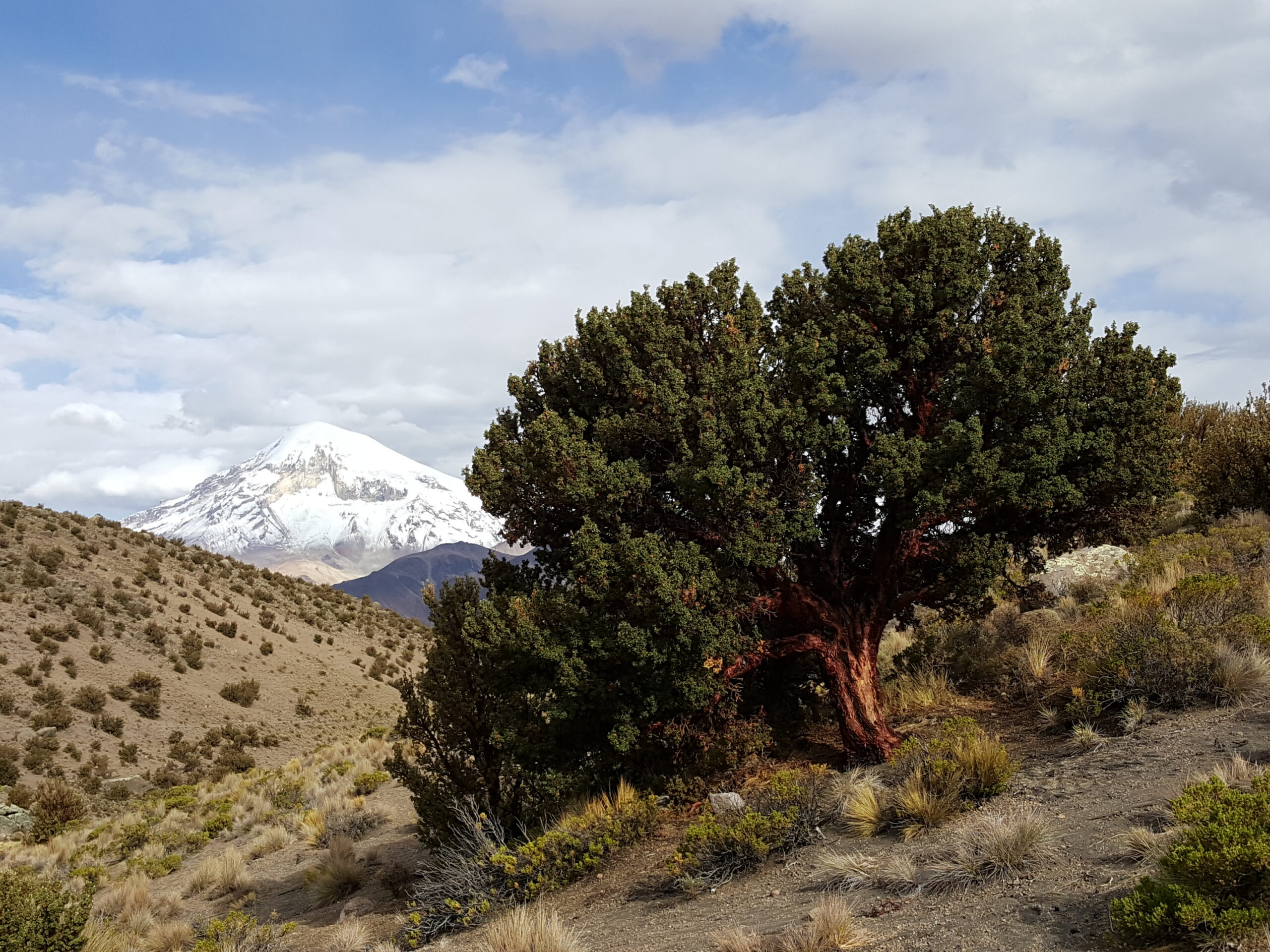
Polyepsis, the world’s highest-elevation tropical tree. Human activities have cut back Polyepsis forests to 10% of their original area, but attempts to plant more of these trees outside their original habitats can have unintended consequences for local water supplies. Credit: Rubí Y. Oliver Salazar via Wikimedia Commons.

AGU News
Press registration is open for 2026 AGU Annual Meeting
Press registration is now open for AGU’s 2026 annual meeting in San Francisco, California, convening 7 to 11 December 2026 at the George R. Moscone Convention Center. Staff, freelance and student journalists are eligible to apply for complimentary press registration until the end of the conference on Friday, 11 December. Press officers and institutional writers covering the meeting are also eligible for press registration.
- REGISTER AS PRESS HERE
- Additional information for press can be found in the conference Press Center.
- Learn about press eligibility requirements.
Featured Research
Planting native Andean trees in the wrong places may steal water from people downstream
Human actions have whittled forests of Polylepis, the world’s highest-elevation tropical trees, down to less than 10% of their original area in Peru, spurring large-scale tree-planting efforts to restore them and the myriad services they provide. But planting trees where they didn’t originally grow can have consequences. Where Polylepis forests replace native grasslands, the aquifer below receives 41% less water, researchers found, potentially costing downstream communities’ usable water. The aquifers near the community of Zurite, for instance, could receive 10-11% less water if the planted Polylepis there reach maturity — enough water to irrigate about 12 hectares (29 acres) of land during the dry season. [JGR Biogeosciences study]
Climate change turns up the temperature on Canadian children
Should Canada reach three to five degrees Celsius of local warming, the average Canadian child today will eventually weather four or five extreme heatwaves — ones so severe they would have occurred just once or not at all during an average Canadian lifetime under the climate conditions of 1981 to 2010. Nearly 40% of Canadian children would experience five or more such events in their lifetimes, with more children affected at higher warming. With still-developing bodies and no ability to care for themselves independently, children are especially vulnerable to extreme heat. Climate action to avoid high-warming futures could avert tens of extreme heat events over children’s lifetimes. [GeoHealth study]
Mars dust could cut Rosalind Franklin mission short if rover misses dust devil season
Touching down on Mars at the wrong time of year in 2030 could reduce the chances of ESA’s Rosalind Franklin rover’s solar panels getting a much-needed cleaning. Dust devils whirling across the planned landing site peak in the first half of the Mars year. Without their help to whisk away dirt, solar panel output could drop by up to 99% over the rover’s 228-Mars-day minimum expected mission, which could end 60 days before the next dust devil cleaning peak. [JGR Planets study]
Great Lakes’ weakening winters bring a cascade of consequences
As climate change shortens and weakens winters in North America’s Great Lakes region, the 40 million people who depend on the lakes face a slew of changes and challenges, as summarized by a new review of existing science. These include more harmful algal blooms, reduced habitat for cold-water fish species, unsafe lake ice, worsened flooding and erosion risks due to more rain and snowmelt, and impacts to economic and cultural traditions like ice fishing and winter tourism and recreation. [Earth’s Future study]
Climate change could put half of global population at high flood risk by 2100
Based on projections of future socio-economic development, rainfall and flood depths, increasing population density could put 50% of the world’s population at high risk for floods by 2100 under a high-emissions climate change scenario (SSP3-7.0). Researchers expect the anticipated population growth in South and Southeast Asia to create flood risk hotspots by exposing more people to future flood hazards. [Earth’s Future study]
Mapping Kīlauea’s Magma Reservoirs
Researchers used a dense seismometer network to monitor a combination of natural and truck-generated seismic signals and identify two regions of subsurface magma storage. [Eos research spotlight][JGR Solid Earth study]