The speed-up is strongest in the Adriatic, where dense water forms and sinks, and may alter the sea's deep circulation
16 September 2026
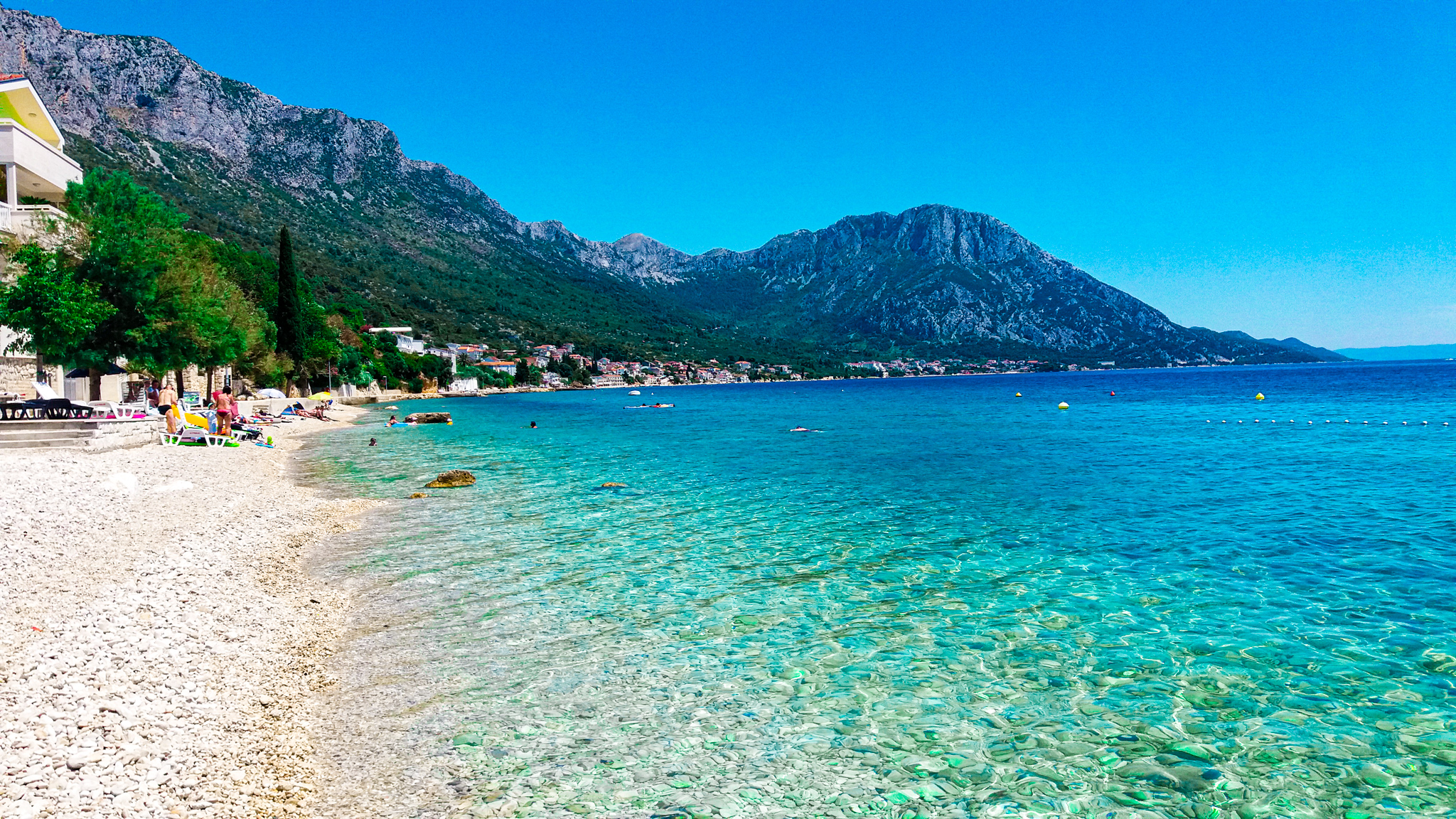
A Croatian beach on the Adriatic Sea. The accelerating warming and salinification in the Mediterranean is strongest in the Adriatic, where it reaches to the seafloor. Credit: tomkennedyastro on Wikimedia Commons

AGU press contact:
Sean Cummings, [email protected] (UTC-7 hours)
Researcher contact:
Elena Terzić, Ruđer Bošković Institute, [email protected] (UTC+2 hours)
WASHINGTON — Across its basins and thousands of meters down, the Mediterranean Sea is getting warmer and saltier. Now, a new study finds it is also doing so at a faster and faster pace. The speed-up is largest in the central and eastern Mediterranean, and strongest of all in the Adriatic, where it reaches all the way to the sea floor.
“What is really surprising is that we see significant changes in every region, reaching great depths,” said Elena Terzić, a physical oceanographer at the Ruđer Bošković Institute and lead author of the study.
The study appears in Geophysical Research Letters, AGU’s journal for high-impact, innovative, and timely articles on major advances across the geosciences.
Discovering hints of a basin-wide change
In recent years, the Mediterranean’s upper 100 meters have been about two degrees Celsius warmer than their 1950–1999 average. Earlier studies had seen signs of the surface warming speeding up, but nobody had measured whether the change was accelerating below the surface across the whole basin.
Terzić and co-author Ivica Vilibić, also at the Ruđer Bošković Institute, had recently documented unprecedented warming and salinification in the deep southern Adriatic, as well as signs of basin-wide changes: pools of unusually salty surface water across the whole Mediterranean that were historically known to occur only at its far eastern end. “We had seen notable changes in our recent studies, both in the deep Adriatic and at the sea surface, and we wanted to quantify the changes across the rest of the Mediterranean,” Terzić said.
To find out, the two compiled temperature and salinity measurements taken by research cruises and robotic floats across the Mediterranean from 1950 to 2025.
Speeding up, all the way down
Temperature and salinity are rising almost everywhere, and the rise is accelerating. In some regions, warming is speeding up by as much as 0.3 degrees Celsius per decade, every decade, with each kilogram of water getting about a tenth of a gram saltier per decade, every decade. Since 2000, Mediterranean surface waters have warmed at about half a degree Celsius per decade, two to three times faster than the global ocean surface. That’s up from less than a tenth of a degree per decade in most of the basin in the second half of the 20th century.
“For us, what was alarming was the rate at which this is changing, and the depths that such significant changes reach,” Terzić said. “The warming and salinification are statistically significant down to three or four thousand meters, and the speed-up itself reaches down to about 2,500 meters.”
Where the deep waters are formed
Differences in seawater density are what drive the sea’s deep circulation. Warming makes seawater lighter and added salt makes it heavier, and because both are rising, the density of Mediterranean water has changed far less than its temperature or salinity. Over most of the basin, warming is prevailing, so the surface is getting lighter and mixing less easily with the water below. But where dense water forms — above all in the Adriatic — the added salt is still keeping the water heavy enough to sink.
Whether it will keep doing so is one of the open questions the study raises. The Adriatic is one of the few places in the Mediterranean where cold winter winds make surface water dense enough to sink. That water then spreads into the central and eastern Mediterranean, carrying oxygen that supports marine life into the deep sea. But since 2000, the deep waters of the southern Adriatic have warmed about six times faster than those of a typical Mediterranean basin. As long as the added salt outweighs the warming, the water still sinks, and it now carries that warmth into the Mediterranean depths.
“Dense water is still forming, but we have indications that the way it forms is changing, and the water that sinks is now warmer and saltier than it used to be,” Terzić said.
The new study did not measure oxygen, but warmer water holds less of it, and oxygen declines have already been documented in parts of the Mediterranean. And marine species trying to escape the warming are running out of refuges: the sea is closed to the north, and the deep water is warming too.
A warning from a small sea
The oceans have absorbed over a quarter of humanity’s carbon dioxide emissions and more than 90% of the excess heat trapped by greenhouse gases, keeping Earth’s climate milder than it would otherwise be. The Mediterranean shows how quickly a sea can respond to that burden. Waters there circulate between depths and surface around ten times faster than in the open ocean. That is why, the authors say, the Mediterranean gives an early indication of how quickly larger ocean basins can transform in response to a warming climate, and why predictions of steady, linear change underestimate that speed.
The authors next want to find out what drives the acceleration: how much comes from the atmosphere, from changing patterns of evaporation, rain and river discharge, and from the Atlantic inflow through the Strait of Gibraltar. They also want to investigate whether today’s climate models capture the speed-up, which decides how far their projections for the region can be trusted.
“The Mediterranean is small enough that we can watch how a sea responds, on timescales we can witness ourselves, and what we see is unprecedented change,” Terzić said. “It is a warning of how fast the ocean can change, and it will continue for as long as our economies keep relying on fossil fuels.”
Notes for journalists:
This study is published in Geophysical Research Letters, an open-access AGU journal, and is available to view and download at this link: https://agupubs.onlinelibrary.wiley.com/doi/10.1029/2026GL124518
Paper title:
“Observational evidence for accelerated warming and salinification propagating into the deep Mediterranean”
Authors:
- Elena Terzić, Ruđer Bošković Institute, Division for Marine and Environmental Research, Bijenička cesta 54, 10000 Zagreb, Croatia
- Ivica Vilibić, Ruđer Bošković Institute, Division for Marine and Environmental Research, Bijenička cesta 54, 10000 Zagreb, Croatia; Institute for Adriatic Crops and Karst Reclamation, Put Duilova 11, 21000 Split, Croatia
AGU (www.agu.org) is a global community supporting more than half a million professionals and advocates in Earth and space sciences. Through broad and inclusive partnerships, AGU aims to advance discovery and solution science that accelerate knowledge and create solutions that are ethical, unbiased and respectful of communities and their values. Our programs include serving as a scholarly publisher, convening virtual and in-person events and providing career support. We live our values in everything we do, such as our net zero energy renovated building in Washington, D.C. and our Ethics and Equity Center, which fosters a diverse and inclusive geoscience community to ensure responsible conduct.
Subscribe or change your emailing preferences for the AGU Newsroom