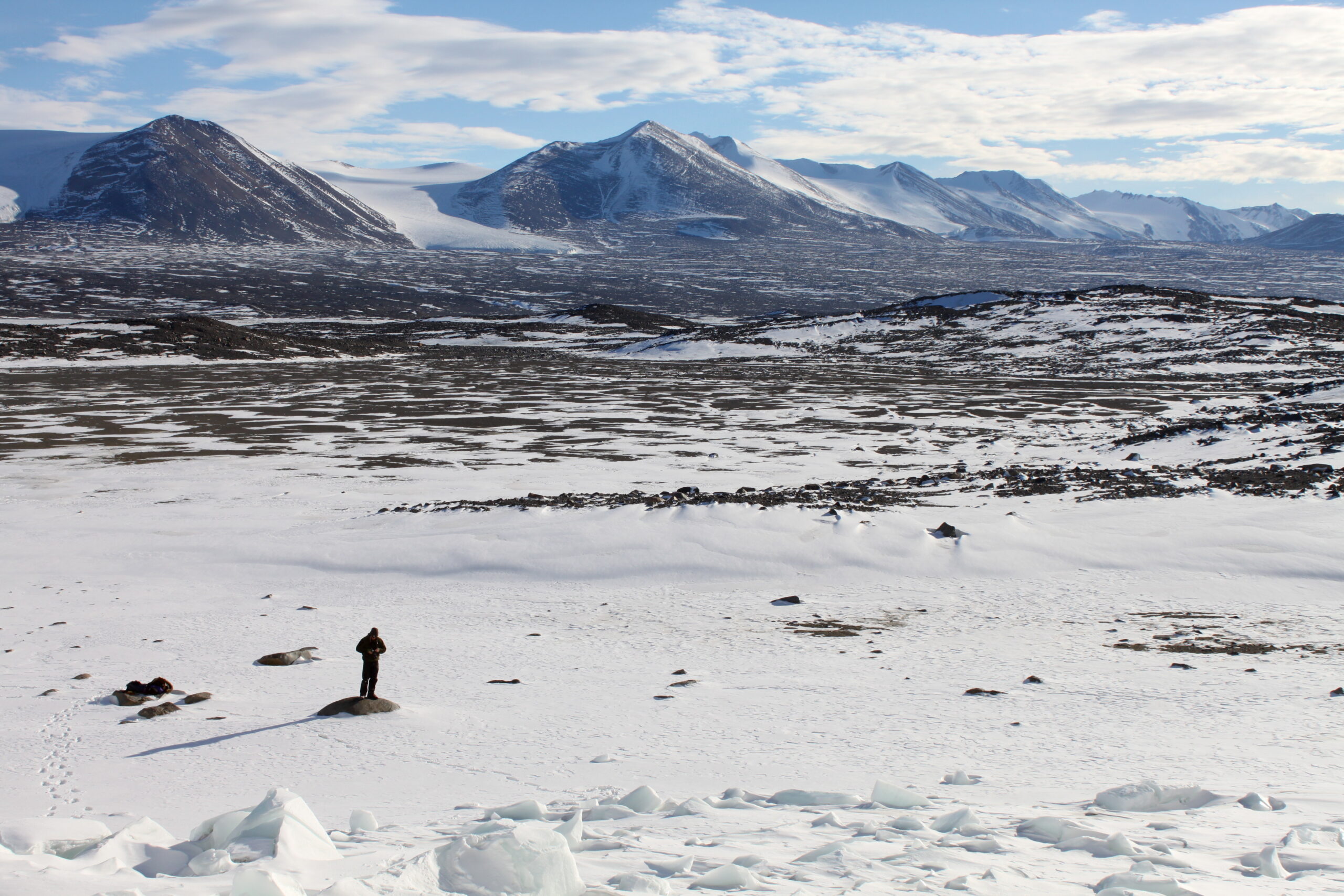
Antarctica’s Taylor Valley, where thawing permafrost is causing unexpectedly high CO2 leakage from ancient carbon stores despite the region having poorer soils and fewer microbes than in the Arctic. Credit: eliduke via Wikimedia Commons

AGU News
Press registration is open for 2026 AGU Annual Meeting
Press registration is now open for AGU’s 2026 annual meeting in San Francisco, California, convening 7 to 11 December 2026 at the George R. Moscone Convention Center. Staff, freelance and student journalists are eligible to apply for complimentary press registration until the end of the conference on Friday, 11 December. Press officers and institutional writers covering the meeting are also eligible for press registration.
- Additional information for press can be found in the conference Press Center.
- Learn about press eligibility requirements.
Featured Research
Antarctic permafrost has sprung an unexpected greenhouse gas leak
Antarctica’s stores of carbon, shielded from the air for thousands of years by ice and permafrost, are now likely leaking CO2 into the atmosphere as the margins of the continent thaw, researchers say. Measuring across almost 22 square kilometers (8.5 square miles) of the Taylor and Wright Valleys, researchers saw a 5.5-fold increase in CO2 emissions over 2020 to 2025. Without the same abundant carbon and microbial activity seen in Arctic permafrost, Antarctica’s CO2 release likely comes from non-biological processes like carbon-rich brines permeating up from deep below the ground in areas that used to be sealed off from the air by frozen soils, scientists say. Researchers caution that similar CO2 sources may extend along the Antarctic coastline, their contributions of carbon to the atmosphere yet to be measured. [Global Biogeochemical Cycles study]
Growing 5G networks could cause weather forecast fumbles by 2040
5G towers emit electromagnetic signals that can look the same to a weather satellite as clouds or moist air. According to a new study, this signal leakage from 5G could diminish the accuracy of future weather forecasts in the U.S. as networks expand to meet demand. The researchers estimate that, had a 5G network of the size expected for 2040 — with up to 7 times more towers than in 2023 in some counties — been present during Hurricane Ida in 2021, the overlapping signals of water vapor and 5G would have caused forecasting errors of up to 10 millimeters for rainfall and 2 C for temperatures. The team recommends adapting 5G technology to limit leakage of confounding signals, especially around cities, but warn that we might still be underestimating the scale of future forecasting problems. [Geophysical Research Letters study]
New sliver of Gondwana’s seas unearthed in Tibetan Plateau
Tiny crystals reveal that, 600 million years ago, a band of rocks now in the Tibetan Plateau lay just off the northeastern coast of the supercontinent Gondwana. The zircon crystals, smaller and more ancient cousins of the kind used to make faux-diamond jewelry, have chemical signatures that match rocks known to have come from inland Gondwana. As weather wore down the supercontinent’s hills and mountains, the zircons washed out to sea, accumulating in mud on a shallow ocean shelf like the one off the U.S. Atlantic coast today. This fragment of ancient seafloor helps geologists understand how plate tectonics eventually dispersed fragments of Gondwana around the world. [Geochemistry, Geophysics, Geosystems study]
Foamy magma causes Moon zits atop lunar lava flows
Frothy magmas oozing out of holes in partially cooled lava flows formed moat-encircled lumps all over the Moon, researchers say. Researchers mapped more than 3,000 of these “ring moat dome structures,” which average about 250 meters (820 feet) wide and 3.5 meters (11.5 feet) high, throughout Mare Imbrium, the Moon’s second-largest impact crater. These features likely form towards the end of volcanic eruptions, when lava flows have partially cooled to form a brittle skin on top. Researchers propose that volcanoes may release a final burst of extra-bubbly lava, which follows the path of the earlier lava flows, reinflating them like a molten, basaltic balloon. When the bubble-filled lava pocket collapses in on itself, a pit forms in the surface of the flow, creating cracks in the “skin” for some lava to ooze out into a dome inside the new depression. These lava flow bumps reveal the inner workings of lunar volcanoes even now that the Moon’s eruptions have calmed down. [JGR Planets study]
Extreme water highs and lows under climate change means less water for humans
In a high-emissions future leading to 2.8 to 4.6 degrees Celsius of warming by the end of the century, more than 40% of Earth’s major river basins may have significantly less water available for human use. Scientists simulated changes in annual water levels from 2015 to 2100 for 520 basins around the world, including both water lows and intense highs like floods where humans can’t easily use the water. Between these two extremes, projected water availability dipped the most in the mid- to low-latitudes, with parts of the Mediterranean and other regions already experiencing water shortages emerging as hotspots. As climate change brings more droughts, floods, storms, and other water extremes, the authors note, lowering emissions can minimize (though not erase) losses to water resources. [Geophysical Research Letters study]
InSight into Seismology on the Red Planet
Viking 2 detected two possible marsquakes in 1976. New analysis links one to the same region where InSight recorded nearly 1,000 marsquakes decades later. [Eos research spotlight][AGU Advances study]