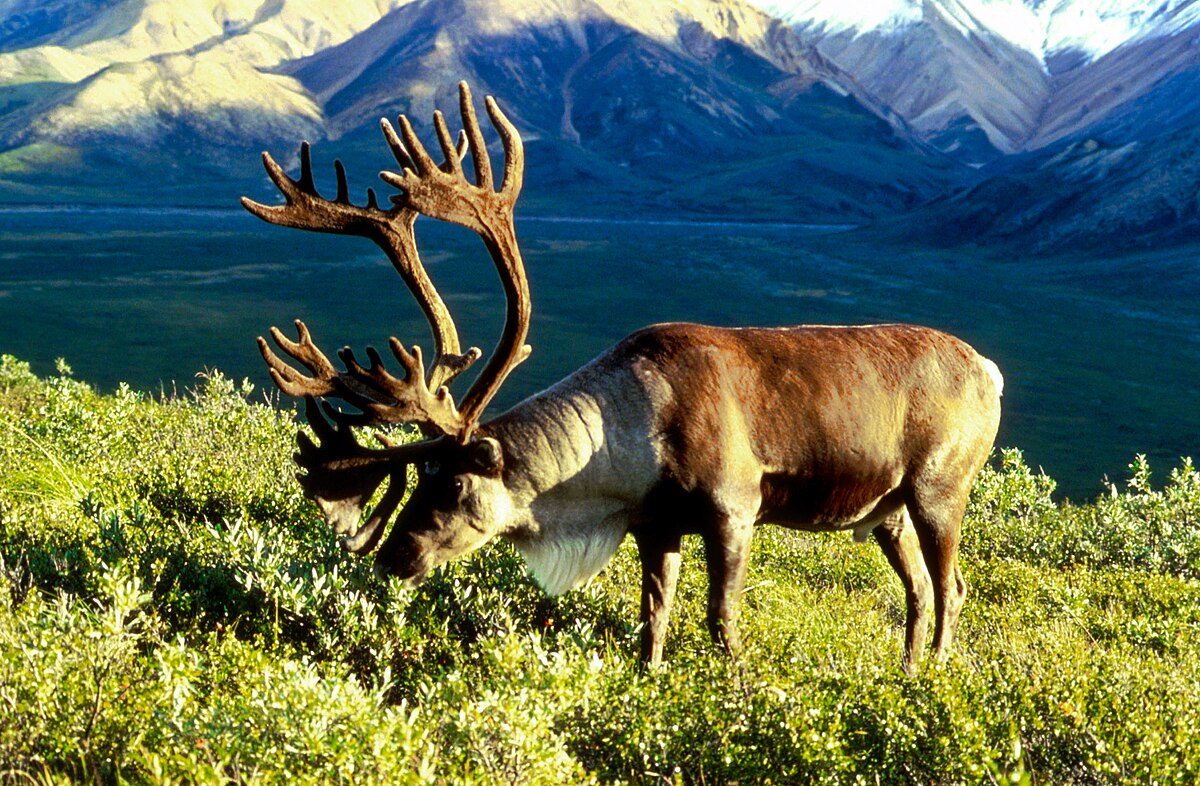
Caribou in Alaska
Credit: Dean Biggins (U.S. Fish and Wildlife Service)

AGU News
Register for AGU’s 2025 annual meeting for on-site and remote access to 20K research presentations in the Earth and space sciences
Join us in New Orleans or online next week at the 2025 AGU Annual Meeting, 15-19 December at the Morial Convention Center.
Recordings of the scientific program will be available to online participants on-demand within 72 hours of the sessions’ end and remain accessible to registered attendees until 14 April 2026. Press briefings will be live-streamed.
Staff, freelance, and student journalists are eligible to apply for complimentary press registration through the end of the conference. Press officers and institutional writers covering the meeting are also eligible.
[press registration] [press events] [scientific program] [virtual attendance]
Featured Research
Rivers have heatwaves, too– and they’re outpacing air heatwaves
Heatwaves may not hit rivers with nearly the intensity of air heatwaves, but they happen double to quadruple the frequency. These underwater heatwaves are driven by climate change through diminishing snowpack and changes in water flow. The new research found human activities like dams extended the heatwaves whereas agriculture reduced them. [Conference abstract – Presentation on Wednesday, 17 December]
Air pollution is decreasing, but increasing natural hazards threaten to upset progress
Despite progress made in decreasing air pollution, hazards like wildfires, droughts, dust storms and even volcanic eruptions can decline air quality. Wildfires, droughts and extreme heat, among other things, are all expected to increase with climate change worsening, and those compounding effects can worsen air pollution in an unknown way. Using 10 years of data, researchers are creating a real-time automated process to see daily air pollution impacts that include multiple hazards at once, something often left out of air pollution prediction models. [Conference abstract – Presentation on Thursday, 18 December ]
Even small companies can save lives by cutting emissions
Companies that have pledged to decrease and minimize their emissions could save potential lives by following through on those promises, even the companies with small environmental impacts. New research found over four million deaths could be saved depending on different emission scenarios of 3,000 companies: no decrease in emissions, some decrease, and hitting their pledged amounts within a shorter timeframe and the pledged timeframe of 2100. According to this study, some companies could impact thousands of lives, while others have a much smaller impact but could still mitigate potential losses. [Conference abstract – Presentation on Monday, 15 December]
Warm ocean water is melting the Thwaites ice shelf from below
Along with steady warming of deep ocean water melting the Thwaits Eastern Ice Shelf from below, short bursts of heatwaves that alter sea ice are having a large impact. These bursts alter water density and disrupt ocean stratification, or the natural layering of water by heat and salinity. This disruption increases the melting speed of the ice shelf. [Conference abstract – Presentation on Tuesday, 16 December]
Crusty snow delivered by climate change blocks reindeer from food in winter
As climate change plays out in snowy regions, warmer winter air can increase the likelihood of rain falling on existing snow. The snow then melts and refreezes, creating layers of ice that prevent foraging animals from nibbling the plants below. In northern Europe’s Fennoscandia peninsula, conditions for this phenomenon have been occurring more often and, in interior regions, earlier in the year since 1960. For winters when those shifts are especially prominent, researchers found, reindeer birthrates tend to drop the following summer. Areas with densely populated herds appear to take the hardest hit, likely because more reindeer must compete for limited food in their iced-over foraging grounds, the researchers note. [Conference abstract – Presentation on Thursday, 18 December]
Chilean undersea mountains show how island nations can legally claim seafloors
When coastal nations want to claim seafloor resources farther than 200 nautical miles offshore, international law requires them to prove that seafloor is a true geological extension of their land. But for island nations on the summits of undersea volcanoes, this gets tricky: those volcanoes’ sides slope gradually to the seafloor, muddling where the island’s territory starts or ends. To solve this, researchers used depth maps to trace volcanic slopes and seismic and gravity data to tease out the signature of the thick, rocky crust below. Where the two cross, they argue, lies the true edge of an island. Testing the method on two Chilean islands revealed an undersea mountain range over 700 kilometers long and up to 90 kilometers wide — proof, the researchers say, that this method could help dozens of coastal and island nations claim sovereign undersea territory. What’s more, the method leans mostly on public data, making it accessible and transparent. [Conference abstract – Presentation on Monday, 15 December]
Long drought may not cripple Amazonian forests completely — but it will remake them
Scientists expect worsening droughts to kill a lot of plant life in the Amazon. To get a clearer picture of what sustained, long-term droughts might do, researchers have subjected an Amazonian forest plot to simulated drought for over 20 years. As expected, trees — especially the largest ones — died at a higher rate over the first 15 years. However, the die-off reduced competition for water, leaving the survivors with more to drink: their sap flow and internal water content matched that found in drought-free forest. As deaths slowed down, the ecosystem stabilized in the final seven years, albeit in a much-altered form — one with less plant mass and, consequently, less carbon stored in wood. [Conference abstract – Presentation on Wednesday, 17 December]
How California’s worsening wildfires might contribute to toxic algal blooms, too
Toxic cyanobacteria have been causing harmful algal blooms to develop more often and last longer in at least 71 lakes across California since 2002, with high-risk blooms occurring earlier in the year, researchers in the state have found. The team hypothesizes that wildfires, also on the rise in California, may play a role — specifically, by leaving burned landscapes more prone to sediment erosion into lakes, providing cyanobacteria with more nutrients to fuel the blooms. If so, fire monitoring could be a valuable tool for forecasting the risk of harmful algal blooms. [Conference abstract – Presentation on Friday, 19 December]
Indonesia’s energy plans threaten its climate goals while barely reducing fuel imports
In its quest for energy self-sufficiency, Indonesia in 2023 produced Presidential Regulation Number 40, designed to boost annual bioethanol production. Put into effect in 2024, the regulation seeks to achieve this by converting at least 700,000 hectares, but potentially up to two million hectares, of land into sugarcane plantation. The caveat: this would occur in the country’s easternmost region, home to some of Earth’s densest remaining tropical rainforest. Using remote sensing and mapping tools, researchers assessed deforestation from the project’s first year, as well as its likely future impact on land use, oil demand, and resulting greenhouse gas emissions. The project would dramatically alter local landscapes and livelihoods, they found, as well as jeopardize Indonesia’s goal of becoming a net carbon sink by 2030 — but would barely make a dent in fuel imports. [Conference abstract – Monday, 15 December]