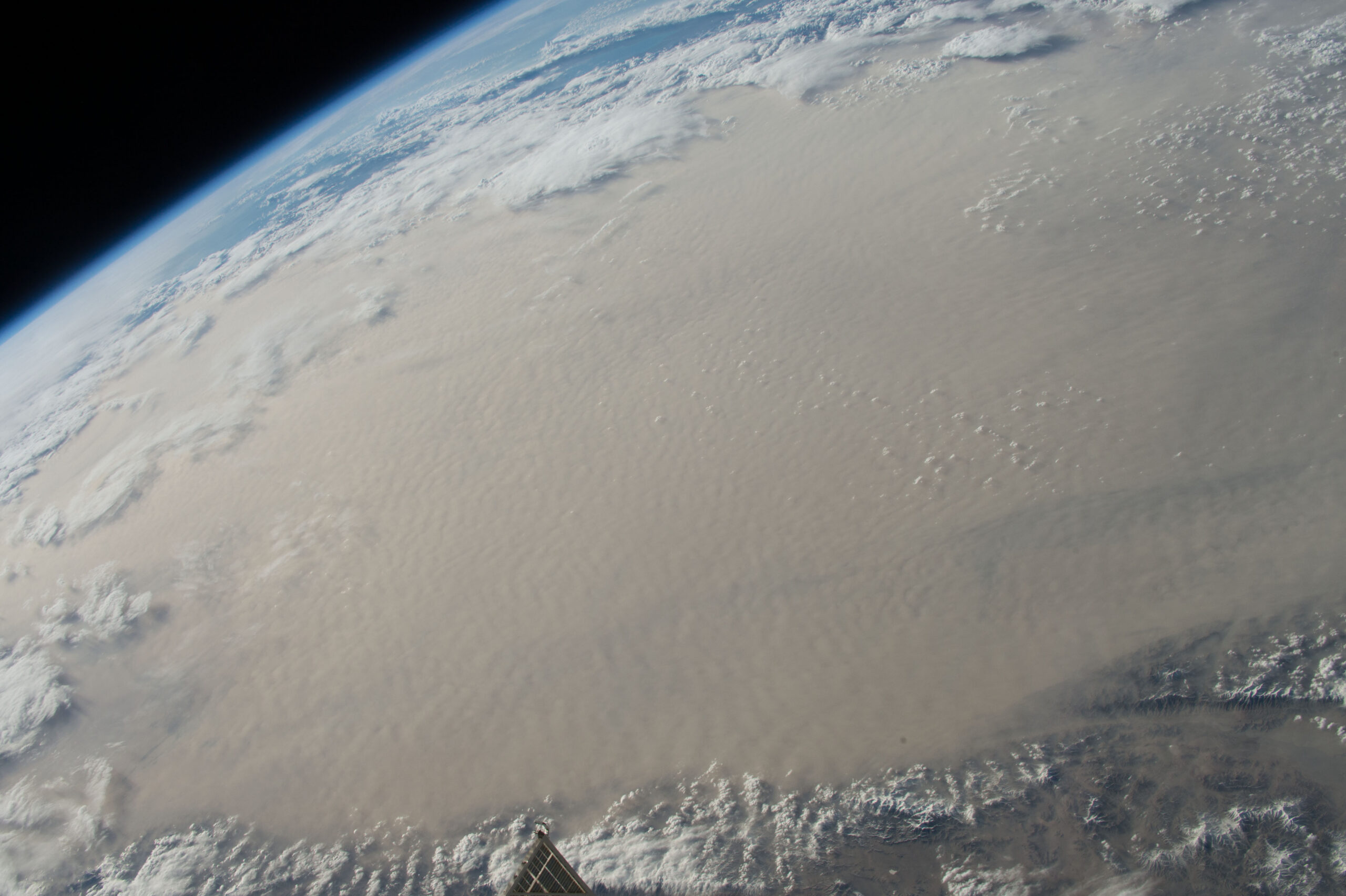
A massive dust storm over the Gobi Desert, which spans southern Mongolia and northern China. Dust kicked up in Mongolia accounts for a significant portion of dust pollution in northern and northeastern China, but declining desertification in Mongolia has improved air quality beyond its borders over the past 20 years. Credit: NASA, Wikimedia Commons

AGU News
AGU 2026 Journalism Awards call for nominations
AGU is now accepting nominations for its 2026 Journalism Awards, which honor outstanding reporting on the Earth and space sciences published in 2025. Nominate your or your peers’ best work by Sunday, 19 April 2026 at 11:59 p.m. ET. [press release and submission links]
AbSciCon26 registration open
Reporters and press officers interested in press registration for the Astrobiology Science Conference to meet in Madison, Wisconsin, 17-22 May should email AGU Media Relations at [email protected]. Please include a link to a byline, masthead or a staff page listing your name and position. Freelancers should provide a link to a portfolio or links to at least three bylined science news stories published in the last 12 months. [press information] [AbSciCon home] [program]
Featured Research
Environmental recovery in Mongolia improves air quality across East Asia
Natural environmental recovery in Mongolia from 2005 to 2023, marked by a drop in desertification across most of the country, reduced national dust emissions by roughly 23%. Because desertification-fueled dust storms in Mongolia impact air quality and health for hundreds of millions of people across East Asia, the improvement had an international ripple effect, cutting dust pollution in North and Northeast China by 5.4% and 13.3%, respectively. Intentional land restoration could have even greater region-wide benefits: researchers estimate that restoration actions in Mongolia, akin to those in China’s Inner Mongolia, could have lowered dust pollution in Northeast China by over 18% during the same period. [JGR Atmospheres study]
Reaching carbon neutrality earlier cuts humid heatwave health risks significantly
Cutting net human carbon emissions to zero by mid-century could reduce the global health risk from humid heat stress by 45%, compared to a scenario in which emissions peak around mid-century but don’t reach net zero by 2100. It would also lower the disparity in risk between low- and high-income countries by over 78%. The earlier humanity achieves carbon neutrality, the more risk it averts: getting there by the 2050s rather than the 2070s, for instance, reduces risk in low-income countries by over 35%. Humid heatwaves present greater danger than either heat or humidity separately, especially for outdoor laborers with limited access to medical services. [Earth’s Future study]
Water from rocket exhaust might stick around on the moon longer than thought
Water from rocket exhaust may bind to grains of lunar soil, causing it to take longer to escape back into space than scientists previously thought, according to a new study based on data from the Chang’e-5 and Chang’e-6 lander missions. Scientists need to know how water moves on the moon in order to develop adequate planetary protection measures. Depending on how they move, water and other substances from spacecraft could contaminate future research sites at the moon’s poles, where ice may preserve clues about the history of the solar system. [JGR Planets study]
Uranus’ faint, thin outer rings born of ice and mystery
Unlike Saturn’s spectacular rings, Uranus’ are dark and difficult to observe — particularly the outermost pair, discovered in 2005. New observations from James Webb Space Telescope combined with older data from Hubble Space Telescope and Keck Observatory in Hawaii find tiny icy grains make up the blue μ ring created by micrometeorite impacts on the planet’s small moon, Mab. The icy composition of the μ ring confirms that Mab is mostly made of water-ice. The authors infer that the dusty, red v ring, meanwhile, must have resulted from collisions between thus-far-invisible, organics-rich rocky bodies orbiting between some of Uranus’ 14 known moons. [JGR Planets study] [Keck Observatory press release]
South Carolina communities take disaster risk reduction into their own hands
A pilot program to improve disaster resilience in South Carolinian communities facing disproportionate exposure to environmental hazards — the first of its kind in the U.S. — met with success, according to a report by researchers at institutions involved in it. The EJ Strong Program provided training sessions in disaster risk reduction to over 110 people from those communities between 2020 and 2024, 46 of whom received certificates at the end. The program also produced an online course, an app, an emergency food access map, and public school materials all focused on disaster risk reduction, plus air quality and flood monitoring systems and funding for disaster resilience projects in vulnerable communities. As heatwaves, floods, sea level rise, and public health crises hit disadvantaged communities the hardest, community-led disaster management can give them more agency over how to manage the risks they face. [GeoHealth study]
Conservation practices on farms can lower flood risk and boost water quality
Nature-based solutions for agricultural conservation, such as winter cover cropping, have boomed over the past 30 years in Shell Creek, Nebraska as local stakeholders and government agencies have worked together to improve watershed management. In a recent study, researchers reported that this trend likely contributed to healthier winter vegetation, less frequent and intense flooding and, to a lesser extent, better water quality. The example of Shell Creek indicates that conservation practices can help make agricultural water systems more sustainable, they wrote. [Water Resources Research study]
Fixing Baltimore’s unequal weather data coverage
A new partnership between researchers and community members created a comprehensive network of weather stations across underserved areas of the city. [Eos research spotlight][Community Science study]
Glaciers may flow into the ocean more quickly than we think
New research found that adjusting a key model variable may give more accurate predictions of glacial retreat. [Eos research highlight][AGU Advances study]
An ancient landscape beneath the East Antarctic Ice Sheet
Geophysical observations of the subglacial topography of Coats Land reveal a landscape formed by tectonics and fluvial erosion that influenced the formation of the East Antarctic Ice Sheet. [Eos editors’ highlight][JGR Earth Surface study]