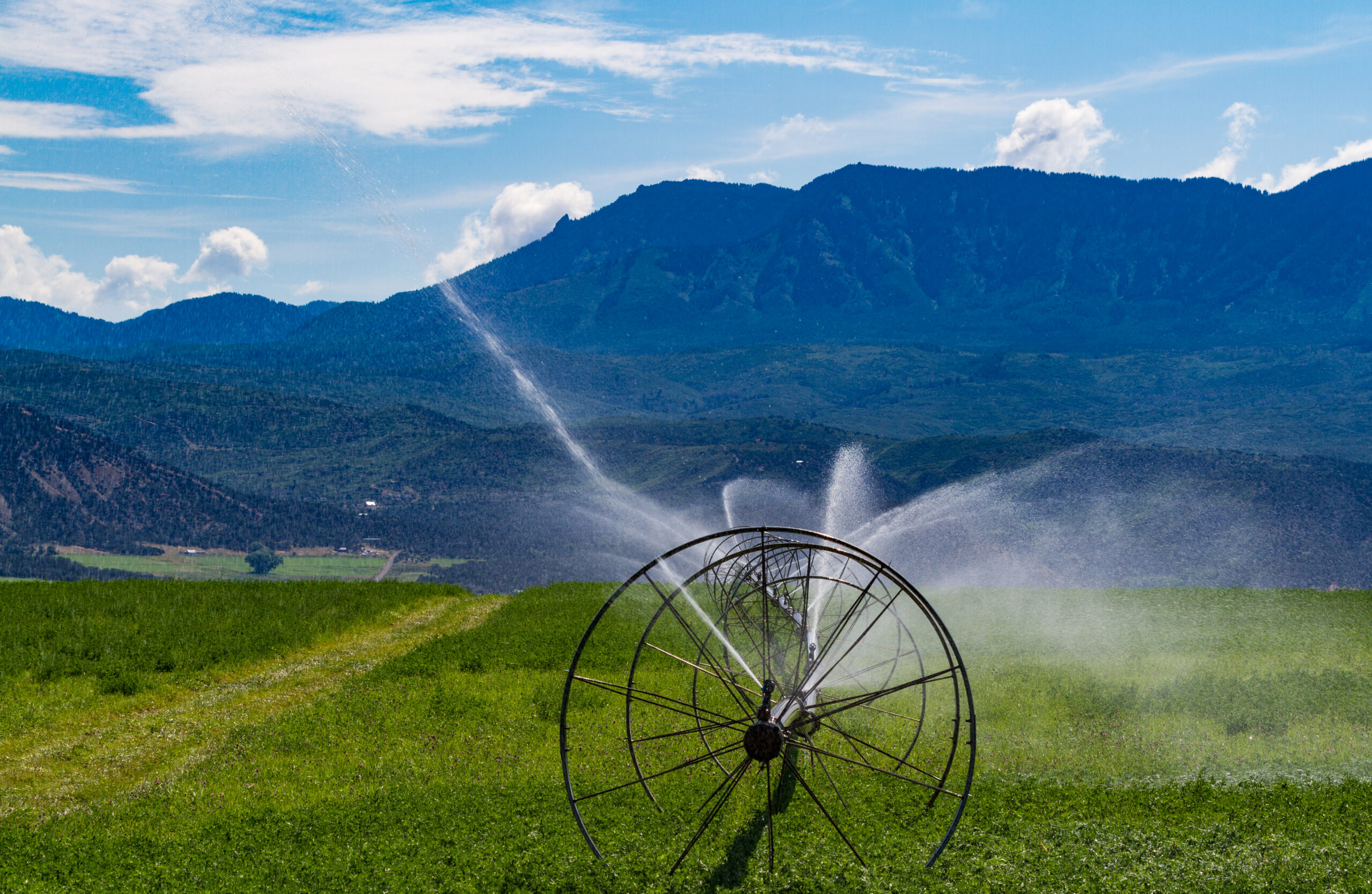
Irrigation on agricultural land in Colorado, USA. The energy required to pump water for irrigation has environmental and economic costs, and many parts of the world are shifting to alternative irrigation power sources like solar. Credit: Tony Webster

AGU News
Register for the JpGU-AGU 2026 Joint Meeting in Chiba, Japan (and online)
Members of the news media interested in covering the Joint Meeting of the Japan Geoscience Union and AGU in Chiba, Japan from 24-29 May 2026, either online or in person, should complete pre-registration at least two days in advance. Registration is free of charge for press covering the meeting and will grant access to all oral presentation sessions, poster sessions, and exhibition areas both online and in person. The meeting is accessible in English. Reporters can send registration questions to press@jpgu.org. [Meeting website] [Meeting press page] [Info for online participation] [Info on session languages] [full program]
Featured Research
Irrigation takes energy. Around the world, the sources of that power are changing.
Researchers have assembled the first global dataset (to the authors’ knowledge) revealing how much energy each country uses for irrigation, which power sources each relies on, and how those things are changing over time. Drawing on a combination of existing data and models, the effort indicates that many countries are shifting how they fuel their irrigation: solar-powered water pumps are on the rise in India and Pakistan, for instance, whereas China and the U.S. continue to rely mostly on the grid. Understanding these patterns can help inform food, energy, and water security goals as well as environmental efforts, the researchers wrote, since the energy cost of irrigation can affect both food prices and greenhouse gas emissions. [Earth’s Future study]
Heat and drought may increasingly strike multiple global breadbaskets at once
Earth’s major agricultural regions will likely see simultaneous droughts and heatwaves occurring more often and for longer stretches through the end of this century, according to model projections. The Indo-Gangetic Plain may take the brunt, with drought-heatwaves eating up 32 more days per year under a mid-range emissions scenario than they did from 1982 to 2019. It won’t be alone, however: high-stress hot-dry extremes hitting over 30% of global breadbasket regions at once may also get more common, putting global food supply chains at risk as the planet’s population continues to grow. [Geophysical Research Letters study]
As the Northern Hemisphere gets less dusty, its clouds trap less heat
As the Northern Hemisphere has gotten less dusty in recent decades, its clouds have gotten better at reflecting sunlight back into space, creating a cooling effect. Clouds can comprise both water droplets and ice crystals, but the former reflects sunlight better than the latter. Dust particles act as “seeds” around which ice crystals can form, so with less dust in the air, clouds in the Northern Hemisphere more readily take on a watery — and more reflective — form. The resultant cooling offsets about a quarter of the warming that other cloud-based phenomena cause, the authors write, meaning that Earth may be warming more slowly than climate models ignoring this effect project. [Geophysical Research Letters study]
With less ice, more sunlight pierces the Arctic Ocean
As Arctic sea ice thins, shrinks in area, and melts earlier in the year due to human-induced warming, it reflects less sunlight, making the waters below brighter and warmer. Satellite and model data reveal that from 1984 to 2024, the Arctic Ocean took on about 300 megajoules of extra heat per square meter from sunlight alone — enough to melt a meter-thick layer of ice. Besides amplifying warming in a region already heating up faster than the rest of the globe, the energy from the extra sunlight could also alter marine food webs. [Geophysical Research Letters study]
In some wetland soils, warming could ramp up microbes’ neurotoxin production
In a laboratory experiments, more heat caused microbes in wetland soils to more actively convert the mercury in those soils into methylmercury, a harmful neurotoxin — but only up to a point. This activity peaked at around 20 degrees Celsius, or 68 degrees Fahrenheit, but slowed down once temperatures reached 25 Celsius (77 Fahrenheit) due to nutrients for the microbes becoming more limited. Overall, the team wrote, this indicates that although warming generally boosts methylmercury buildup, how far this effect goes depends on the content of the soil itself. [JGR Biogeosciences study]
How much will Western wildfires worsen under warming?
A new study reevaluates the use of vapor pressure deficit, or VPD, in climate models to predict increases in area burned by wildfire across the U.S. West. [Eos research spotlight] [AGU Advances study]