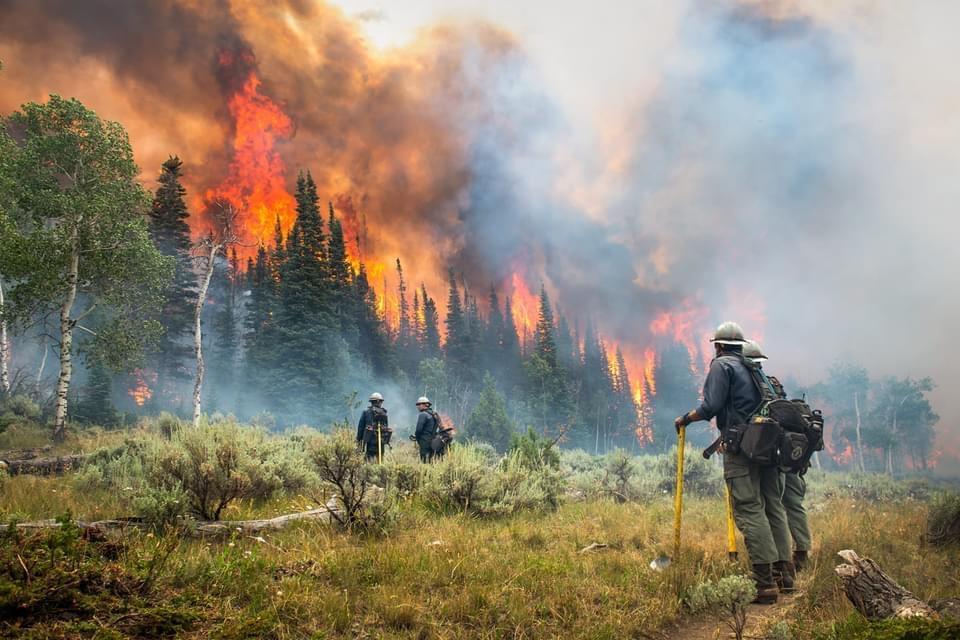
Firefighters stand before a wildfire in Wyoming, USA. As climate change dries out the American West, priming it for more wildfire, projections of future burned area vary depending on whether scientists base their estimates more on atmospheric dryness or soil dryness. Credit: United States Forest Service, Wikimedia Commons

AGU News
AbSciCon26 registration open
Reporters and press officers interested in press registration for the Astrobiology Science Conference to meet in Madison, Wisconsin, 17-22 May should email AGU Media Relations at [email protected]. Please include a link to a byline, masthead or a staff page listing your name and position. Freelancers should provide a link to a portfolio or links to at least three bylined science news stories published in the last 12 months. [press information] [AbSciCon home] [program]
Research roundup: When cities make it rain
By altering the shape, temperature, and atmospheric stability of the landscapes on which they sit, urban areas have the power to change regional rainfall. Check out the latest research on this topic from AGU journals:
- Urbanization in Vietnam’s Ho Chi Minh City metro area as of 2020 has brought 30% more daily rainfall to the urban center than the landscape would have had without any urbanization. [JGR Atmospheres study]
- Global satellite data show that most large cities receive a greater amount of light rain, but less intense heavy rain, than nearby rural areas. [Earth’s Future study]
- Heat from Houston, Texas draws moisture from nearby countryside to form taller clouds and trigger stronger, wetter, longer storms over the city than in rural areas. [JGR Atmospheres study]
Featured Research
Western U.S. wildfire projections may be greatly overestimated, study argues
Previous studies may have overestimated future wildfire-burned area in the Western United States by up to an order of magnitude, a new study claims. Most studies use atmospheric dryness to estimate how big fires will get, since the two have historically correlated well. Soil moisture has also mirrored burned area quite well in the past, but scientists expect it to change far less than atmospheric dryness under climate change, meaning projections from the two will diverge. At 3 degrees Celsius of warming, for instance, projections based on atmospheric dryness estimate the area burned during each 6-month fire season will grow 16 times larger than in the period from 1984 to 2014, while those based on soil moisture show burned area doubling. Recent advances in hydrology, the authors write, indicate the latter will provide the better proxy going forward. [AGU Advances study]
Past jump in farm burning on the Tibetan Plateau likely sped up glacier melting
Biomass burning shot up fourfold on the western Tibetan Plateau after the 1970s, mostly from the expansion of farming and crop residue burning in the northwestern Indian Peninsula. The finding comes from the first high-resolution history of biomass burning in the region, based on an analysis of charcoal particles in an ice core covering the period from 1935 to 2012. Agricultural burning releases black carbon, which can settle on Tibetan glaciers in a dark layer that absorbs sunlight, likely making those glaciers melt faster. [JGR Atmospheres study]
Carbonate weathering projected to sequester up to 25% more carbon by 2100
Carbonate weathering, a natural process in which worn-down rocks react with water and carbon dioxide to lock away atmospheric CO2 and help regulate the global climate, sequestered 127 million tons of carbon per year from 1950 to 2014 — about 3.7% of what the world’s forests sequester. Compared to that period, scientists project, this global carbon sink will increase roughly 14% to 25% by 2100. That’s partly because at altitudes above 3,000 meters, snow and glaciers melting from climate warming provide more water and plant growth, both of which aid in weathering. Below that elevation, however, warming hinders the weathering process instead. [Earth’s Future study]
Metals and rippled rocks on Mars hint at an ancient lake friendly to life
In the Gale Crater on Mars in late 2022, NASA’s Curiosity rover encountered the largest deposit of iron, zinc, and manganese ever found together in the crater. The metals lay within preserved ripples in the rock, a shape indicating that a broad, shallow lake once filled that area — even though the rocks were deposited during a time when Mars’ climate was turning drier and colder. In Earth’s lakes, metal-rich deposits like this form via chemical reactions almost always in the presence of microbial life, suggesting that this lake may have provided favorable conditions for Martian life. [Los Alamos National Laboratory press release][JGR Planets study]
Europe’s baby steps away from rising seas
In 1859, the Dutch king forced evacuation from Schokland, an island community struggling with damaging floods caused by subsidence. Stone embankments could not hold back storm surge from the sea and the defenses became too expensive to maintain. Since then, retreat has remained less popular than engineered defenses in the battle against rising sea levels in Europe, according to a new study that reviewed 44 proposed or complete managed retreat projects in 11 European countries (map), relocating 8,700 households. Most projects are small, disconnected from broader climate adaptation planning and reactive to devastating flooding rather than proactive. Because modern governments prefer persuasion over force, they will need adequate and transparent compensation, early community buy-in and trusted local leaders to make this adaptation strategy effective. [Earth’s Future study]

Mediterranean mussel farming could collapse by 2050
New experiments suggest that ocean warming and acidification are on track to slash both oyster and mussel farming yields. [Eos research spotlight][Earth’s Future study]
Navigating the past with ancient stone compass needles
The emerging field of magnetic microscopy allows scientists to reconstruct ancient magnetic fields from individual magnetic particles. A new study evaluates the accuracy of the technique. [Eos research spotlight][JGR Solid Earth study]
Amazon River breezes mimic pollution in clouds
Natural river breezes create clouds over the Amazon that mimic the signs of pollution, complicating climate impact assessments. [Eos editors’ highlight][AGU Advances study]