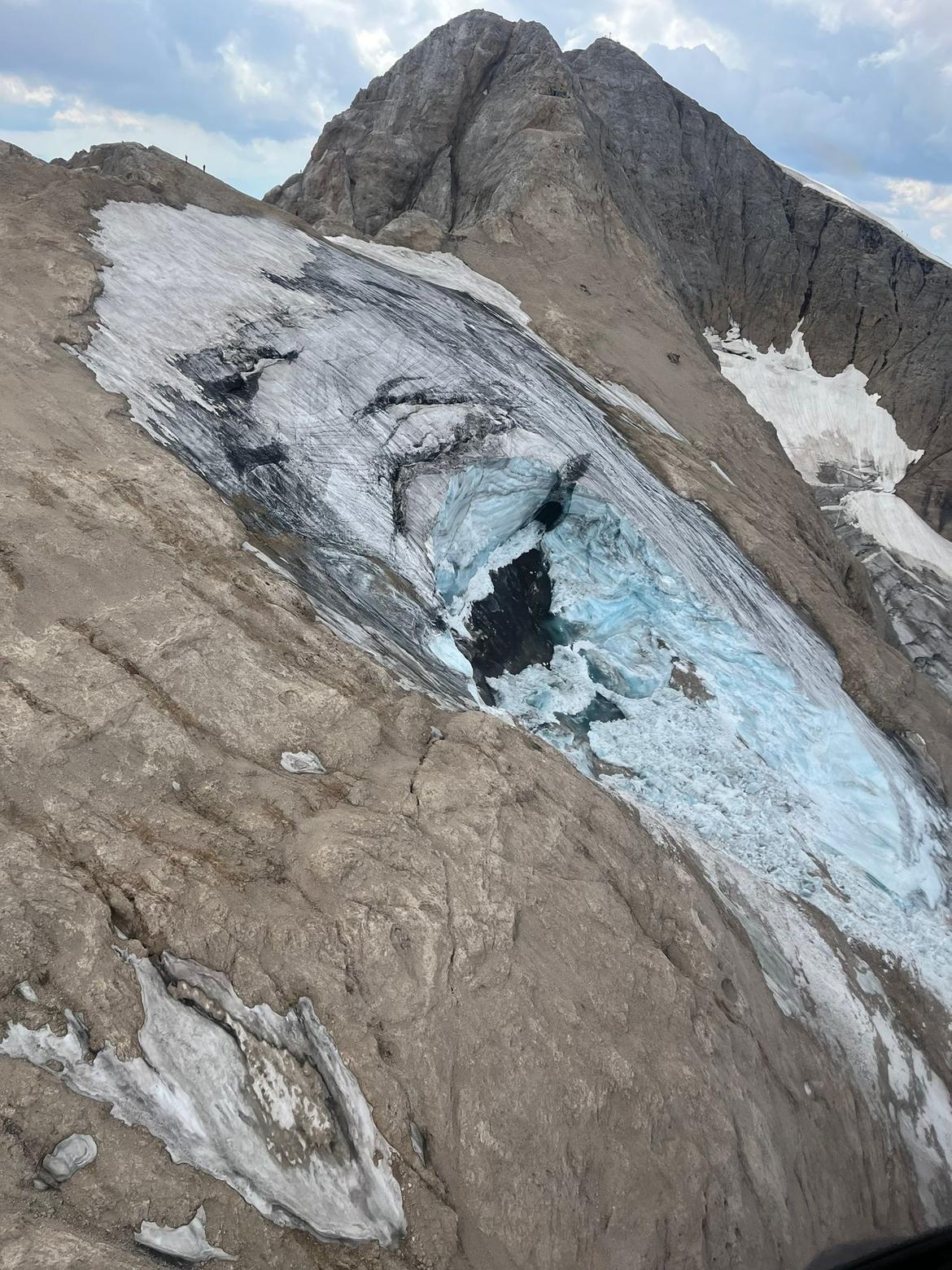
Remnants of the 600-foot-wide Marmolada glacier in the Dolomites, Italy, after the 3 July, 2022, collapse that killed 11 mountaineers. Credit: Provincia autonoma di Trento via Wikimedia Commons
.jpg)
Featured Research
Climate change primed Italian glacier for fatal 2022 collapse
On 3 July, 2022, ice collapsing from the Marmolada glacier in the Dolomites killed 11 mountaineers. A new study finds that unusually high temperatures in May and June weakened the ice and caused meltwater to build up under the glacier, which helped connect existing cracks to carve off a chunk of ice the size of 25 Olympic swimming pools. Researchers warn that climate change will weaken other glaciers, putting mountaineers and alpine communities at greater risk as temperatures rise. [Geophysical Research Letters study]
- See also: Post-Collapse Ice Cliff Backwasting at the Marmolada Glacier Observed by Terrestrial Radar Interferometry [JGR Earth Surface study]
- See also: Briton survives huge avalanche – and he filmed it [Sky News YouTube video]
In a changing climate, too much rain threatens India’s monsoon crops
Seasonal monsoon rains are critical to agricultural productivity in India, delivering 80% of annual rainfall. But too much rain can be equally bad, particularly if it arrives in high intensity bursts, waterlogging crops and washing away nutrients. Monsoon rains are becoming increasingly erratic as the climate warms, shifting where and when rain falls, with more episodes of heavy rain. Modeling based on three decades of crop yields in India predicts yield declines in staple monsoon crops like cotton and soybean. Peanut, pearl millet and sorghum yields rise until they hit an optimum rain threshold around 2040, then sharply decline. Farmers will need region-specific solutions including resilient crop varieties, drainage and optimized sowing schedules to adapt to future monsoons. [Earth’s Future study]
Expanding forests may worsen water stress in arid China
More than any other factor, forest growth in China reduced river flows from 1980 to 2020 in over 50 watersheds as forests expanded in many regions due to climate change and tree-planting efforts, according to a review of research. Trees draw water up through their roots and release it through their leaves, cooling the air and reducing flood risks but leaving less water for human use. This effect is strongest during the growing season, when plants guzzle the most water. New model simulations further showed that between 1980 and 2020, tree water uptake worsened water losses from climate change in over 130 Chinese water basins, impacting at least 17 basins even more than climate change itself. To balance water conservation with forest growth goals in water-stressed regions amid climate change, solutions may include prescribed burning, plantation thinning, and focusing on native tree restoration. [Water Resources Research study]
Antarctic changes are slowing down global ocean circulation
New research shows the deepest layer of the Southern Ocean is shrinking faster than scientists realized, losing 3% of its volume in the waters nearest the pole between 2002 and 2023. This cold, dense Antarctic Bottom Water fills 40% of Earth’s oceans, driving currents and regulating climate as it flows off the seafloor shelf around Antarctica into other ocean basins. The rate of shrinking has quadrupled from 2002 to 2015, which researchers suggest could be linked to the rapid decline in Antarctic sea ice since 2016. [Australian Antarctic Program Partnership press release] [Geophysical Research Letters study]
Deer to blame for half of wild ruminants’ methane emissions
The digestive workings of ruminants — wild animals like deer, moose and llamas that ferment fibrous plants in their guts — create perfect conditions for bacteria to brew methane. A new study combining up-to-date estimates of global animal populations and gut gassiness found that the world’s wild ruminants contribute 3 million tons of methane to the atmosphere per year (around 38 times less than livestock) with more than 50% of global ruminant emissions coming from just six species of deer. [JGR Biogeosciences study]
Patterned frozen soils get their shape from gravity and funky physics
An enigmatic feature of frozen soils can be explained in part by non-Newtonian fluid physics. Enter the Oobleck. [Eos Research Spotlight] [AGU Advances study]