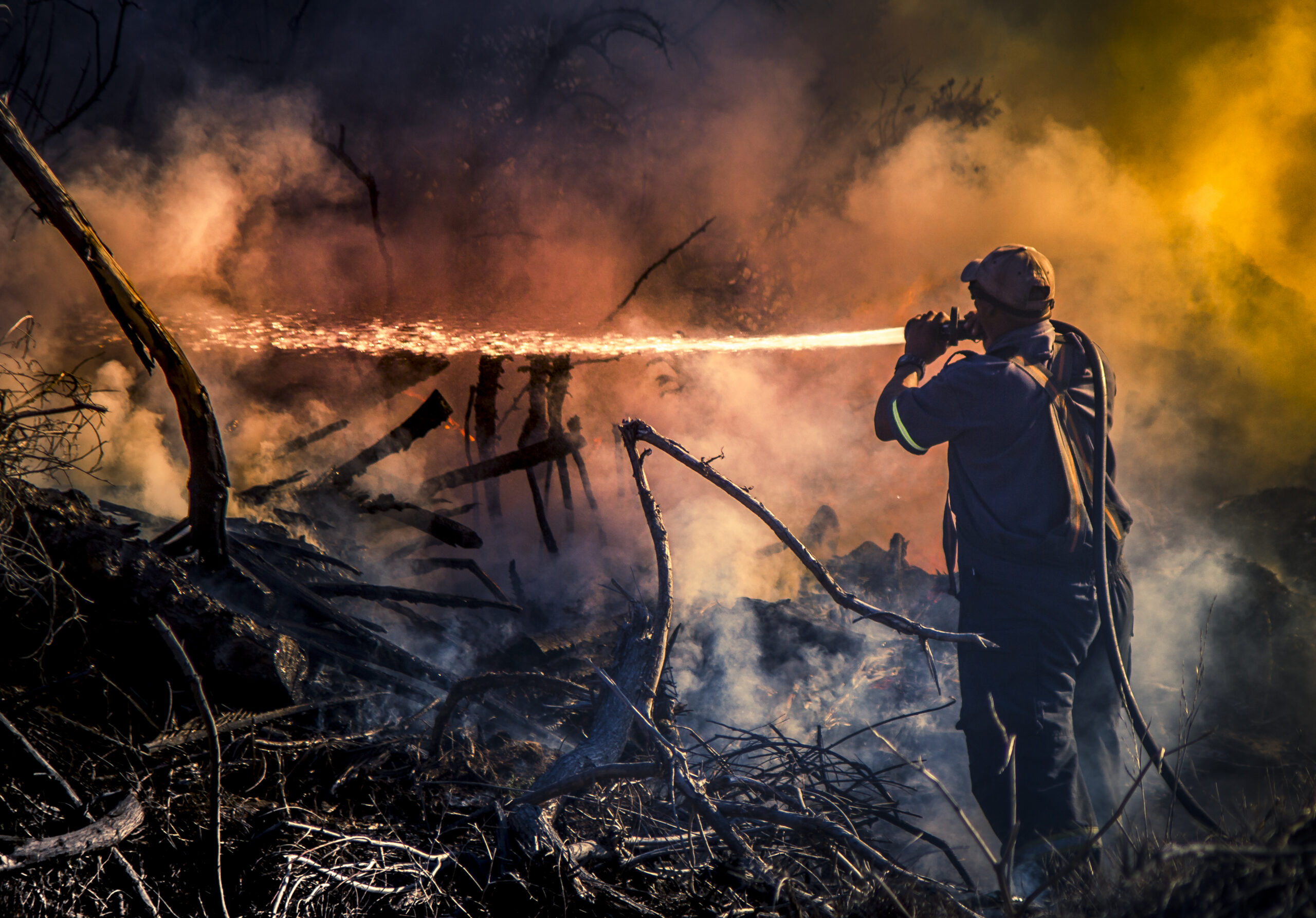
A firefighter battling a 2017 grassland fire near Cape Town, South Africa. As the dry season across Africa shortens, wildfire-burned area is decreasing each year in both of the continent’s hemispheric regions. Credit: StevenTerblanche on Wikimedia Commons.

Featured Research
As Africa’s dry season shortens, its wildfires burn less widely
Since 1990, Africa’s dry season has shortened enough that its wildfires burn millions of acres less land each year. The dry season’s arrival has lagged by roughly 1.75 days per decade from 1990 to now in the northern hemisphere and by 0.4 days per decade in the southern, with increased rainfall at the start of the dry season keeping plants and soils wetter for longer. Understanding how shifts in rainfall timing affect wildfires can help improve fire prediction and management efforts in the context of climate change, researchers say. [Geophysical Research Letters study]
Electrification and energy efficiency could cool L.A. streets by 0.65 degrees Celsius
In the densest urban areas of Los Angeles, vehicles, buildings and human bodies generate enough heat to make their surroundings more than 4 degrees Celsius hotter. A new study projects that initiatives like switching to electric cars and making buildings more energy efficient would cool the city by 0.65 C on summer days. With cars contributing around half of Los Angeles’ current heat emissions, widespread electric vehicle adoption could help cool neighborhoods near highways as much as 0.95°C, reducing the public health threat of heat in the city. [JGR Atmospheres study]
If you live in the US, your rain may come from farther away than it used to
In watersheds of the Southwest and southern Great Plains of the United States, moisture in the atmosphere now travels from 30 to 50 miles farther away than it did 35 years ago before finally falling as rain, lingering in the sky an extra two to four hours. A greater portion of that rain now also originates from evaporation over the oceans, rather than over land. As the climate warms, the atmosphere can hold more water vapor for longer periods. Understanding changes in how water moves through the sky can help us understand where and how much of that water will become available for human use, researchers say. [Geophysical Research Letters study] [University of Wyoming press release]
Mine waste can boost wetland carbon storage
In the six years following a mining industry environmental disaster impacting Brazil’s Rio Doce estuary, researchers have found a silver lining — the soil in Rio Doce is changing, shifting towards minerals that hold onto carbon for longer. In 2017, the collapse of the Fundão dam unleashed the equivalent of 380,000 truckloads of iron-rich mine waste into waterways. Since then, researchers observed a 61% increase in carbon stably bonded to iron and a 25% increase in carbon trapped in other longer-lasting minerals. The researchers suggest that carefully managed addition of iron during wetland restoration projects could help other estuaries securely lock away more carbon in their soils. [JGR Biogeosciences study]
Coastal towns with eroding beaches may need to move inland sooner than thought
Rising seas and worsening storms have led many coastal communities to start adding sand to their eroding beaches, a strategy called “beach nourishment.” But this may only delay the inevitable. A case study of Hutchinson Island, Florida concluded that eventually retreating inland is the only way to meet criteria the U.S. Army Corps of Engineers commonly uses when funding beach nourishment projects. Balancing goals like maintaining recreational opportunities and mitigating housing damage could require Hutchinson Island residents to move inland in roughly fifty years — a few decades sooner than most studies would recommend, as the authors say previous research doesn’t fully account for uncertainties in how environmental and economic forces will change in that time. [Earth’s Future study]
Students enable widespread water monitoring in India
High school students and other volunteers monitored water for pollutants just as well as professionals. [Eos research spotlight] [Community Science study]
Making weather and climate information reach the communities that need it
Many at-risk communities remain unreached by forecasts due to barriers in language, access, and trust in information systems. A new study looks at how to overcome these. [Eos editors’ highlight] [Community Science study]