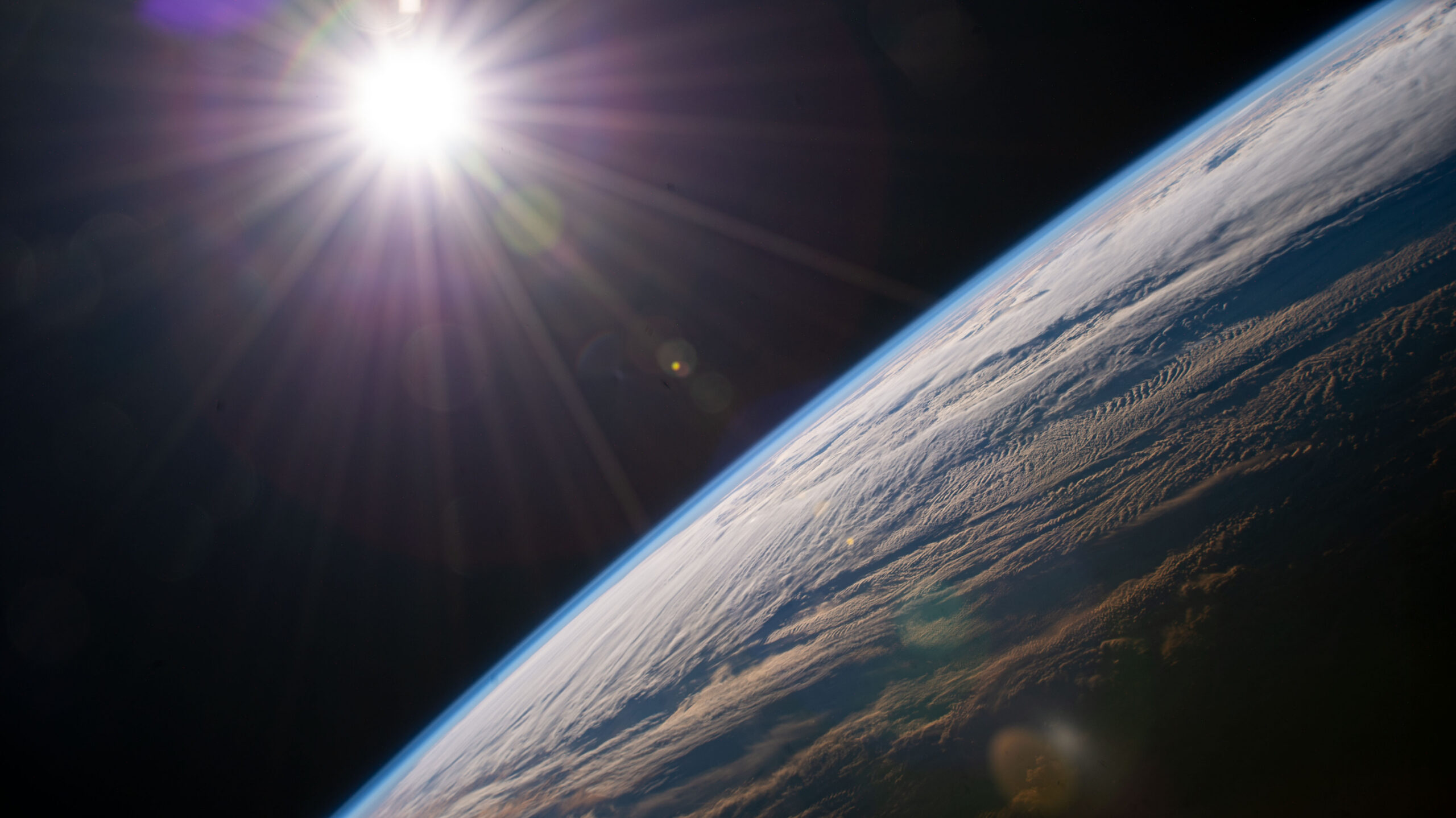
The sun will eventually grow too bright for Earthly life to persist, but exactly when remains uncertain. A new study suggests the limit may lie hundreds of millions of years farther down the road than earlier research estimated. Credit: NASA
AGU News
AGU opposes rule that would rewrite the terms of US Science
Last week, the U.S. Office of Management and Budget proposed a federal rule that would embed political control into the rules governing federal research funding in the United States. If finalized as written, this rule would give political appointees veto power over peer review, allow the government to cancel active grants mid-project with minimal justification, ban entire categories of science from federal funding, and restrict researchers’ ability to publish their work and attend scientific conferences. AGU President Brandon Jones urges the AGU community to submit a comment through AGU’s Action Center before 13 July. [video statement on YouTube] [written statement From the Prow] [AGU Action Center comment submission page]
Featured Research
Life on Earth could last hundreds of millions of years longer than once thought
As the sun steadily brightens with age, life on Earth will eventually end. Either the planet will get too hot for life, or the rising heat will increase the rate at which it stores CO2 in carbonate rocks — reducing the greenhouse effect but leaving plants too little CO2 for photosynthesis, effectively ending life anyway. Previous studies of the second scenario estimated life has another 1.35 billion years to go. But new model simulations of future climate scenarios indicate it could last up to 1.8 billion years from now, since some photosynthetic life may thrive even at low CO2 levels. In this case, life will last about as long as Earth’s oceans, which will eventually be lost to space as the brightening sun heats the planet. [JGR Atmospheres study]
Restoring peatlands can reduce fires, Indonesia’s efforts show
After draining and deforestation paved the way for widespread peatland wildfires in 2015, efforts to restore Indonesia’s peatlands may be paying off. Damming canals and pumping in groundwater to re-wet the land resulted in 2.6 fewer fires per square kilometer (6.7 per square mile) in restored peatlands than in unrestored ones in 2019, based on satellite measurements. Though climate also played a role, researchers estimated those efforts contributed 38% of the drop in fires across over 3,900 square kilometers (1,500 square miles) of restored peatland between 2015 and 2019 — both El Niño years, which tend to make Indonesia drier. The results show restoration should remain a priority, the researchers wrote, though climate variability may render its benefits invisible in some El Niño years, such as 2023. [Geophysical Research Letters study]
Young, planted forests gobble CO2 to get leafy fast, potentially helping climate
Across China, planted forests upped their leaf area about 66% faster than natural forests from 2000 to 2022, according to satellite data and machine learning analysis. Even when comparing forests of similar age and growing conditions, planted forests got leafier 4.6% faster nationally, with an even greater difference in mixed and evergreen forests. That’s partly because those planted forests are younger and respond more strongly to rising CO2 levels in the atmosphere, using it to grow more vigorously. Although natural forests start outpacing planted ones once the latter hit around 40 years of age, researchers said the results still highlight how planted forests can help absorb CO2 to support climate action. [Geophysical Research Letters study]
El Chichón and Pinatubo volcanic eruptions slowed sea ice loss
Arctic sea ice has been shrinking over the past four decades, but after 2000, the retreat sped up abruptly. Sunlight-blocking aerosols from the 1982 El Chichón and 1991 Pinatubo eruptions counteracted the ice-melting effect of greenhouse gases during the 80s and 90s; if the volcanoes had not erupted, ice would have diminished 1.5 times faster before the turn of the millennium. Climate models accounting for both human and natural influences predict the arrival of ice-free Arctic summers decades earlier than those that only incorporate human emissions, around 2049 if greenhouse gas emissions continue at current levels. This timeframe generally agrees with estimates based on sea ice thickness. [Geophysical Research Letters study]
In some cases, hurricanes may help salt marshes withstand sea level rise
In 2017, Hurricane Irma dumped up to eight centimeters of new sediment in some coastal salt marshes, according to an analysis of 37 sites across four marshes tucked behind barrier islands from Florida to South Carolina. The finding suggests that although storms often erode salt marshes, they can also — under the right conditions of exposure, location and wind and wave strength — help build them back up. When this occurs, it makes salt marshes more resilient to sea level rise, which can kill off salt marsh plants via long periods of inundation. [JGR Earth Surface study]
Mangroves may be losing their grip on carbon storage as sea levels rise
Locally, mangroves can sometimes adapt to rising seas, but global trends look troubling. [Eos research spotlight] [Earth’s Future study]
Rocket launches and reentries harm Earth’s ozone layer
Solid-state fuels—recently used to help launch astronauts to the Moon for the first time in decades—appear to be the fuel type with the most detrimental effects on the ozone. [Eos research spotlight] [Earth’s Future study]