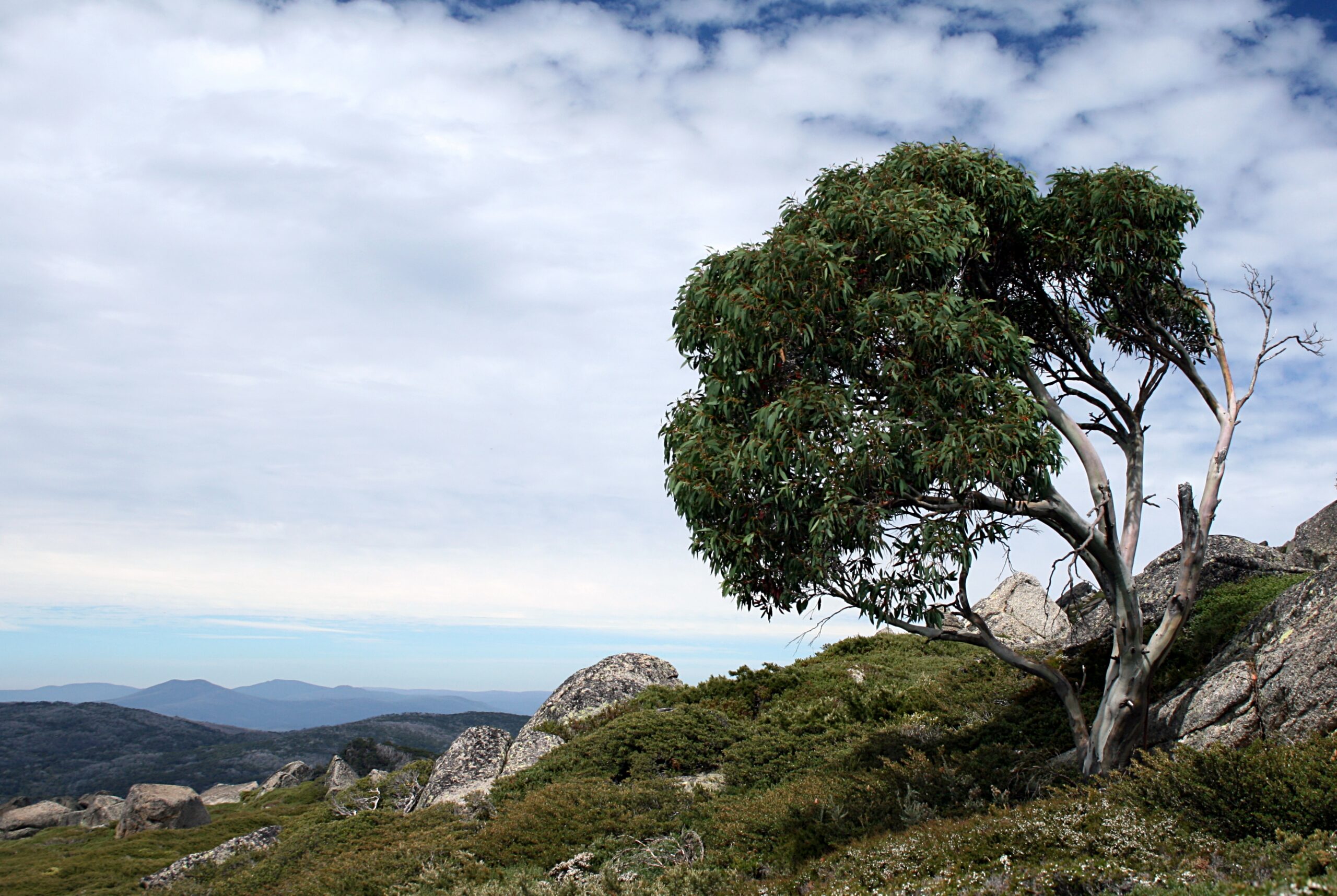
A lone snow gum tree (Eucalyptus pauciflora) in New South Wales, Australia. Wood-boring beetle infestations have caused dieback of snow gum forests across the Australian Alps. Credit: Toby Hudson on Wikimedia Commons

Featured Research
Heatwave research roundup:
- Can AI predict rare ‘butterfly effect’ weather events? [JGR Machine Learning and Computation study]
- Extreme temperatures: prediction vs. observation [JGR Atmospheres study]
- Unprecedented Europe heat in June–July 2019: Risk in the historical and future context [Geophysical Research Letters study]
- Heat Waves: Physical Understanding and Scientific Challenges [Reviews of Geophysics review]
Changing climate may bring more big floods to eastern US
When intense rain falls over a large area all at once, flash floods in multiple catchments can combine into dangerous incidents like the 2023 Vermont floods, 2024 Hurricane Helene floods and 2024 Kentucky floods. In the contiguous United States, most extreme rainfall increasingly occurs during rare, larger-scale events rather than more common smaller events. In the eastern U.S., large events are also becoming more frequent, suggesting the region should prepare for outsized future flooding in the years ahead. [Geophysical Research Letters study]
Texas’ flooding risks rise with climate change, especially for roads and railways
By area, 25% of the U.S. state of Texas is already highly flood-prone. As new risk maps based on high-res models reveal, that 25% also contains half the state’s roads and railways and 80% of its bridges. By 2100, climate change alone could grow that high-risk area by 10% to 12%, exposing up to 15% more of Texas’ transportation infrastructure to severe flooding — even without accounting for future construction there. Since economies and emergency services depend on roads and railways, flood damage to transportation can hit especially hard. The researchers also note that existing regulatory maps, including FEMA’s, don’t capture major flood risks in rapidly urbanizing zones, underscoring the need for forward-looking disaster planning. [Earth’s Future study]
Beetle-infested snow gum trees let loose potentially climate-altering compounds
When infested with wood-boring beetle larvae, snow gum tree trunks in the Australian Alps release a resin that gives off chemicals known as volatile organic compounds — seven times more so than when not infested. Given the beetles’ ongoing spread through the mountains’ snow gum forests, that could have implications for the region’s climate, researchers say: volatile organic compounds influence atmospheric chemistry in ways that can promote cloud formation, sunlight reflectivity, and wildfire risk. [JGR Biogeosciences study]
Low-wind, low-sun ‘energy droughts’ challenge renewables in some regions
Rising adoption of solar and wind power have successfully averted the IPCC’s worst-case-scenario future, but not all regions have equally favorable weather conditions for renewables. A warming climate may exacerbate disparities by contributing to more days when low winds and minimal sunshine cause energy prices to spike. In densely populated southwestern China, already-limited renewable energy resources and low income levels make the region particularly vulnerable to this combination of extreme lows. Planning and investment are needed to offset the burden on less wealthy populations. [Earth’s Future study]
This swirling ocean eddy shares food with its neighbors
On a research cruise in the Mediterranean Sea, scientists discovered an odd phenomenon around a swirling eddy. The eddy sucks low-nutrient surface water down below the reach of sunlight, concentrating those few nutrients within itself without sending many back up. Instead, it then pushes those nutrients out towards its edges — meaning the most nutrient-poor waters the team encountered in fact house a hidden relay system for gifting nutrients to neighboring waters. Small-scale currents like these abound in the oceans, raising questions about how they might shape the distribution of nutrients at the base of marine food webs on larger scales, too. [Geophysical Research Letters study]
Solar storms can affect Earth’s weather. A new study examines how.
New findings could help narrow down the mechanisms by which solar activity influences our weather. [Eos research spotlight] [Geophysical Research Letters study]
Where methane is emitted matters for global burden
Methane emitted at higher latitude regions (Europe) tends to stay in the atmosphere longer, contributing to higher global concentrations than other regions (Asia, North America). [Eos editors’ highlight] [JGR Atmospheres study]