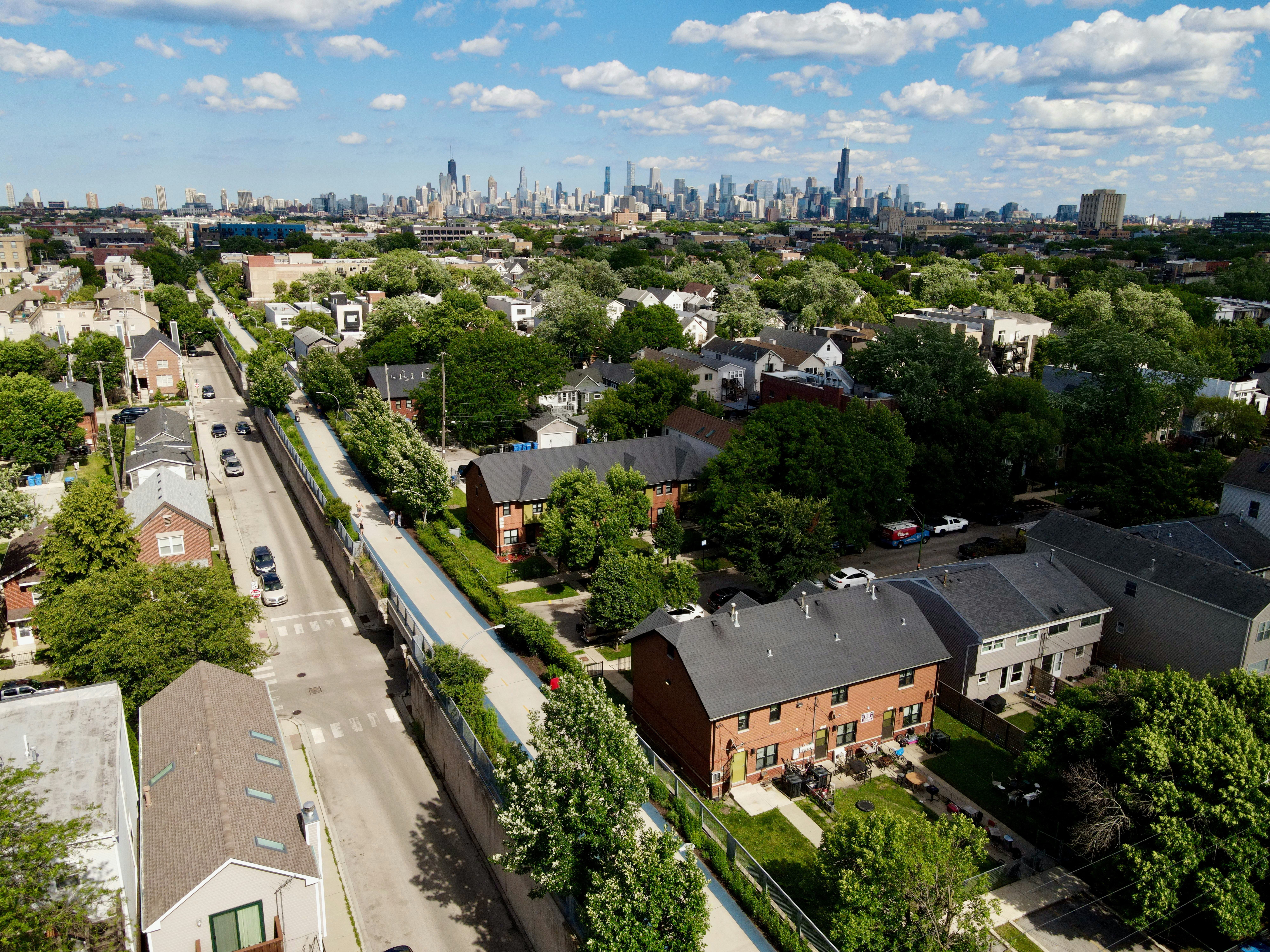
A leafy neighborhood in Chicago, looking towards the city. A new study has found that neighborhoods with growing canopy cover see fewer annual deaths from a wide range of diseases compared to neighborhoods where tree cover is shrinking over time. Credit: Shep McAllister on Unsplash.
Featured Research
Tree canopy losses associated with mortality in Chicago
Death rates drop in Chicago neighborhoods where tree cover expands year-to-year and rise in those where it declines, including from heart, lung, musculoskeletal and mental health diseases. Researchers estimate that growing the city’s canopy by 0.03% (about 14,000 trees) per year would be associated with 105 fewer annual deaths, with hotter neighborhoods benefiting the most from added tree cover — though, they note, the study did not prove a direct causal link between canopy changes and mortality. Crucially, the team found that the total amount of canopy at any given time appears less important than how much the canopy changed over the 2011 to 2021 study period: in the hottest neighborhoods, on Chicago’s South and West sides, mortality rose as canopy fell despite a relatively high baseline of tree cover. [GeoHealth study] [Northwestern University press release]
In heat and drought, planted and natural forests may be stronger together than alone
When extreme heat and drought both struck the Yangtze River Basin at once in 2022, the region’s forests didn’t all react the same way. In most areas, human-planted forests took hard hits during the extreme event but bounced back quickly the following year, while their natural counterparts suffered less but took longer to return to full health. The more extreme the conditions, researchers noticed, the greater the difference: natural forests’ superior height, mass and diversity granted resilience upfront, while planted forests’ youth conferred recovery potential. Managing forests to maintain the diversity found in natural areas, rather than planting monocultures, may capture the best of both worlds as climate change continues, the researchers write. [Water Resources Research study]
Warming helps Arctic plants in the early season but hurts them down the road
High temperatures tend to boost Arctic plant growth early in the growing season but stifle it later in the year if heat and dry soils persist, according to a recent study of Arctic ecosystem productivity between 2000 and 2022. Although regional and interannual differences exist, the researchers wrote, the overall pattern makes taiga and tundra more vulnerable and weakens their carbon storage abilities as climate change warms the Arctic at a disproportionate rate. [Geophysical Research Letters study]
Storms erode a New Jersey beach twice as often as 47 years ago
At a beach in Sandy Hook, New Jersey, U.S.A, storms large enough to eat away over 86 square feet of beach area in 48 hours now happen two to three times a year, up from one or two times a year in the late ‘70s. Researchers on the beach used radar to find buried layers of coarse sand, shells and pebbles — evidence of erosive storms from 2009 to 2019 — then ran simulations to see what kind of storm conditions likely produced those layers and how common those conditions have gotten over time. The team hopes their method can help other coastlines unpack their storm histories to improve beach management as strengthening storms and rising sea levels stress coastal communities. [Earth’s Future study] [Rutgers University press release]
Sand and gravel mining consumes riverbeds to feed global concrete appetite
In 2024, the world turned about 28 billion metric tons of sand and gravel — by far the most-mined solid materials on Earth — into concrete. Urbanization, population growth and infrastructure development have driven demand above the capacity of natural systems to replenish the resource, according to a new review that digs into where mining is happening and its social and environmental consequences. Taking too much risks riverbanks collapsing, water quality degrading, groundwater levels dropping and salt water intruding into coastal waterways. Though demand is global, China and India currently consume the most and extraction is most intensive in Asia and Africa. [Reviews of Geophysics review] [Eos Editor’s Vox] [Nanyang Technological University press release]
How Water Flows Toward Cities During Hurricanes
Topography is a key factor exacerbating compound flooding, while coastal wetlands help protect cities. [Eos Research Spotlight] [Geophysical Research Letters study]
How Does Social Vulnerability Evolve After a Tropical Cyclone?
An initial rise in the social vulnerability index is followed by a decrease, but that decrease comes with a catch. [Eos Research Spotlight] [GeoHealth study]