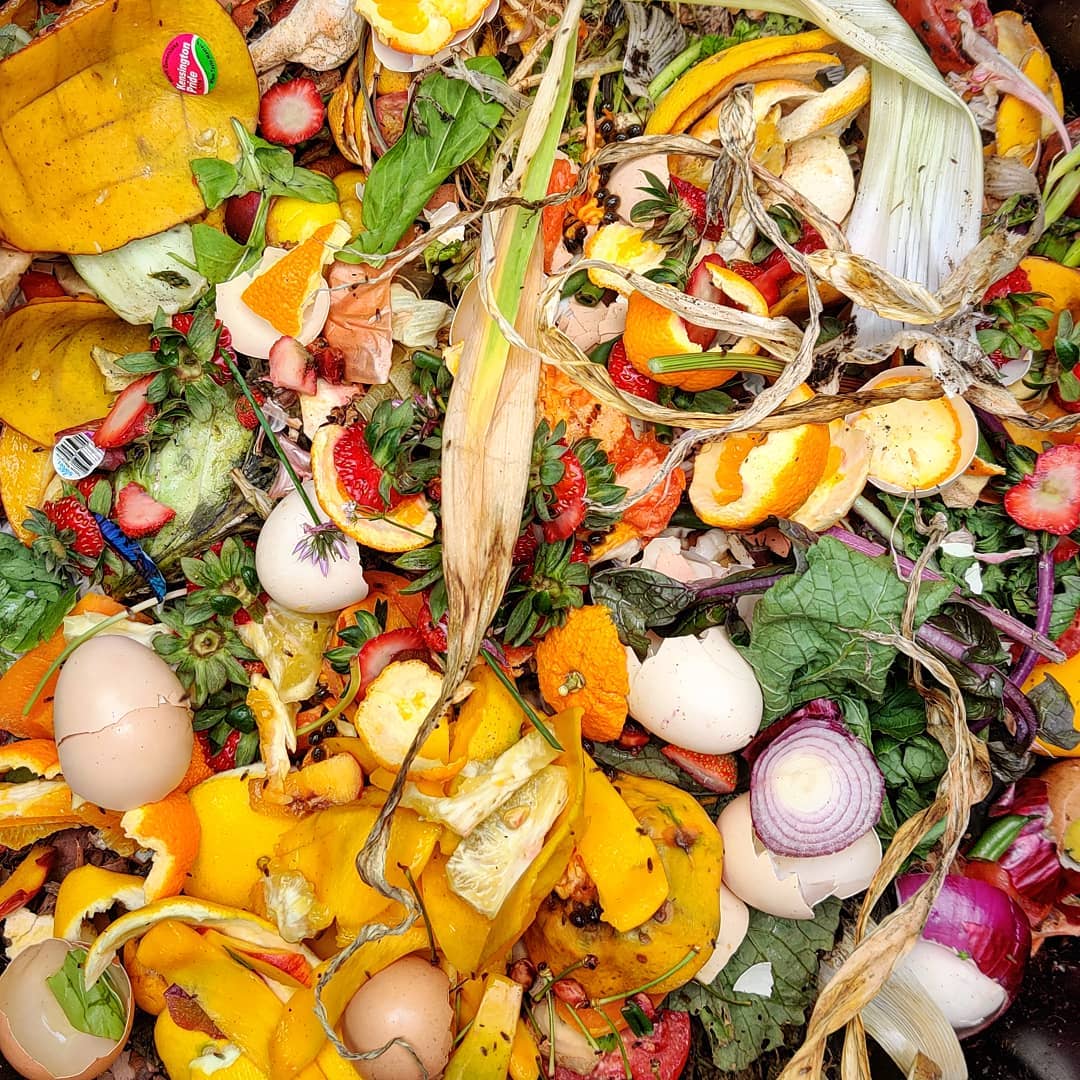
Most food waste in the U.S. goes to landfills, where its decomposition contributes nearly 10% of the nation’s emissions of methane, a greenhouse gas more potent than carbon dioxide. Credit: Niwrat on Wikimedia Commons

Featured Research
Keeping food scraps out of landfills could reduce US methane emissions by 6%
Food and yard waste sent to rot in landfills contributes almost 10% of the U.S.’s annual methane emissions. A new study finds that reducing that waste by 75% through interventions like donating edible food, processing waste in specialized digestion facilities, and composting could cut total methane emissions by 6% — equivalent to 30 megatons of carbon dioxide per year, or 5% of total U.S. agricultural carbon emissions in 2022. Currently, only 13.5% of food waste stays out of landfills. Researchers note that increasing this percentage by a factor of five will require major nationwide investment in composting facilities, curbside compost collection and public awareness of how to reduce and dispose of food waste. [Earth’s Future study]
Warming climate will intensify sudden rainstorms in tropical cities
A new study projects that intense rainfall events lasting less than an hour in tropical cities will hit two to three times more often and deliver up to 17% more water by 2100 under 4.5 degrees Celsius of warming. This cloudburst-style rainfall can trigger flash floods and other hazards, especially in cities where paved surfaces and buildings prevent water from infiltrating into the ground. Researchers recommend that tropical cities build pipes and flood infrastructure to withstand more extreme conditions, particularly across Asia and Africa, where 90% of population growth by the end of the century is expected to occur. [Earth’s Future study]
The abyssal ocean is warming 3.7 times faster than 40 years ago
In the abyssal zone below 13,100 feet (4,000 meters), the ocean’s heat absorption increased from 5.4 terrawatts in 1988 to 20.2 terrawatts — about 1,600 times the heat used to keep all U.S. homes warm each year — in 2018. The finding comes from a new study using the largest-ever set of ocean temperature measurements by depth. To date, Earth’s oceans have absorbed 90% of the excess heat from human-caused climate change. Understanding how that heat is distributed throughout the oceans’ 352 quintillion gallons of water helps scientists monitor changes in ocean circulation and sea level rise resulting from climate warming. [Geophysical Research Letters study]
- See also: The layer of cold, deep water around Antarctica is shrinking [Geophysical Research Letters study]
Extreme flooding on land helps coastal waters sequester carbon
During extreme flood years, 30% to 40% more organic carbon got buried in sediments in the coastal East China Sea than during normal years, according to a new study of a three-century sediment record from the Sea’s inner shelf. Floods wash nutrients and carbon from the land down the Yangtze River to the sea, feeding blooms of phytoplankton, which take up carbon dioxide into their bodies as they photosynthesize. On geologic timescales, this helps lock away carbon dioxide as phytoplankton bodies and droppings sink to the seafloor. Scientists expect extreme flooding events to intensify under climate change, meaning coastal seas may play a stronger role in global carbon sequestration. [Paleoceanography and Paleoclimatology study]
Alaskan fjords fossilize 3,000 years of storms
Alaska’s Aleutian Islands are famed for their savage storms — but the most intense ones likely occur less often today than in the past. A new study dug up 60 feet of sediment from the bottom of the Skan Bay fjord to look back on three millennia of fossilized storms preserved by tiny variations in the sizes of mud and silt particles. The 56 storms recorded in the rock suggest that intense storms were seven times more frequent during the 750 – 1250 A.D. Medieval Climate Anomaly — a window of warmer, drier climate in Europe and North America — and have been on the decline in the thousand years since. Scientists use “paleotempestual” records like this to understand how larger climate trends impact storm frequencies, helping to make climate change projections more accurate. [Paleoceanography and Paleoclimatology study]
Many Americans underestimate health risks of extreme weather, new study finds
The research examines the “risk perception gap,” or the difference between climate-related mortality estimates and public perceptions of climate risk, across U.S. counties. [Eos research spotlight] [GeoHealth study]
Super-Earths may be solid deep inside their mantles
New estimates show that a mineral likely common in these rocky planets’ interiors is resistant to melting, even at high temperatures. [Eos research spotlight] [AGU Advances study]