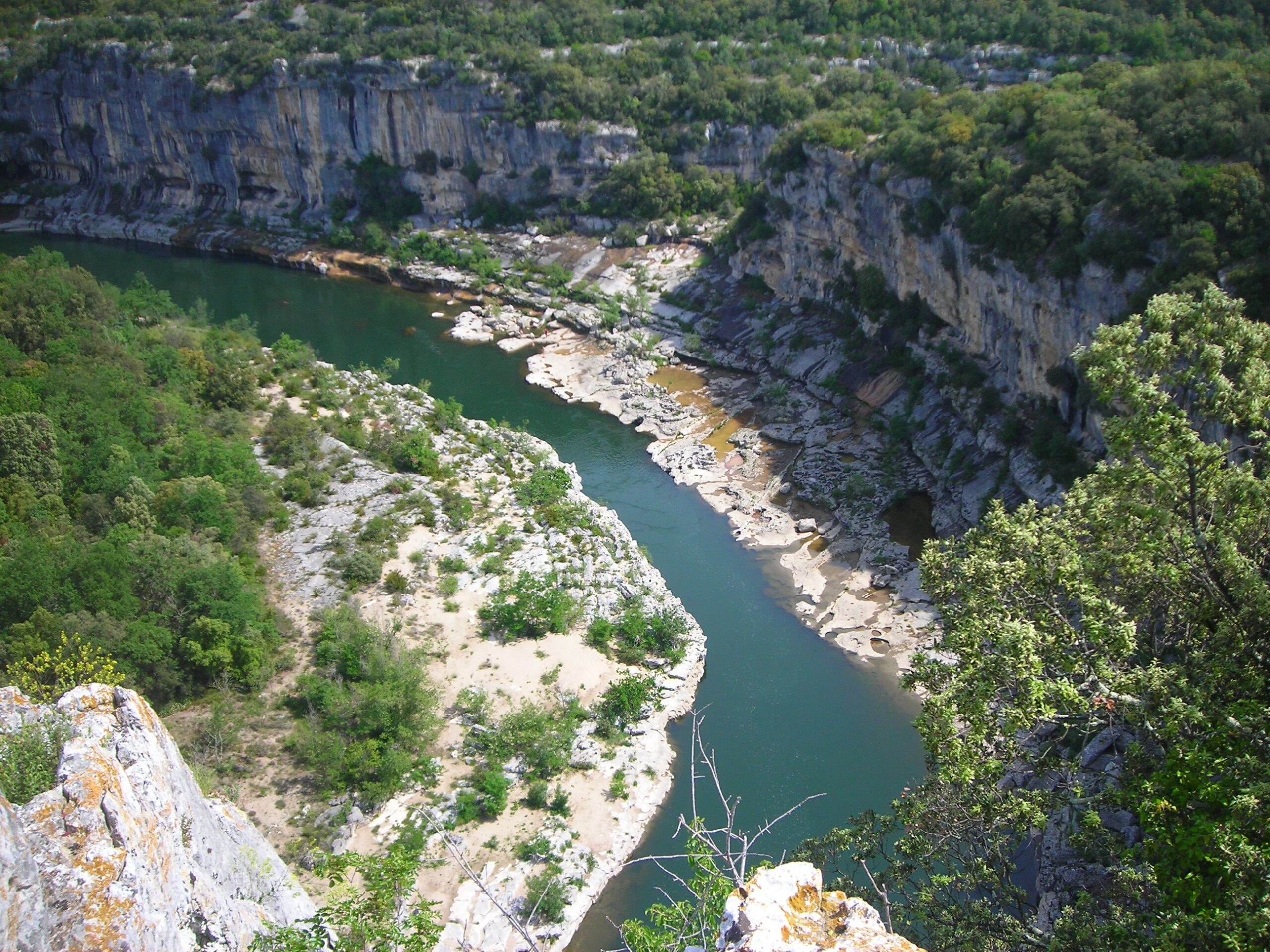
A river flowing through a canyon in the south of France. A new study looking at trends in river flows and precipitation between 1951 and 2020 finds that some rivers levels are falling despite overall increases in rainfall. Credit: steinchen on Pixabay.
AGU News
Press registration is open for 2026 AGU Annual Meeting
Press registration is now open for AGU’s 2026 annual meeting in San Francisco, California, convening 7 to 11 December 2026 at the George R. Moscone Convention Center. Staff, freelance and student journalists are eligible to apply for complimentary press registration until the end of the conference on Friday, 11 December. Press officers and institutional writers covering the meeting are also eligible for press registration.
- REGISTER AS PRESS HERE
- Additional information for press can be found in the conference Press Center.
- Learn about press eligibility requirements.
Featured Research
Rivers losing flow despite receiving more water
A new study charting global flows and precipitation in over 10,000 rivers from 1951 to 2020 has found that 27% have flow trends that don’t match up with how much water they receive from snow and rainfall. 40% of these mismatched rivers get more precipitation now than they did 70 years ago yet are still trending towards lower water levels. Researchers suggest this mismatch may be more common in regions where more water evaporates back into the atmosphere after rainfall and where rainfall extremes are getting more frequent. Understanding what factors besides rainfall control these rivers’ flows will be crucial for predicting future water availability in a changing climate. [Geophysical Research Letters study]
New study finds tighter limits on life beneath the ocean floor
Scientists have long suggested that billions of tons of microbes inhabit cracks and crevices in rock for miles below ground. However, a new study suggests this may be an overestimate, particularly under the oceans. Researchers stitched together global measurements of the temperature gradients in Earth’s crust to find the total area potentially suitable for microbes, which have only been observed to survive up to 122 degrees Celsius. This limit occurs roughly 3 miles (5 kilometers) below land and 1.2 miles (2 kilometers) below the seafloor. This, combined with the biological limits of underground pressure, indicates there could be 5 to 15 times less microbial mass beneath the oceans than previously estimated. [JGR Machine Learning & Computation study]
Waves can supplement — or steal — energy in offshore wind farms
A new study has found that friction between wind and waves can increase or decrease wind speeds at offshore wind turbines by up to 6%, changing a wind farm’s power output. By simulating wave-wind interactions for turbines off the coast of Brazil, researchers found that high wind speeds create choppy seas that increase the water’s drag on the air above, slowing wind down at the height of turbine blades. On the other hand, powerful ocean swells can give the wind a boost from below, increasing potential power output. As offshore wind becomes a larger part of global power production, accurately predicting fluctuations in sea breezes for each wind farm will be key to managing energy supplies around the world. [JGR Oceans study]
Artificially reducing ocean acidity might not lead to long-term carbon storage
A new study finds that between 18 and 59% of the carbon that would be trapped by adding alkalis, substances that can consume acids, to the ocean could leak back out again by the year 10,000. Adding alkalis like quicklime or lye to the oceans would reduce the acidity of seawater, making it easier for carbon-trapping minerals to form and sink to the bottom. Scientists have proposed this could help achieve carbon neutrality by storing carbon on the seafloor for tens of thousands of years. A new study simulated 8,000 years of ocean evolution after adding five billion tons of slake lime per year — the same mass as about 11 Empire State buildings — from 2020 to 2070. Researchers find that adding alkalis could initially bring down atmospheric CO2, but the formation of carbon-trapping minerals would use up the alkalinity after a couple of hundred years, ultimately re-releasing some of the stored CO2. [Global Biogeochemical Cycles study]
The ocean has been “breathing” increasingly heavily over the past four decades
The ocean both absorbs carbon dioxide from the atmosphere and releases it back again in a kind of “breathing” pattern. But according to observations spanning 1982 to 2022, unusually deep inhalations and exhalations (ranking among the strongest 10% of such events from 1982 to 2011) have become more common and intense. While extreme carbon uptake events have gotten more frequent by 1.22 days per decade since 1982, extreme releases of carbon have risen nearly twice as fast, at 2.23 days per decade. Researchers say changes in sea surface temperature are the biggest factor driving these extreme “breaths” and project further increases under strong future warming scenarios. [JGR Atmospheres study]
Four in Five Researchers Report Harmful Interactions During Geoscience Fieldwork. A New Survey Suggests a Path Forward.
A new survey documents the prevalence of harmful interactions that occur during fieldwork. Many instances go officially unreported. [Eos research spotlight] [AGU Advances study]
Tiny Cyanobacteria May Be the Secret Heroes of Ocean Carbon Sequestration
Even when larger phytoplankton produce more carbon, much of it is lost on the journey to the ocean floor. [Eos research spotlight] [AGU Advances study]
Extreme Equatorial Storms are Larger and More Persistent Under Warming
Extreme storms in the tropical regions are expanding and becoming more persistent with climate warming, resulting in higher storm rainfall volumes while peak intensity remains unchanged. [Eos editors’ highlight] [AGU Advances study]