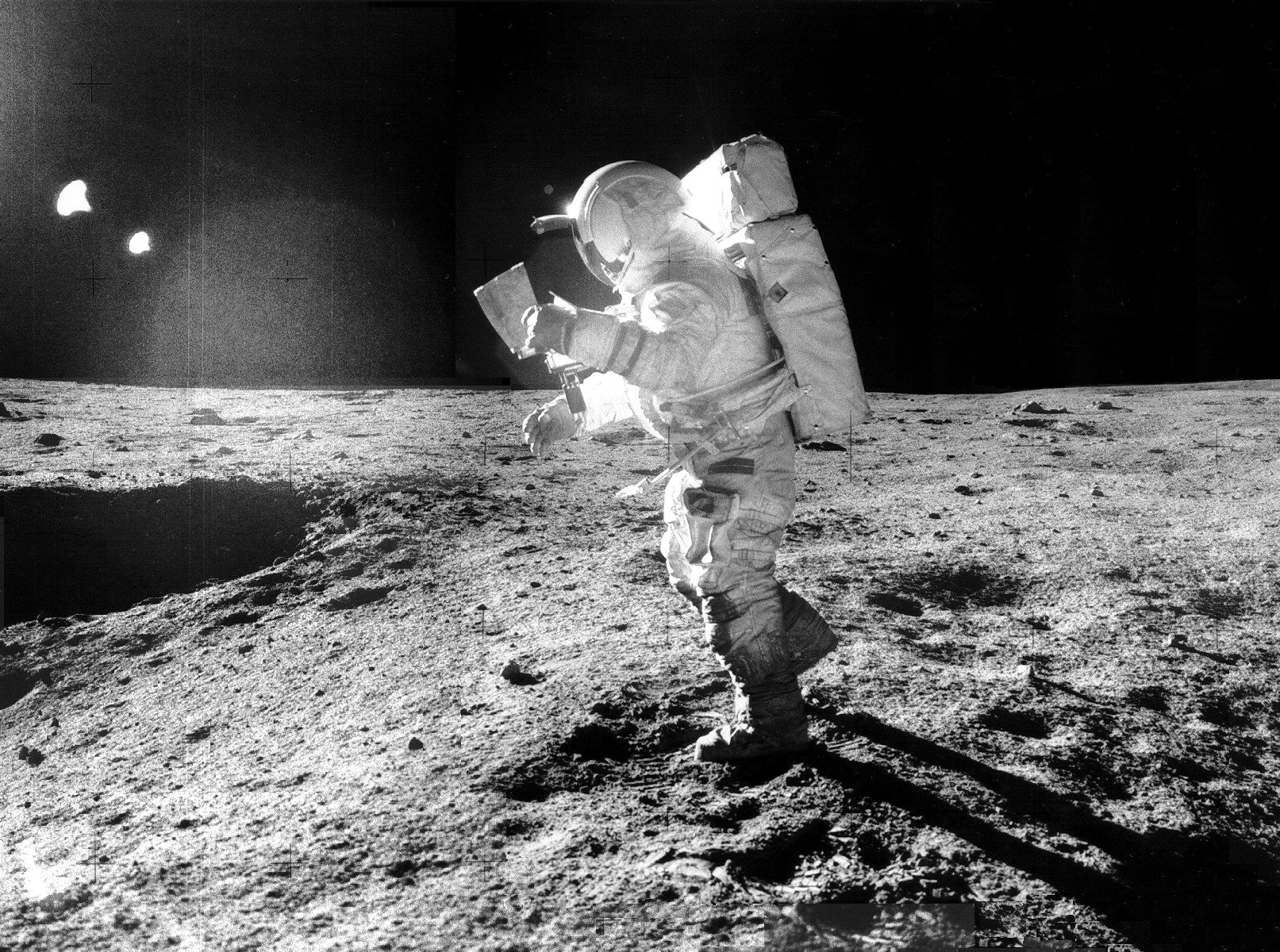
Apollo 14 astronaut Edgar Mitchell checking a map during a moonwalk. NASA’s Apollo 14 and 16 missions were the only two moon landings to measure soil thickness in the lunar highlands, but a new study suggests both missions landed in regions where the soil is tens of feet thinner than usual. Credit: NASA/Alan Shepherd/Edgar Mitchell on Wikimedia Commons

AGU News
Press registration is open for 2026 AGU Annual Meeting
Press registration is now open for AGU’s 2026 annual meeting in San Francisco, California, convening 7 to 11 December 2026 at the George R. Moscone Convention Center. Staff, freelance and student journalists are eligible to apply for complimentary press registration until the end of the conference on Friday, 11 December. Press officers and institutional writers covering the meeting are also eligible for press registration.
- REGISTER AS PRESS HERE
- Additional information for press can be found in the conference Press Center.
- Learn about press eligibility requirements.
Now published: Opening commentaries for AGU’s U.S. Climate Collection and Impactful Datasets special collections
The U.S. Climate Collection is a first-of-its-kind collaboration that gives assessment-related research on U.S. climate change a dedicated home, so that it can inform future climate assessments at every scale. Its opening commentary, “Research priorities for robust climate assessments in the United States,” appears in Earth’s Future and is co-published in the Bulletin of the American Meteorological Society. It brings together 175 authors to set out research priorities for future national, regional, local, sectoral, and topical assessments. Papers in the collection itself will appear across AGU and AMS journals, depending on their topic. [Earth’s Future/Bulletin of the American Meteorological Society commentary]
The Impactful Datasets in Earth, Space, and Environmental Sciences Collection is a living collection that honors the people who create and curate the datasets behind research, analysis, and decision-making, work that traditional academic metrics often miss. Datasets are highlighted along three dimensions (People, Planet, and Prosperity). The collection was developed with the ESIP community. Contributors nominate datasets that matter to their work and then submit data papers that build on their nominations. The opening commentary appears in AGU Advances, while the data papers in the special collection are published in Earth and Space Science. Nominations remain open. [AGU Advances commentary] [AGU Press Release]
Featured Research
Apollo astronauts landed on weirdly thin moon soil
A new study of craters across the lunar highlands — older, lighter-colored regions of the moon’s surface — has measured soil as deep as 160 to 380 feet (50 to 120 meters). These thick soils are a stark contrast to the 30 to 50 feet (10 to 15 meters) of soil measured by NASA’s Apollo 14 and Apollo 16 crews when they touched down on nearside lunar highlands in the 1970s. Researchers identified craters hundreds of meters across without any visible rock chunks, indicating that impacts struck tens of meters of soil instead of bedrock, the latter of which would have kicked up rocky fragments. The study’s results contradict scientists’ previous theory of moon-wide thin soils from the initial Apollo results. Future highlands moon landings might encounter soils with a very different geologic history than those seen or sampled before. [Geophysical Research Letters study]
Urban trash accidental fertilizer for farms
Cropland soils near ongoing urbanization activities in Kumasi, Ghana have over twice as much of the crucial nutrient phosphorus, a recent study found. Urban agriculture helps feed growing cities across tropical western Africa, but soils there are often phosphorus-poor. An analysis of 225 topsoil samples from rainfed maize fields in Kumasi found rising levels of phosphorus — particularly in forms usable to plants — as urbanization influence intensified. Much of the additional phosphorus was also bound to calcium, leading researchers to suggest the nutrient came accidentally from calcium-rich household and construction waste like ash, charcoal, eggshells, bones, concrete, brick and cement. Intentional composting and waste recovery programs, they wrote, could help cities maximize the effect to support urban food production. [JGR Biogeosciences study]
Stronger wildfires trigger years of faster shrub growth in Alaskan tundra
In the Arctic tundra of northern Alaska, soils beneath areas that weathered severe wildfires thawed deeper below ground, allowing shrubs to grow faster and giving them a competitive edge over neighboring plants after the fire. Researchers used field and satellite measurements to study how the intensity of a burn impacted plant regrowth and photosynthesis years after the wide-ranging Anaktuvuk River Fire of 2007. Severely burned tundra had roughly 38% higher plant growth, 43% more shrub area, and 48% more photosynthetic activity than unburned tundra 11 to 15 years post-fire. Scientists expect climate change to make Arctic fires more frequent and intense, a trend that could hasten the shift towards shrub dominance in the tundra already unfolding due to warming. [AGU Advances study]
Spritzing salt into the sky to cool climate could stifle natural sea spray
Waves cast tiny particles of salt, known as sea spray aerosols, into the air where they act as catalysts for forming clouds over the oceans. Supplementing natural spray with artificial aerosols could cool the planet by generating more clouds to reflect energy from the sun back into space, but a new study suggests there could be a catch. By simulating the effect of extra salt spray over tropical oceans, researchers found that the cloud-based cooling effect alters ocean wind patterns, shutting down some natural sea spray production and canceling out the effect of up to 23% of the aerosols added. The study cautions that combatting global heating with geoengineering can have unintended consequences on natural systems that need to be accounted for so that interventions have the intended effect. [JGR Atmospheres study]
Tropical forests are being felled for farms up ever-steeper mountain slopes
Destruction of tropical carbon stores by deforestation nearly tripled as agriculture encroached into ever-steeper mountain forests between 2004 and 2019. As remaining flat ground for farming diminished, the average slope of land converted to croplands became more than half a degree steeper over the same 15-year window. The forests on these slopes tend to store more carbon than their lowland counterparts. The researchers suggest that the carbon release and negative ecosystem impacts from cutting down trees to expand farms may now outweigh the benefits to crop production, calling for stronger land use regulations to balance food security and climate goals. [Geophysical Research Letters study]
Of Cosmic Rains and Delayed Trains
Scientific detective work corrected the date of an early disruption in telegraph service, solidifying the links between solar weather and technological disturbances. [Eos Research Spotlight] [Space Weather study]
Briny “Death Pools” Hold Clues to Early Life
New evidence from the depths of the Red Sea supports the oxidation of manganese and iron as an engine for life in the earliest oceans. [Eos Research Spotlight] [AGU Advances study]