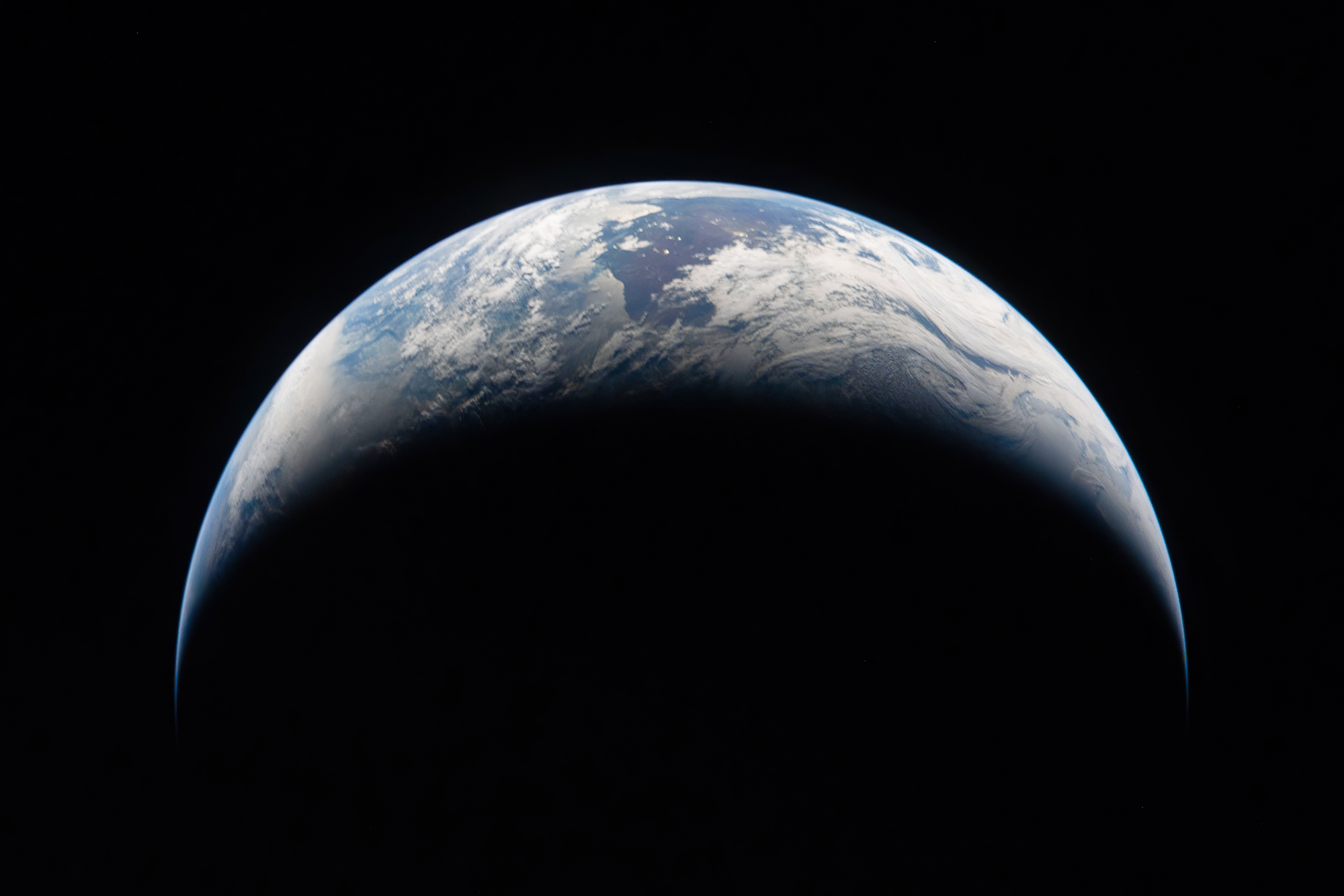
Earth as seen by NASA’s Artemis II lunar flyby in April 2026. According to a new study, our home planet is gradually getting rounder as the poles rise by up to a millimeter every year. Credit: NASA/Artemis II/JSC/ESRS/University of Texas at El Paso/Kevin M. Gill on Wikimedia Commons
.png)
AGU News
Press registration is open for 2026 AGU Annual Meeting
Press registration is now open for AGU’s 2026 annual meeting in San Francisco, California, convening 7 to 11 December 2026 at the George R. Moscone Convention Center. Staff, freelance and student journalists are eligible to apply for complimentary press registration until the end of the conference on Friday, 11 December. Press officers and institutional writers covering the meeting are also eligible for press registration.
- REGISTER AS PRESS HERE
- Additional information for press can be found in the conference Press Center.
- Learn about press eligibility requirements.
Featured Research
The Earth is getting rounder
Earth’s poles are rising by 0.5 to 1 millimeters per year, slowly un-squashing our planet’s slightly flattened, jelly-donut-like shape, according to a new study. Linking satellite measurements of changing altitude across Earth’s surface from 1997 to 2015 to the planet’s shape, researchers found that the rounding effect also seems to be accelerating over time, with the poles rising an extra 0.4 millimeters per year faster every decade. Though our planet seems solid, the Earth’s interior acts more like an extremely slow-flowing liquid, warping over time under forces like the weight of ice sheets and oceans. Currently, our planet bulges out a little around the equator. But as ice sheets melt and reduce the force acting on the Earth at the poles, the equator is gradually cinching in as the poles push upwards, molding our planet into a more spherical shape. [JGR Solid Earth study]
Sewage still pouring nitrates into rivers despite decades of wastewater treatment
More than a third of global nitrate pollution comes from sewage and wastewater, according to a new inventory of nitrate pollution sources. Researchers suggest that sewer overflows during heavy rains and leaky, inefficient water treatment plants contribute much of the pollution. In Europe, which treats over 80% of its wastewater, sewage accounts for 42% of nitrate in river water. In Asia, the treatment rate is 30 to 60%, but the wastewater nitrate contribution remains similar at 39%. Nitrate, a form of nitrogen found in chemical fertilizers and human and animal waste, can degrade river water quality and cause toxic algal blooms and dead zones in downstream estuaries and bays. [Global Biogeochemical Cycles study]
Powerline fire hazards to rise with climate change in Alberta, Canada
As the climate warms, simultaneously hot, dry and windy weather — ideal for enabling powerline-sparked wildfires to escape control — will occur on roughly eight to 15 more days per year in Alberta, Canada by 2100, compared to conditions of the past three decades. With electricity networks expanding, researchers projected future fire conditions for Alberta to map out high- and low-hazard areas for building new powerlines through the end of the century. Under all future climate scenarios considered, 30% of the region will be unsafe for building new powerlines, they found, with low-risk areas limited to under 16%, underscoring the need for smart energy system planning to mitigate wildfire risk. [Geophysical Research Letters study]
Do eddies hasten Antarctic ice melt? It all hinges on which way they swirl
Ocean eddies, swirling vortexes of seawater, near Antarctica can grow up to 10 kilometers (6.2 miles) wide, sometimes occurring directly under shelves of ice that jut out over the ocean from the land. Recent simulations indicate that these eddies can either push water down or pull it up, like a drill or screwdriver for seawater, depending on which way they swirl. Counterclockwise eddies pull warmer water up from the depths, up to doubling the peak melting rate of the ice shelves above them, while clockwise eddies push water downwards, drawing colder, fresher water just below the ice shelves and slowing their melting. Ice shelf melting adds to sea-level rise, making it valuable to understand how eddies impact the melting process, the researchers wrote. [Geophysical Research Letters study]
How the pull of the moon can trigger “slow earthquakes”
Tidal stresses—tiny gravitational forces from the sun and moon, about as strong as the gentle press of a hand—constantly act on Earth’s crust and can even trigger slow sliding along some faults. Using simulations, researchers found that it’s about timing. Tidal stresses repeatedly rise and fall in strength, as does the responsiveness of certain faults to outside forces. When the timing of those two patterns syncs up, those faults become more prone to slippage — similar to how pushing a swing at just the right time in its arc makes it swing higher. [JGR Solid Earth study]
During droughts, some shrubs get by with a little help from their friends
Shrubs in the dusty dryness of northern China’s Loess Plateau adapt to water scarcity differently depending on how closely clustered they are, a new study suggests. During monitoring from 2022 to 2024, stand-alone shrubs grew deep roots to tap into small but reliable water sources belowground. Shrubs living in clusters opted instead for shallow roots to suck up water as soon as it arrived, taking advantage of the wetter surface soil shielded from evaporation by the plants’ collective canopy. However, the latter strategy could leave plants more sensitive to droughts long and dry enough to fully desiccate the uppermost soil layers. Researchers suggest that ecological restoration efforts could take advantage of these adaptations by planting shrubs apart or together based on water availability. [Water Resources Research study]
In Alaska, Wildfires Help Prevent Future Burns. Will That Feedback Loop Hold?
Without the suppressive effects of younger vegetation, Alaskan fire activity would be 5 times higher. [Eos research spotlight] [JGR Biogeosciences study]