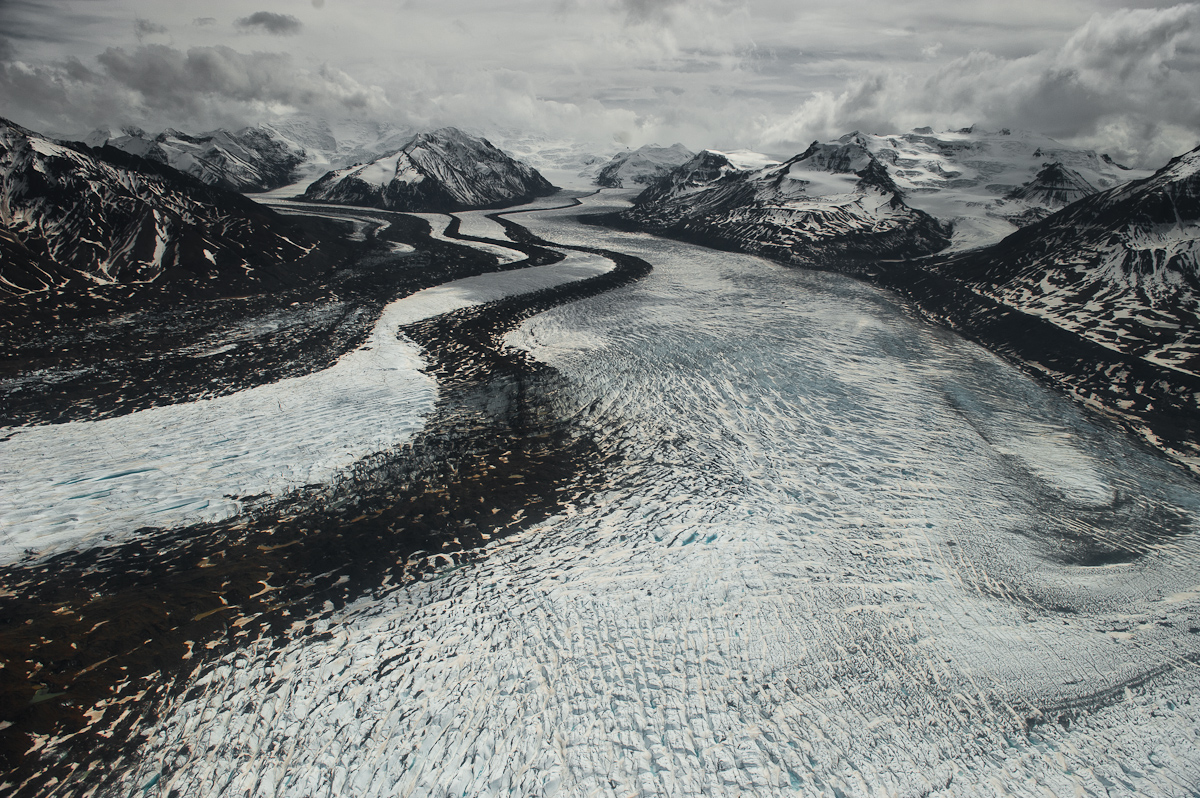
A glacier in Wrangell-St. Elias National Park & Preserve, Alaska. By the end of the century, Alaska could lose up to 75% of its glacier mass compared to 2015. Credit: Neal Herbert, Alaska National Parks Service via Wikimedia Commons.

AGU News
Press registration is open for 2026 AGU Annual Meeting
Press registration is now open for AGU’s 2026 annual meeting in San Francisco, California, convening 7 to 11 December 2026 at the George R. Moscone Convention Center. Staff, freelance and student journalists are eligible to apply for complimentary press registration until the end of the conference on Friday, 11 December. Press officers and institutional writers covering the meeting are also eligible for press registration.
- REGISTER AS PRESS HERE
- Additional information for press can be found in the conference Press Center.
- Learn about press eligibility requirements.
Featured Research
Alaska to lose half to three-quarters of glacial mass by 2100
Come 2100, 49% to 73% of Alaska’s total glacial mass as of 2015 will have melted away, depending on how much climate change warms the planet. By then, in all scenarios, every glacier smaller than one square kilometer in area will have vanished entirely. Researchers attribute the changes mostly to melting from climate warming but also expect more Alaskan precipitation to fall as rain rather than snow, which makes it harder for glaciers to gain new ice. Of the glaciers predicted to survive to 2100, 15% to 60% will have ceased adding ice and will eventually disappear as well. Shrinking glaciers means less meltwater available to downstream communities and ecosystems, as well as worsened sea-level rise and flooding hazards. [Earth’s Future study]
Bouncing ice helps debris-laden avalanches race downhill
Debris-ice avalanches move faster than they should, at least based on the friction between chunks of dirt and ice alone. Researchers tumbling ice and debris together in a centrifuge found that jostling ice particles create vibrations that reduce friction for the entire avalanche, helping it cascade down a mountainside even faster than if it had a perfectly smooth slope to slide on. [JGR Earth Surface study]
Humanity off-track to meet Global Methane Pledge goal by 2030
Under the Global Methane Pledge launched in 2021, most countries have pledged to collectively cut global emissions of methane — the most important greenhouse gas after carbon dioxide, responsible for a third of warming so far — by 30% from 2020 to 2030. At best, the world’s current methane reduction plans would only achieve an 11% reduction, though researchers say humanity could still hit the target by making full use of existing technologies to slash emissions, especially in the global energy sector. [Global Biogeochemical Cycles study]
Growing cities and shrinking forests boost European warming up to 0.25 C per decade
Europe is warming twice as fast as the global average, but increased greenhouse gas emissions aren’t the only factor at play. Expanding urban areas and farm fields are absorbing more sunlight, reducing the cooling influence of plants and changing how the air moves over the land, boosting warming across the continent. [JGR Atmospheres study]
Warming makes floods increasingly costly for China, especially in poor regions
With every half a degree Celsius of warming, economic losses from flooding in China’s poor regions rise 22%, compared to 19% in non-poor regions. Keeping future losses at today’s levels would require major upgrades to existing flood protection systems in China, which bears roughly a third of the globe’s human displacement from flooding. [Earth’s Future study]
Disappearing Moon Craters
Modeling of small lunar craters demonstrates that topography- and size-dependent degradation rates affect crater-based age determinations and constrain the origin and preservation timescales of lunar water ice. [Eos editors’ highlights][AGU Advances study]
Research Roundup: Air Pollution is a Global Health Problem
- Inhaling particles of black carbon and organic matter increases arthritis odds in Chinese middle-aged adults. [GeoHealth study]
- Pumping brakes on emissions of hazardous compounds like formaldehyde and benzene could avoid global increase in non-cancer health risks. [GeoHealth study]
- Particulate pollution contributed to over six million premature deaths in 2010. Stronger environmental governance could cut it to five million in 2050. [GeoHealth study]