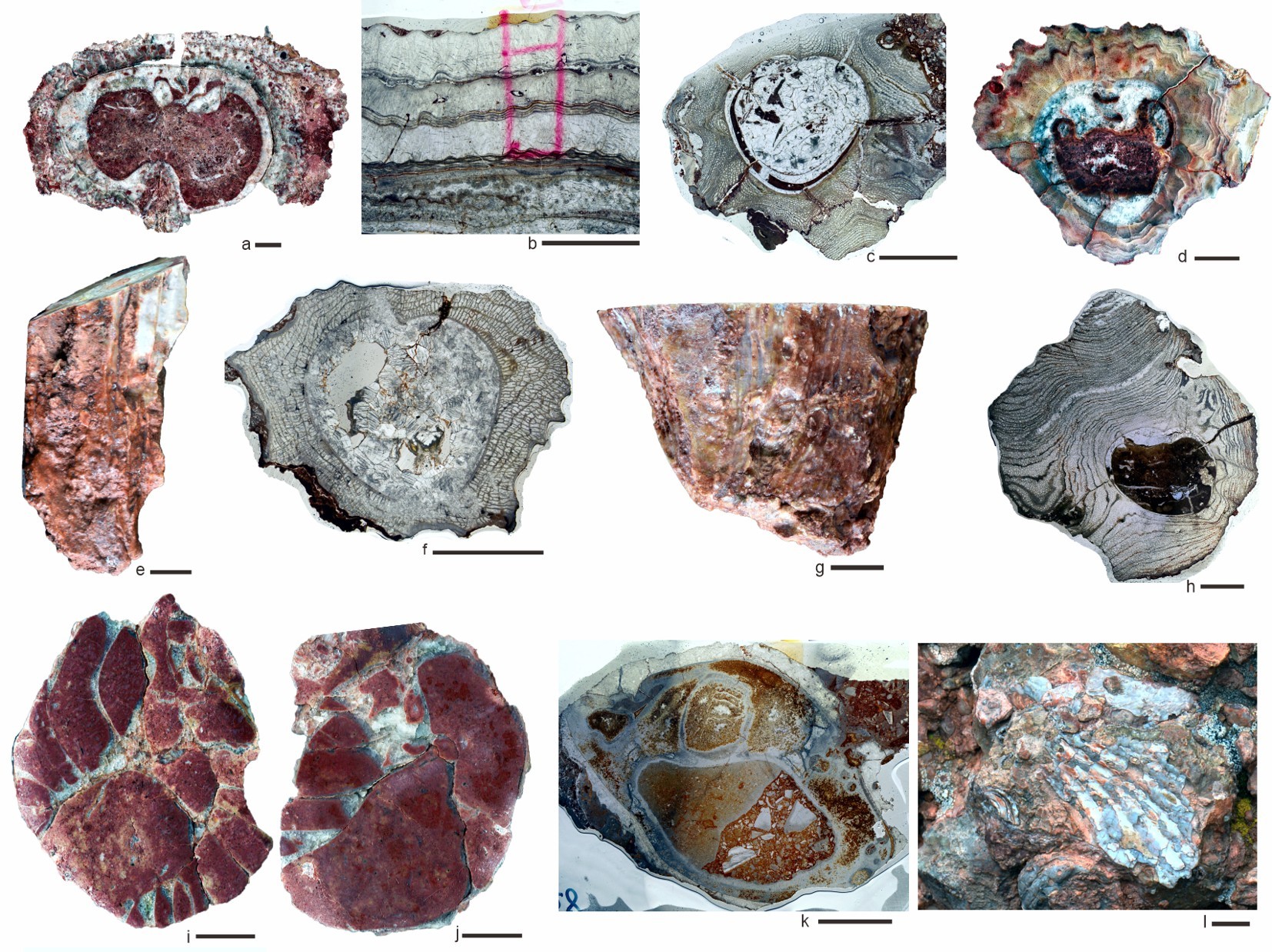
Colorful 94.5-million-year-old fossils of seafloor creatures found on the Tibetan Plateau. The seawater chemistry preserved by these clams, snails, and other bottom-dwellers suggest they lived in a shallow sea with waters about as warm as a hot tub. Credit: Adapted from Wang et al. 2026 (Supplementary Information)
AGU News
Press registration is open for 2026 AGU Annual Meeting
Press registration is now open for AGU’s 2026 annual meeting in San Francisco, California, convening 7 to 11 December 2026 at the George R. Moscone Convention Center. Staff, freelance and student journalists are eligible to apply for complimentary press registration until the end of the conference on Friday, 11 December. Press officers and institutional writers covering the meeting are also eligible for press registration.
- REGISTER AS PRESS HERE
- Additional information for press can be found in the conference Press Center.
- Learn about press eligibility requirements.
Featured Research
Before the Tibetan Plateau rose from the sea, critters swam in hot tub temperatures
A fossil site in central Tibet — the youngest known remains of ocean-dwelling creatures in the region — has offered clues to what conditions looked like 94.5 million years ago, before the Tibetan Plateau uplifted to its current heights. In the late Cretaceous, parts of the plateau lay beneath a shallow sea in a greenhouse climate. Chemical signatures of the ancient seawater preserved in fossilized shells of clams, snails, and other bottom-dwellers indicate that shallow coastal waters reached up to 39 degrees Celsius, or about 102 degrees Fahrenheit, about the temperature of a hot tub. [Geophysical Research Letters study]
Ocean changes contributed to tripling of western US annual burn area since the ‘80s
Wildfire area in the western U.S. tripled from 1984 to 2022 due to drying and warming largely caused by human-driven climate change. A recent study finds that about a fifth of that tripling stems from a general oceanic temperature trend over that time, in which the western tropical Pacific has warmed while the east has cooled, akin to a super-long-term La Niña event. This trend has amplified drying in the Southwestern U.S., setting the stage for forest fire. The temperature observations also conflict with climate models, most of which expect human-driven climate change to cause an opposite long-term effect in the Pacific, more like El Niño conditions. As long as the mismatch persists, the authors write, climate model projections may underestimate the western U.S.’s true susceptibility to forest fire. [Earth’s Future study]
Move over, earthquakes: tsunamis from undersea landslides could be even worse
Most tsunamis originate from earthquakes, but about seven percent come from submarine landslides, massive collapses of sloping seafloor. Scientists simulated a prehistoric landslide, displacing 6 cubic miles (25 cubic kilometers) of sediment, in the modern-day Sea of Japan, an area with evidence of past slides. The results showed more danger than the region’s typical earthquake-driven tsunamis pose: up to 30-foot (nine-meter) waves inundating the Korean coast, with flows up to 10 feet (3 meters) deep rushing up to a mile (1.5 kilometers) inland at over 42 feet per second (13 meters per second). Waves could hit major Korean cities like Ulsan and Busan within 25 to 50 minutes of the landslide, leaving far less time for warning or evacuation than earthquake tsunamis, which typically give an hour or two. In parts of Japan, waves could reach roughly 55 feet (17 meters) in height. Current tsunami risk assessments and warning systems focus mostly on earthquake tsunamis, but the authors argue landslide tsunamis should be accounted for too. [JGR Oceans study]
Antarctic ice sheet’s first growth spurt 410,000 years earlier than previously thought
Antarctic glaciers first began grinding rocks to dust 34.41 million years ago — 410,000 years before scientists previously thought. Based on chemical signatures of ground-up Antarctic bedrock in ocean mud, a new study suggests, Antarctica’s ice sheets had false starts 34.41 and 34.19 million years ago before really ramping up around 34.06 million years ago. Pinpointing the start of glacial action helps scientists reconstruct the events that tipped Earth out of its ice-free “hot house” state into the partially glaciated “ice house” phase we inhabit today. [Geophysical Research Letters study]
Connected green corridors beat isolated islands for reducing heat illness in cities
Green space is good for us, especially in hot regions like Arizona where shade and evaporation from plants can reduce occurrences of illnesses like heat stroke and heat exhaustion. A new study shows that the health benefits of greenery don’t just depend on the sizes or total area of green spaces people have access to, but also how interconnected they are. Using maps of green spaces and heat illness data for Arizona census blocks from 2013 to 2023, researchers found that having more green patches, more closely spaced, was associated with fewer ER and hospital visits for heat illnesses. Researchers argue that creating more continuous green corridors could be the most effective way to prep urban areas for more frequent andintense heatwaves on the way due to climate change. [GeoHealth study]
Preserving Soil Carbon by Preserving the Forest Floor
A 20-year study of British Columbia forests examines how soil carbon is affected by logging. [Eos Research Spotlight] [JGR Biogeosciences study]
Mapping Childhood Lead Exposure Risk in the United States, Neighborhood by Neighborhood
A researcher uses housing and poverty data to identify locations where children are more likely to be exposed to lead. [Eos Research Spotlight] [GeoHealth study]