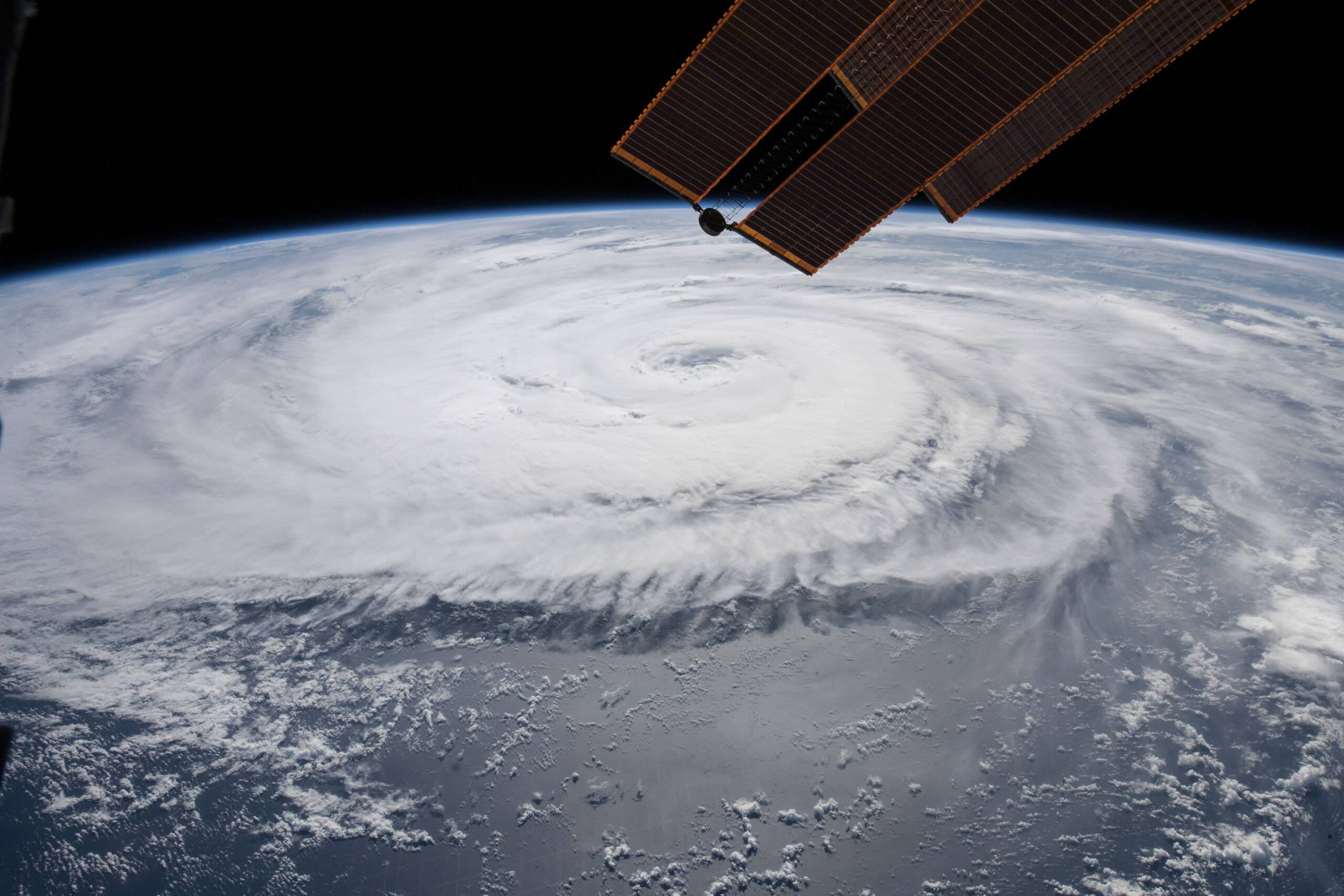
A typhoon over the Pacific Ocean as seen from the International Space Station. When these storms pass over marine heatwaves in the western North Pacific Ocean, they have a 9% to 12% chance of rapidly strengthening two days later. Credit: Earth Science and Remote Sensing Unit, NASA Johnson Space Center via Wikimedia Commons

AGU News
Press registration is open for 2026 AGU Annual Meeting
Press registration is now open for AGU’s 2026 annual meeting in San Francisco, California, convening 7 to 11 December 2026 at the George R. Moscone Convention Center. Staff, freelance and student journalists are eligible to apply for complimentary press registration until the end of the conference on Friday, 11 December. Press officers and institutional writers covering the meeting are also eligible for press registration.
- First images from Nancy Grace Roman Space Telescope to debut at AGU26
- Browse the scientific program
- Additional information for press can be found in the conference Press Center.
- Learn about press eligibility requirements.
Featured Research
Typhoons charge up faster after meeting marine heatwaves
Typhoons in the subtropical western North Pacific that pass over unusually warm ocean water have roughly a 9% to 12% chance of rapidly getting stronger roughly two days later. Winds in these storms can get over 15 meters per second faster in under 24 hours, offering little advance warning. Typhoons that don’t touch an ocean heatwave, meanwhile, suddenly intensify like this only about 3.5% to 4.5% of the time. The finding comes from a recent study based on sea surface temperature records and typhoon tracks. Researchers call attention to the tripling of the annual number of marine heatwave days in that part of the Pacific between the 1982-2002 and 2003-2023 periods. [JGR Oceans study]
The U.S.’s largest oil region is leaking more than twice the methane we thought
Oil and gas infrastructure in the Permian Basin, an oil-rich stretch of Texas and New Mexico, emitted 2.4 times more methane than EPA inventories suggest from 2018 to 2025, based on new high-resolution satellite measurements. For the first time, researchers found a way to pinpoint hotspots of the greenhouse gas around pipelines, wells and storage tanks, which they suggest could help improve future emissions attributions in the Permian Basin and other oil- and gas-producing regions. [Geophysical Research Letters study]
Cutting back illegal cocaine plantations could slash Colombia’s carbon emissions
In 2022, the greenhouse gas emissions from illegal deforestation, applying fertilizers and pesticides during coca plant cultivation and cocaine refining in Colombia rivaled those of the country’s entire shipping and aviation industries. Researchers urge international investment in supporting legal livelihoods and rainforest restoration in Colombia through mechanisms like climate financing to reap the combined social and climate benefits of reducing illicit cocaine production. [Earth’s Future study]
2026 Alberta tremors were largest recorded quakes caused by carbon injection
Researchers have tied two magnitude 4 earthquakes in April and May of 2026 to Shell’s Quest Carbon Capture and Storage (CCS) project in Alberta, Canada. These quakes are the strongest known CCS-related seismic activity and were felt up to 70 kilometers (43 miles) away, including in Edmonton. Researchers caution that mitigating human-caused climate change by storing CO2 underground could cause larger, more frequent earthquakes in the future, even tens of kilometers away from the injection site. [Geophysical Research Letters study]
Potential moon base sites may have their own electric fields
With no atmosphere or magnetic field blocking the stream of charged particles from the sun, the moon’s surfaces may take on electric charge that could complicate future lunar missions. New simulations of a hypothetical lunar cave, the kind of place astronauts might set up a base, showed that sunlit areas of the cave floor took on positive charges while shadowed areas went negative, creating electric fields that could interfere with astronauts’ instruments, among other potential impacts. [Geophysical Research Letters study] [Kobe University press release in English] [Original press release in Japanese]
What it would take to meet Australia’s climate and biodiversity goals
Australia has committed to reaching net-zero greenhouse gas emissions by 2050 and to both domestic and international biodiversity restoration targets. A recent study uses LUTO2, a national land-use model, to explore pathways for meeting Australia’s climate and biodiversity goals while satisfying projected agricultural demand without depleting catchment water resources. Within the scenarios and assumptions examined, the model identifies pathways that meet these goals but involve substantial changes to land use and agricultural management. This modelling capability allows for investigation of the consequences of various choices to inform a more integrated approach to balancing land uses. The authors write that these pathways can inform policymakers, environmental planners, and landholders about the kinds of land-use and management changes that could support a nature-positive, net-zero transition. [Earth’s Future study]
Tracking Lava Flows from Space
Underused in volcanic monitoring, synthetic aperture radar offers important information about lava lakes, craters, and flows. [Eos research spotlight] [JGR Solid Earth study]
The Hidden Greenhouse Gas Emissions Woven into Braided Rivers
Slow-moving backwaters and smaller rivers can be hotspots of nitrous oxide emissions, revealing how channel complexity and nitrogen availability shape the climate footprint of braided rivers. [Eos editors’ highlight] [JGR Biogeosciences study]
Research Roundup: The potential — and pitfalls — of hydropower in a changing climate
- While generating clean energy, nearly 5,300 unmonitored hydropower reservoirs around the world also emit hundreds of millions of tons of greenhouse gases each year [Global Biogeochemical Cycles study]
- World’s hydropower reservoirs have eight times more energy potential than 60 years ago. Upgrading unpowered dams could raise it another 15%. [Earth’s Future study]
- Central Himalayan glacial lakes could hypothetically produce hundreds of gigwatt-hours of hydropower per year — but would peak by 2030 as the glaciers that feed them dwindle [Water Resources Research study]