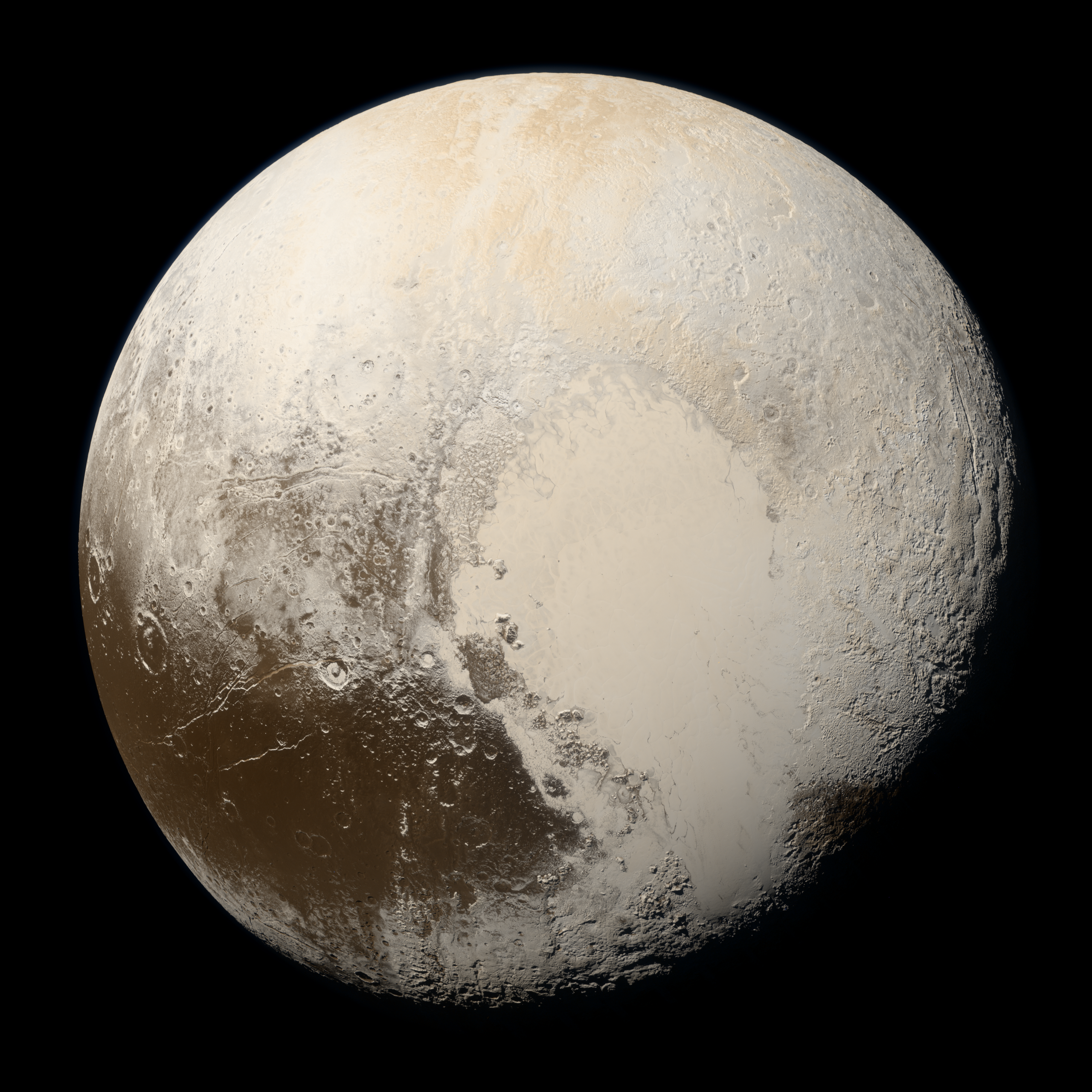
A true-color image of Pluto captured by NASA’s New Horizons mission in 2015. Impact craters on Pluto’s surface can highlight other, previously invisible geological features, allowing scientists to reconstruct the dwarf planet’s history. Credit: NASA/Johns Hopkins University Applied Physics Laboratory/Southwest Research Institute/Alex Parker via Wikimedia Commons.

AGU News
Press registration is open for 2026 AGU Annual Meeting
Press registration is now open for AGU’s 2026 annual meeting in San Francisco, California, convening 7 to 11 December 2026 at the George R. Moscone Convention Center. Staff, freelance and student journalists are eligible to apply for complimentary press registration until the end of the conference on Friday, 11 December. Press officers and institutional writers covering the meeting are also eligible for press registration.
- First images from Nancy Grace Roman Space Telescope to debut at AGU26
- Browse the scientific program
- Additional information for press can be found in the conference Press Center.
- Learn about press eligibility requirements.
Featured Research
Craters and cracks on Pluto’s cold, icy surface reveal hidden tectonic history
By scouring Pluto’s surface to map 22,000 kilometers (13,670 miles) of unusually straight crater edges, researchers have uncovered previously hidden geologic events that shaped the dwarf planet. When an asteroid strikes a surface, the edges of the resulting impact crater will sometimes hew to the straight shapes of existing but hidden cracks that surface left behind by events like the formation of mountains, making it possible to use crater edges to trace buried features. . For instance, straight edges on craters around Sputnik Planitia, a heart-shaped, nitrogen-ice-filled depression on Pluto’s surface, suggest Sputnik may have started filling with nitrogen ice early in the planet’s history — potentially due to ice oozing in via “ice volcanoes” — with the ice weighing down the middle of the basin and cracking its surroundings as Pluto’s surface flexed to accommodate the new burden. [JGR Planets study]
Arctic could become navigable by late 2030s as future warming thins sea ice
Climate projections for Arctic sea ice thickness under moderate warming (SSP2-4.5) suggest ice could thin enough for ships without ice-breaking capabilities to pass through as early as summer 2036. By 2100, potentially navigable conditions with ice thinner than 0.15 meters (0.5 feet) could last around four months each year, which could create both new opportunities and new hazards for Arctic shipping, researchers say. [Geophysical Research Letters study]
As Earth approaches climate “tipping points,” satellite observations may help provide early warning
Climate change is pushing Earth’s ecosystems towards potentially irreversible tipping points, like forests transforming into grasslands or ecosystems switching from carbon sinks to carbon sources. A new review summarizes how researchers can use the abundant spatial coverage of satellite measurements to build tipping point monitoring and early warning systems. [Reviews of Geophysics review]
Flight log from Hiroshima bombing records height of only ever nuclear firestorm
The US’s nuclear bombing of Hiroshima, Japan, during World War II caused the only nuclear firestorm in history. In theory, firestorms after a big enough nuclear explosion could deliver soot and debris into the upper atmosphere and trigger a nuclear winter. Using flight logs from the Enola Gay aircraft, researchers calculated that the firestorm plume was at least 11.3 kilometers high (7 miles high), close to the height needed for soot to start blocking sunlight which would trigger global cooling, which they say strengthens the argument that nuclear winter scenarios are possible. [Geophysical Research Letters study]
Lake Baikal’s water levels recovering after decades of drying
A 343-year record of river flows around Russia’s Lake Baikal show that unusually wet conditions have soaked the region since 2017, reversing decades of drying in the 20th and early 21st century. Researchers attribute the moisture influx to changing air circulation patterns as the climate warms, but caution that it’s too soon to say whether the welcome water is here to stay. [Geophysical Research Letters study]
Harnessing Glacial Lakes for Hydropower
As mountain glaciers retreat and glacial lakes grow, a new study looks at how excess water could generate renewable energy and help reduce flood risks. [Eos research spotlight] [Water Resources Research study]