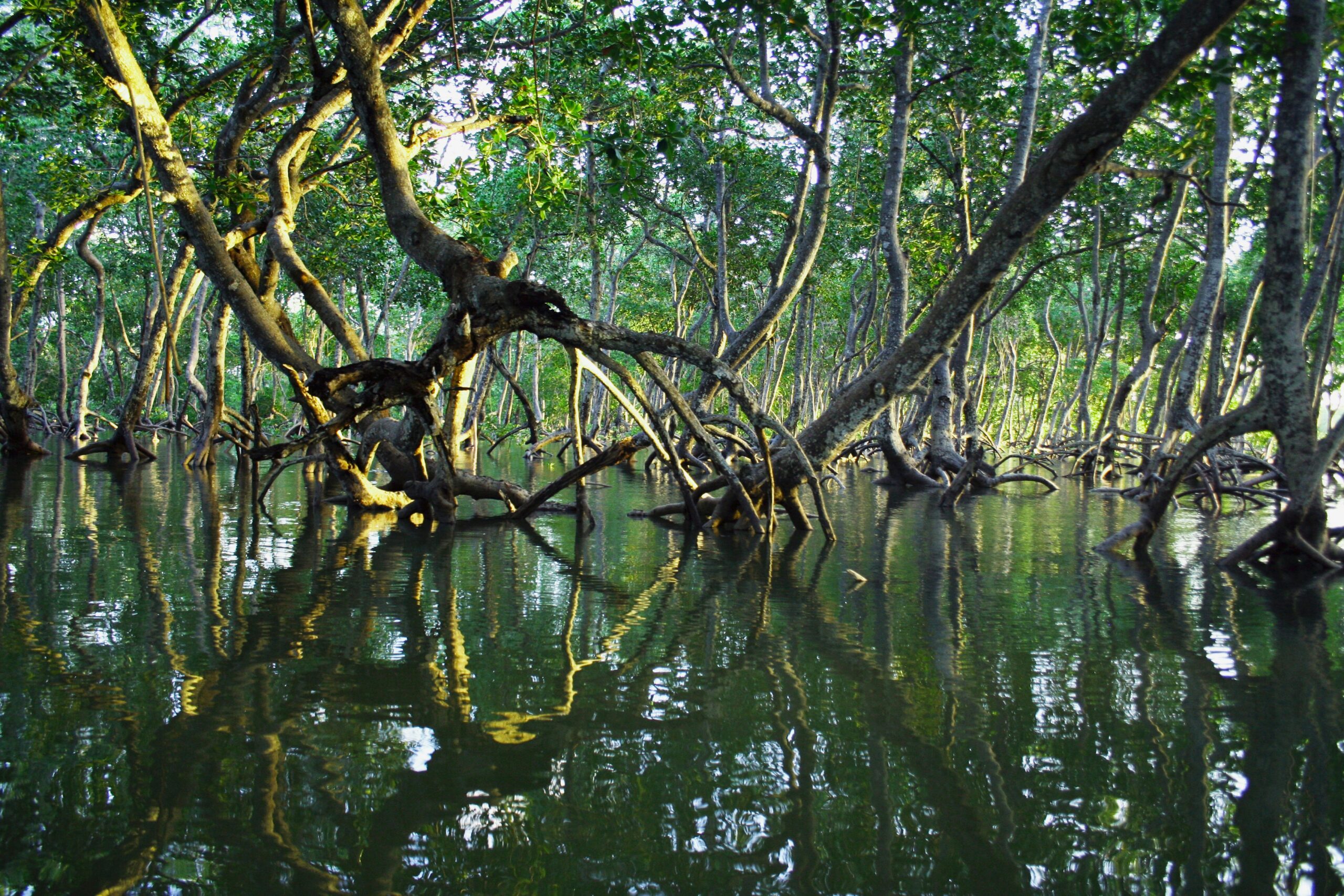
A mangrove forest along the Mida Creek near the coast of Kenya. Each year, mangroves remove hundreds of thousands of metric tons of excess nitrogen from coastal ecosystems around the world, mitigating the impacts of nitrogen pollution from human activities. Credit: Timothy K, Unsplash
AGU News
AbSciCon26 registration open
Reporters and press officers interested in press registration for the Astrobiology Science Conference to meet in Madison, Wisconsin, 17-22 May should email AGU Media Relations at [email protected]. Please include a link to a byline, masthead or a staff page listing your name and position. Freelancers should provide a link to a portfolio or links to at least three bylined science news stories published in the last 12 months. [press information] [AbSciCon home] [program]
Featured Research
Mangroves clean up nitrogen pollution to the tune of $8.7 billion every year
Earth’s mangroves remove 870,000 metric tons of nitrogen from coastal ecosystems every year, a new analysis reports, with the potential to capture 5 million metric tons annually under ideal conditions. Because nitrogen pollution from human activities can trigger harmful algal blooms and oxygen depletion that threaten public health and coastal economies, the cleanup saves roughly $8.7 billion annually, more than 12 times the value of mangroves’ carbon sequestration. The paper’s authors argue for a “blue nitrogen” market to financially recognize this service and incentivize mangrove conservation, nitrogen pollution reduction, and coastal water quality management. [Earth’s Future study]
Ongoing greening masks the impact of deforestation in Southeast Asia
Despite losing up to almost 7% of its forested area, Southeast Asia became about 5.5% greener and 12.5% more ecologically productive from 2001 to 2022, according to an analysis of satellite data. The gains likely stem mostly from intensified agricultural practices and rising carbon dioxide concentrations, the latter of which is spurring plant growth in many parts of the world. However, this masks the damage deforestation has caused: had the forests remained intact, researchers estimated, Southeast Asia would be about 16% greener and 6% more productive than it is today. The finding exemplifies how “greener” doesn’t always mean “healthier” in ecological terms, the team wrote. [Geophysical Research Letters study]
Excess dry plants, more than wind or topography, made L.A.’s 2025 fires so severe
The conditions of burnable fuels before the devastating January 2025 wildfires in California’s Los Angeles County determined those fires’ burn severity more than winds or topography, according to a modeling study examining three of those fires. The study’s findings and methods may help land managers assess fire hazards based on changing fuel conditions, informing fuels treatments (such as prescribed burns) to reduce the severity of future fires. As both wildfire risk and the wildland-urban boundaries most vulnerable to disastrous fires grow, understanding what drives severe fires becomes increasingly important for proactive fire management, the authors write. [AGU Advances study]
Global warming could prompt Earth’s peatlands to heat the planet even further
If global warming remains relatively low, Earth’s peatlands above the 25th parallel north will continue to sequester carbon while releasing methane, a balance that has historically had a net cooling effect on the climate. Under a high-warming scenario, however, these peatlands could start emitting more methane and carbon dioxide, while also sequestering less of the latter, by mid-century, substantially amplifying global warming by the late 23rd century. Warming in peatlands is altering both primary productivity, which ultimately sequesters carbon, and decomposition, which releases methane, shifting the balance of planet-warming gases these ecosystems emit and absorb. [JGR Biogeosciences study]
Hydrologists call for a unified, AI-ready repository for U.S. water data
A November 2025 executive order commanded the DOE to develop an AI platform trained on U.S. federal scientific data called the “Genesis Mission.” The DOE has listed water availability for energy as a key challenge for the project. Hydrologists Amobichukwu Amanambu and Jonathan Frame argue in an op-ed that the focus should broaden to consider critical water issues holistically, including demands from agriculture, data centers and other stakeholders beyond the energy sector, as well as predictive management of surface water, groundwater and flooding. [Eos opinion]
How space plasma can bend the laser of gravitational wave detectors
A new study reveals how and to what extent laser beams are bent during propagation through space plasma in TianQin, a geocentric space-borne gravitational wave detector. [Eos editors’ highlight][Space Weather study]
More braided rivers from increasing flow variability
Global analysis of satellite data and river flow records show that higher flow intermittency after climate change may lead to an increasing number of threads in braided rivers, thus impacting ecosystems. [Eos editors’ highlight][AGU Advances study]