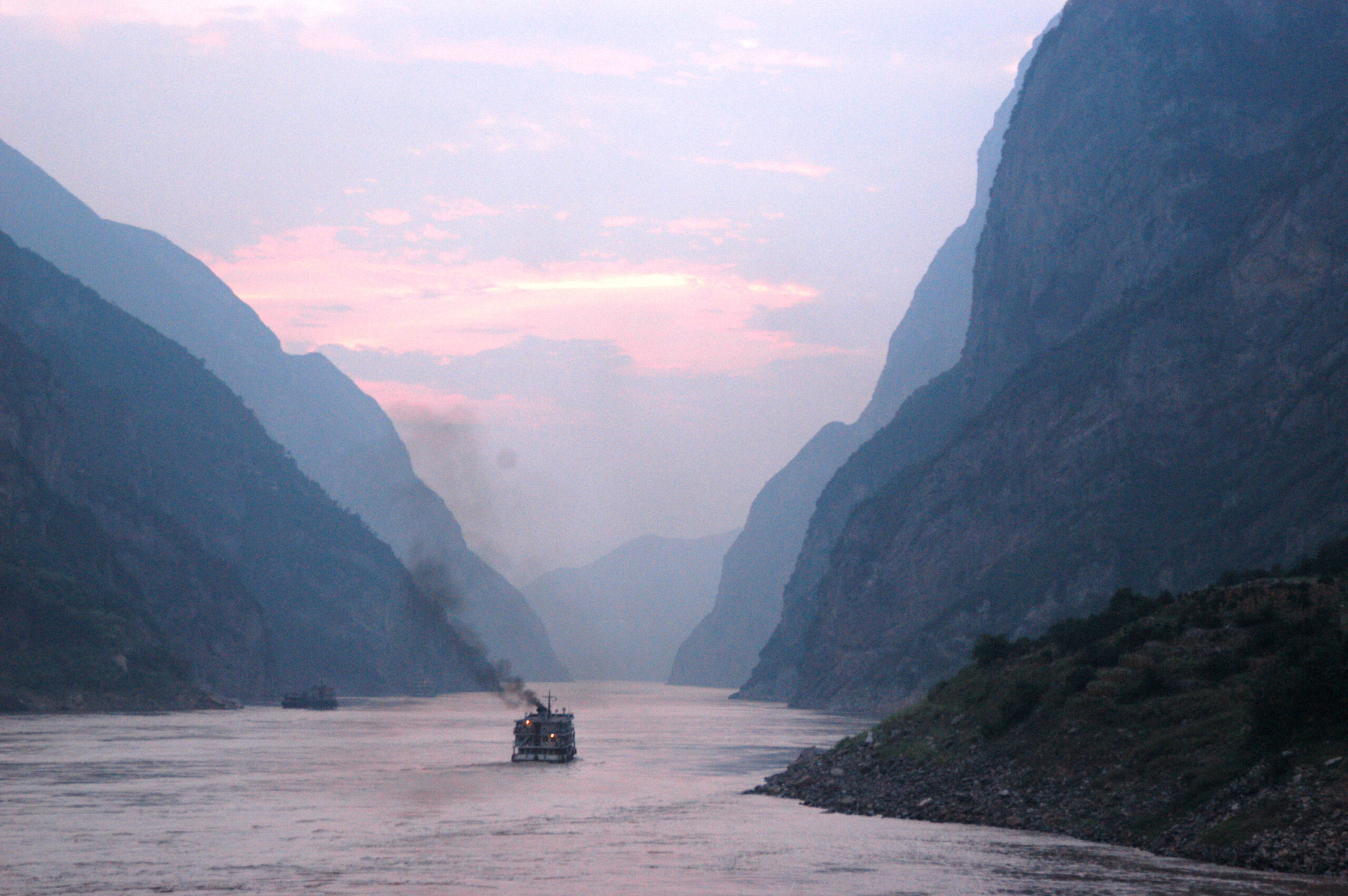
Dusk on the Yangtze River. As the topographic divide between the Yangtze and Yellow rivers’ basins has moved over time, billions of cubic meters of water that once flowed into the latter each year now drain into the former. Credit: Andrew Hitchcock, Wikimedia Commons

AGU News
AbSciCon26 registration open
Reporters and press officers interested in press registration for the Astrobiology Science Conference to meet in Madison, Wisconsin, 17-22 May should email AGU Media Relations at [email protected]. Please include a link to a byline, masthead or a staff page listing your name and position. Freelancers should provide a link to a portfolio or links to at least three bylined science news stories published in the last 12 months. [press information] [AbSciCon home] [program]
Featured Research
The Yangtze is stealing the headwaters of the Yellow River
China’s two longest rivers arise on the Tibetan Plateau, on opposite sides of a 3,000-kilometer-long divide that separates their drainage basins. Deep gorges and steep terrain shape the Yangtze headwaters while the Yellow flows through the gentle Zoige Basin. A new study argues the Yangtze is actively pirating the Yellow’s headwaters, pushing the divide northwestward. The climate swings of the Quaternary, the current ice age, amped up erosion in this region in favor of the steeper Yangtze basin. Over the last few million years, the Yangtze has stolen 30,000 square kilometers that once drained into the Yellow, reducing the annual runoff in upper Yellow River by 5 billion cubic meters. It’s about the same volume (4 billion cubic meters) that China plans to transfer back to the Yellow River through the western route of the massive South-to-North Water Diversion Project. [JGR Solid Earth study]
This asteroid literally dug up evidence of past water on Mars
Roughly fifteen years ago, an asteroid left a 25-meter-wide crater in Mars’s dusty Arabia Terra region, driving itself into the plains within a much larger, older crater. The impact acted as “nature’s drill,” write the authors of a new study, offering a rare glimpse beneath the Martian surface. Observations of the crater from the Mars Reconnaissance Orbiter have revealed that magnesium saponite — a clay mineral that only forms with water around — exists just a few meters down, presenting another piece of evidence for past water on Mars. [JGR Planets study]
Coral heat stress in 2024 over three times more anomalous than in most warm years
Compared to the historical average from 1981 to 2010, marine heatwaves around the globe in 2024 spanned more days and were more intense by more than three standard deviations — in other words, exceeding the historical average over three times more than most other above-average years for marine heatwaves. The extreme conditions of that year, when the average global sea surface temperature reached a record 0.61 degrees Celsius above the historical average, contributed to the fourth worldwide coral bleaching event on record. Reefs in the Red Sea, the Coral Triangle, Fiji, the Caribbean, and Brazil suffered especially severe heat stress, researchers report. [Geophysical Research Letters study]
ER visits from asthma spike during nighttime heatwaves in Baltimore
When heatwaves in Baltimore last through the night, emergency rooms receive more patients with heightened asthma symptoms. A new study drawing on hundreds of adult and pediatric cases from 2016 to 2022 and air temperature measurements at the neighborhood level found that socially vulnerable neighborhoods and those with the greatest nighttime temperature changes were most likely to see ER visits shoot up. Baltimore’s Code Red Extreme Heat alert system, which relies on daytime temperature forecasts, doesn’t capture this correlation between heat and asthma, potentially underestimating residents’ heat exposure. Including measurements taken at night, when the city’s heat island effect strengthens, could improve early warning systems, the researchers wrote. [Johns Hopkins University press release][GeoHealth study]
In extreme weather, Appalachian forests’ slow and steady response wins the race
Appalachian forests’ adaptations to droughts and floods only appear months or years after the fact. The delayed response may provide critical resilience for the forests’ ecosystems, reducing how much water vegetation drinks up during dry periods and promoting water recharge when precipitation increases. [Water Resources Research study]
How wildfires worsen flood risk
A new approach to analyzing watersheds shows how storms occurring after a wildfire can have higher flooding risk than similar storms that occurred before a fire. [Eos research spotlight][Water Resources Research study]
Want to predict wildfire severity? Look to the state of vegetation
A new study connects satellite data on vegetation condition, topography, and weather conditions to examine the predicted versus actual burn severity of the 2025 Los Angeles wildfires. [Eos research spotlight][AGU Advances study]
Where was Baltica 616 million years ago?
Disentangling magnetic signals in its ancient rocks gives an updated view of the paleocontinent’s position during the Ediacaran period. [Eos research spotlight][Geochemistry, Geophysics, Geosystems study]
Toward marine cloud brightening at scale: A science agenda
Marine Cloud Brightening (MCB) is a Solar Radiation Management (SRM) solution to cool the planet by changing the albedo of low-altitude marine clouds to increase reflected shortwave radiation. [Eos editors’ highlight][AGU Advances study][AGU Ethical Framework Principles for Climate Intervention Research]
Let’s not forget about long droughts
Why do conceptual hydrologic models struggle to model long-term droughts? A new study investigates. [Eos editors’ highlight][Water Resources Research study]