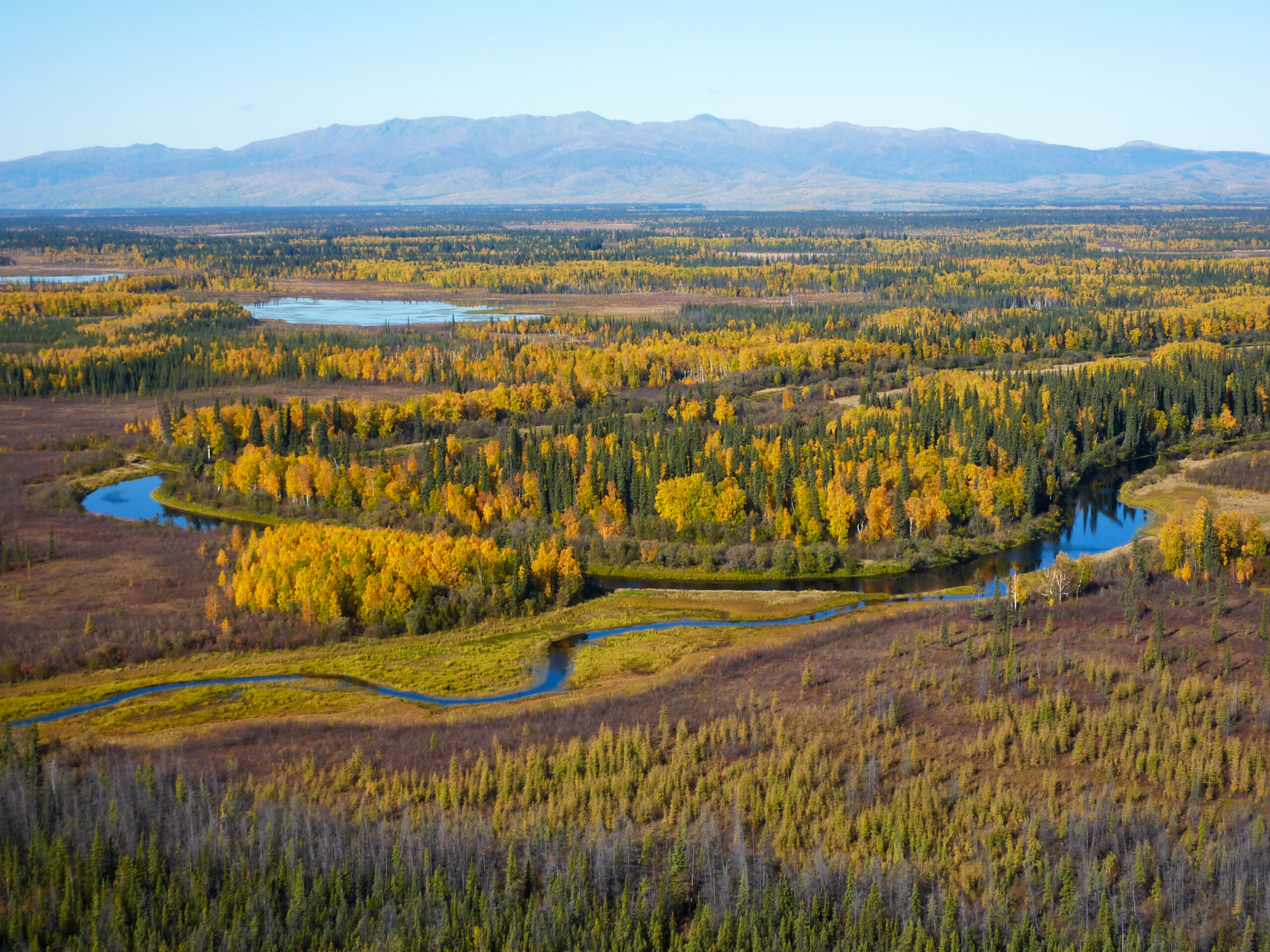
Mixed deciduous and evergreen boreal forest on the banks of the Yukon River, Alaska. As forests recover from disruptions like fires and storms, warming temperatures give deciduous trees a leg up over evergreens in some areas, which researchers anticipate will change the makeup of forests in the future. Credit: United States Fish and Wildlife Service (USFWS) Alaska on Wikimedia Commons.
.jpg)
Featured Research
Climate change will likely make boreal forests more deciduous, less evergreen
As climate change brings more fires, storms and other disturbances to boreal forests, warmer temperatures will likely give deciduous trees a leg up, allowing them to outcompete evergreens in some places as those forests regrow. How a forest regrows in the first decade after a fire or storm can predict a long-term shift to deciduousness with 90% accuracy, a new study finds. However, while deciduous trees may dominate certain areas for longer periods, they probably won’t take over permanently. The findings, from recent model simulations of forest recovery under climate scenarios through the next century, adds to a growing body of evidence that warming may restructure boreal forests by favoring deciduous trees where evergreens once reigned. [JGR Biogeosciences study]
Largest-known lunar shield volcanoes revealed
Researchers have identified two 50-mile-wide (80-kilometer-wide) shield volcanoes — a type of wide, rounded volcano with shallow sloping sides — on the Moon. The Prinz-Harbinger and Theophilus volcanoes are more than double the size of any previously known lunar shield volcano and around 25% larger than Earth’s most famous one, Mauna Loa. For these volcanoes to form, large volumes of magma must have collected close to the lunar surface, a process previously thought to be unlikely on the Moon. Researchers suggest large meteor impacts could have created networks of cracks that enabled magma to flow towards the surface. [Geophysical Research Letters study]
Stacking droughts worsen wildfires
Flash droughts — events where the amount of water in the soil drops sharply below the previous 20 days’ average — can stack on top of multi-year dry conditions, creating a one-two punch that can desiccate vegetation and prime the land for fire. A new study examining global fire and moisture data from 2002 to 2021 shows that fires that burned under combined flash and standard drought moved 3% faster, grew 21% larger and lasted 8% longer on average than fires during long-term standard drought conditions alone. Researchers suggest that monitoring for flash droughts could improve early detection of high fire risk conditions, especially as climate change drives up temperatures and makes sudden dry conditions more common worldwide. [Geophysical Research Letters study]
This CubeSat lost a week of its life to a solar storm, falling 1.5 miles towards Earth
A Slovenian CubeSat satellite known as TRISAT drifted over 1.5 miles (2.5 kilometers) closer to Earth in four days during the powerful geomagnetic storm of May, 2024, cutting about a week off its operational lifespan. Satellites’ orbital tracks naturally shrink over time, but geomagnetic storms can heat and expand the Earth’s upper atmosphere, increasing drag on satellites and causing them to slip back towards Earth. In a recent study, researchers write that low-orbit satellites without their own propulsion systems, like CubeSats, take the biggest hits: TRISAT saw its orbital decay rate more than double during the 2024 storm’s peak impact. Besides shortening satellites’ operational lifespans, accelerated orbital changes like this can make it harder for scientists to accurately predict satellites’ orbits and safely manage satellite traffic. [Space Weather study]
A goldilocks zone to maximize wetlands’ warming-mitigation abilities
Temperate wetlands have the greatest cooling effect on the climate when water levels hover near the soil surface, a recent study finds. Leave it too dry or too flooded, and the system doesn’t store as much carbon, while inundation up to a point can cause wetlands to belch more methane, another greenhouse gas. The findings come from data on gas movement at 43 wetlands across a range of climates around the world. Because wetlands play both cooling and warming roles — absorbing CO2 but releasing methane — land managers hoping to maximize the net cooling effect may want to focus on managing water tables, such as by rewetting degraded wetlands, the researchers write. [Geophysical Research Letters study]
Extreme Heat May Drive Asthma Risk in Baltimore, Especially at Night
A new study paints a fuller picture of how heat affects respiratory health, especially in Baltimore’s socially vulnerable neighborhoods. [Eos Research Spotlight] [GeoHealth study]