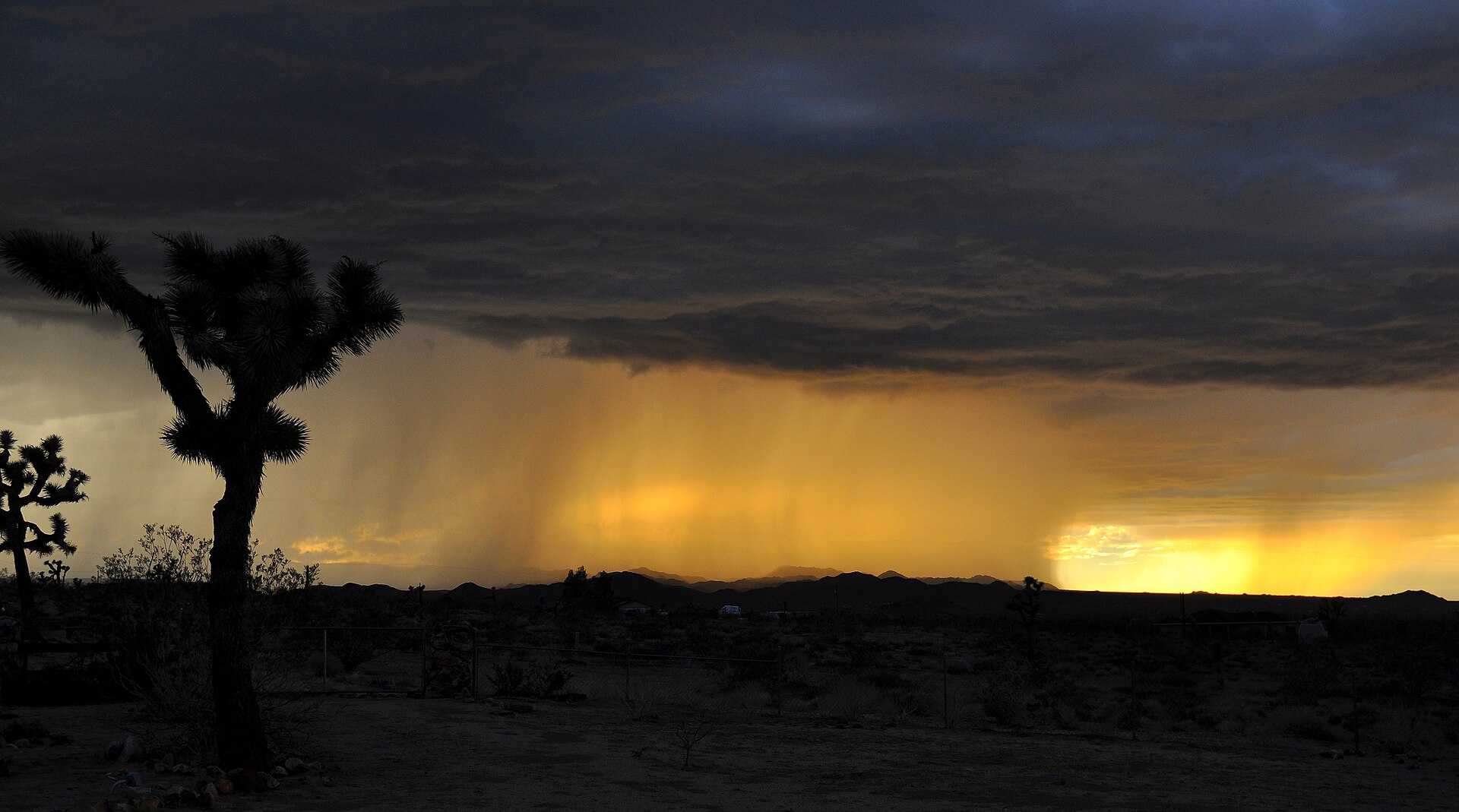
Heavy rain inundating California’s Mojave Desert. Extreme downpours right after hot droughts are more intense than the rains that follow cooler droughts, according to a new study. Credit: Jessie Eastland via Wikimedia Commons.

Featured Research
Hot droughts trigger harsher rains
A new study finds that bursts of extreme rainfall occur 66% to 315% more often after hot droughts than after non-hot droughts. Based on weather data from 1979 to 2023, every hot drought has about a 45% chance of potentially damaging wet conditions ensuing. When this whiplash occurs, the resulting rain starts 10% sooner, gets 14% heavier, and lasts 12% longer on average compared to rains after cooler droughts. Researchers project that future greenhouse warming will make this drought-to-downpour whiplash more common, ramping up the strain on infrastructure, agriculture and ecosystems alike. [Earth’s Future study]
Spacecraft nearer the Sun can help warn of solar storms 3 to 13 hours sooner
Space weather like solar storms can fry satellites, damage power infrastructure, and cause communication blackouts. Currently, space weather predictions and warnings are based on observations from spacecraft close to Earth, which can only detect incoming events 10 to 80 minutes before they arrive. A new study used data from a satellite much further away — ESA’s Solar Orbiter mission, sent in part to take the closest-ever images of the sun — to successfully predict the effects of two 2024 space weather events 4.3 and 15.3 hours before they reached Earth. Future monitoring spacecraft could use a similar approach to provide hours — not minutes — of warning. [Space Weather study]
Staying below 1.8 C of warming could spare 7% of the Amazon from higher fire risk
A new study finds that extremely hot, dry conditions associated with a high risk of wildfires occurred on at least 3 days per year across over half of the Southern Amazon between 2001 and 2023, compared with just over a tenth of the region between 1979 and 2001. On average, the number of days of wildfire risk has also risen, with some areas now experiencing 30 or more high fire risk days per year. Researchers attribute the increase to human carbon emissions and predict that these extremes will become even more common by 2100. Compared to the current emissions trajectory towards 2.7 degrees C of climate warming, staying below 1.8 C would reduce the forested area with over 30 days of wildfire conditions per year in 2100 from 22% to less than 15%. [Geophysical Research Letters study]
Deepest-ever Moon rock sample survived shock of becoming a meteorite
In 2017, a meteorite dealer sold a moon fragment from the North African desert containing an unassuming brown blob whose mineral makeup suggests it comes from 55 miles (88 kilometers) below the moon’s surface — the deepest ever lunar sample from any mission or meteorite. Scientists feared that the shock of being thrown from the moon by a violent impact may have corrupted the sample, rendering it useless for understanding the chemical composition deep inside the Moon, which holds clues to the moon’s evolution. A new study has scrutinized the cracked and warped mineral grains of the meteorite and found that the damage doesn’t appear to be destructive — the sample still likely preserves the chemistry of the deepest part of the moon scientists have ever seen. [Journal of Geophysical Research Planets study]
An Antarctic path to better sea-level rise projections, outlined by scientists
80 scientists from 17 countries agree: we need a better understanding of how the Antarctic Ice Sheet is losing ice along its coastal margin to better predict sea level rise. The ice sheet, expected to continue shrinking as the climate warms, is the largest source of uncertainty in current sea-level rise projections. After reviewing current knowledge of the sheet’s coastal zone — where interactions between ice, land, and ocean can produce outsized impacts on ice loss — the scientists identified the most significant gaps in our understanding of those interactions, including the topography of bedrock below coastal ice. The team calls for coordinated international efforts to fill those gaps. [SCAR press release] [Reviews of Geophysics study]
Did ocean motion carve Enceladus’s tiger stripes?
Wobbles of the moon’s icy shell may set off waves in the subsurface ocean that sculpt water-spewing fissures from beneath. [Eos research spotlight] [AGU Advances study]